Two brothers occupy one position
In Book 8, Teucer fights with his bow beside Ajax, son of Telamon. They are brothers through their father, and this Ajax should not be confused with the son of Oileus. Ajax opens his shield to let Teucer look out and shoot; the archer then withdraws under its cover. The poem compares that return with a child moving toward its mother. The image does not remove Teucer's skill. It makes protection visible within it. What appears from a distance to be one man's accurate shot depends on another man's position, timing, and willingness to remain beside him under threat.
Praise does not create the effort
Agamemnon sees Teucer's success and urges him onward, promising a future prize if Troy falls. His praise also recalls Telamon's care in raising Teucer. The archer answers that he has already been doing everything he can. The exchange distinguishes a leader's encouragement from the effort it seeks to encourage. Work can precede the public promise of reward. At the same time, the promised prizes include a woman treated as property, a feature that should not disappear behind an innocent word such as gift. Honour in the army is distributed through relationships whose unequal costs remain part of the scene.
The target is not the whole field
Teucer tries repeatedly to strike Hector, but other men fall instead, and Apollo deflects one of the attempts. The episode therefore refuses to make skill identical with complete control over an outcome. There is the intended target, the path of the arrow, divine intervention, and the people standing around the target. Hector responds by attacking Teucer with a stone and injuring him. Ajax immediately protects his fallen brother with the shield while attendants carry him away. The shield's role has changed from enabling a shot to enabling removal. Support continues when the visible achievement has stopped, rather than disappearing with the loss of immediate usefulness.
A broken string requires another answer
Book 15 returns Teucer to combat beside Ajax. As he aims at Hector, Zeus breaks his bowstring, and the weapon falls from his hands. Teucer recognizes divine opposition and complains to his brother. Ajax does not tell him that determination alone will repair the bow. He asks him to put it aside, take a spear and shield, and keep fighting while encouraging the others. Teucer changes his equipment and returns to Ajax's side. The adaptation is concrete, involving tools and a different exposure to danger. It does not mean that the gods have become irrelevant or that the original difficulty was imaginary.
Cooperation has more than one form
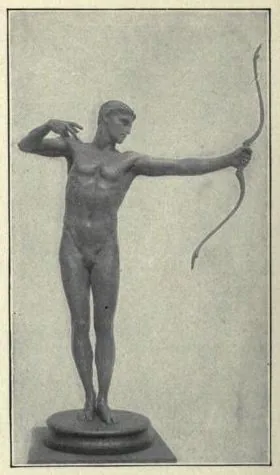
Read together, the books show a partnership that survives changes in bodily condition and equipment. At one moment Ajax shelters a working archer; at another he shields an injured brother; later he proposes a new way to contribute. None of these actions makes the fighting harmless. They nevertheless complicate the picture of the solitary warrior whose worth consists only in striking successfully. The sculpture illustrated here represents Teucer as an archer, not the whole Homeric scene with Ajax. The poem supplies what an isolated figure cannot show: the person beside him, the protection behind the shot, and the continuing relationship when the bow no longer works.