A weapon with room for other lives
In Book 18 of the Iliad, Thetis asks Hephaestus for armour after Patroclus has died wearing Achilles’ old equipment. The craftsman can provide magnificent protection, but he cannot promise to remove death from her son’s future. That limit matters before we examine a single image: the shield will enter the fighting without making its bearer exempt from human loss.
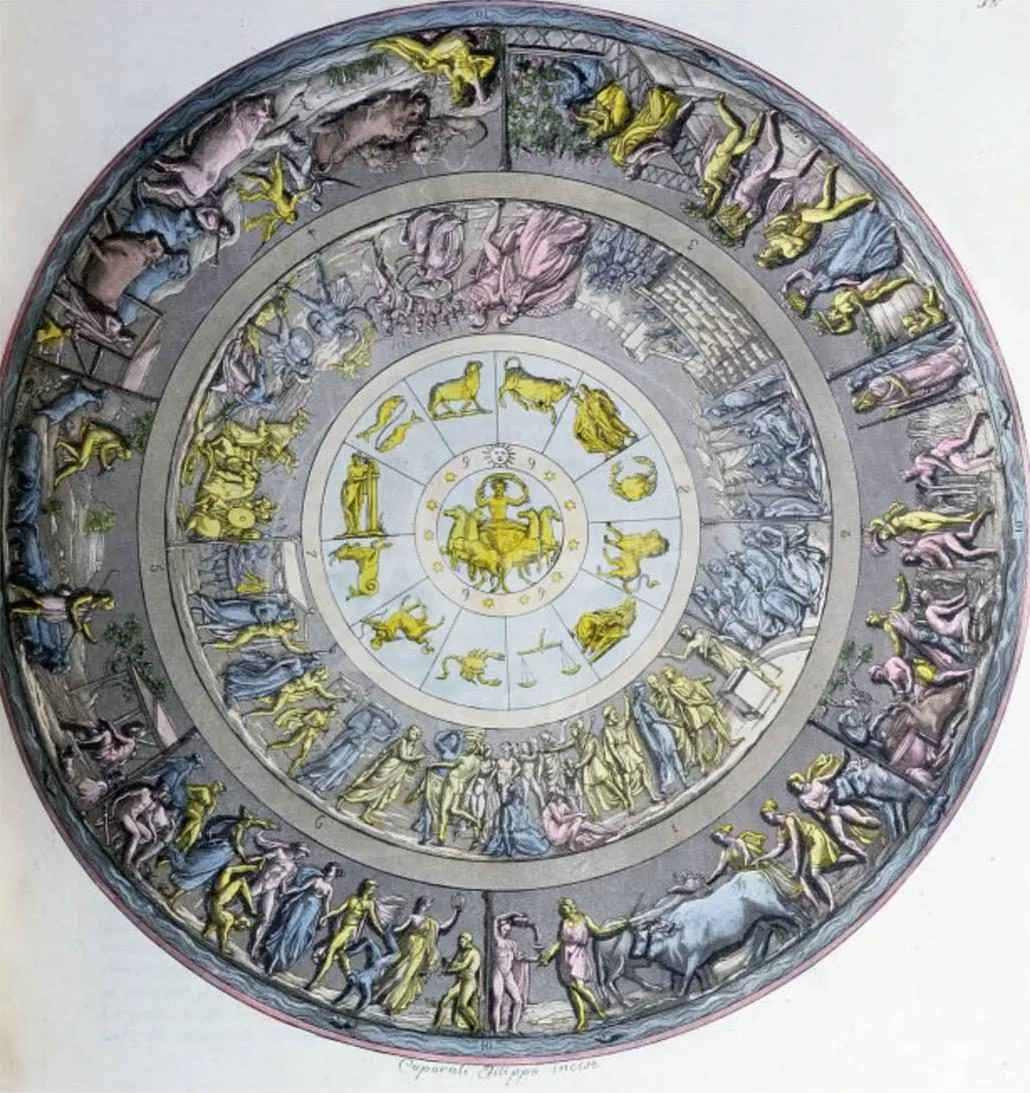
Its surface nevertheless opens outward. Sky, settlements and cultivated land occupy a weapon designed for one man. These are not episodes from Achilles’ personal biography, and the poem does not identify every pictured city with Troy. We can read the shield as a widening of attention: other people’s needs and rhythms remain present beside the hero’s urgent return to battle.
A peaceful city still has a dispute
One city celebrates marriages, yet nearby a crowd gathers over compensation for a killing. Heralds restrain the supporters; seated elders speak in turn. Peace here includes an unresolved grievance. It does not mean that nobody has suffered violence, but that a community has made a place where the consequences can be argued before listeners rather than settled immediately by another blow.
The precise dispute deserves care. Translations differ over whether payment has already been made or whether compensation may be offered and refused. Gregory Nagy’s study explores the second reading and its limits on revenge. Neither reading supplies a modern courtroom transcript. What remains visible is the difficult public work of hearing claims, maintaining turns and seeking a judgment beyond each party’s anger.
The patience of fields and vineyards
The agricultural scenes change our sense of time. Ploughing requires repeated journeys across the same ground; harvesting depends on people cutting, gathering and binding together. Food is being prepared for the workers. The poem gives these coordinated tasks room to unfold, inviting us to notice the labour that sustains a household after the dramatic moment of an individual achievement has passed.
In the vineyard, young people carry fruit while a boy plays and sings. Work and music share a scene rather than occupying opposite worlds. This is no proof that ancient rural labour was always contented: the shield selects and arranges its images. We can still notice its interest in a season that has to reach maturity before the harvest can be carried home.
A dance needs more than one body
Later, dancers join at the wrists and alternate between circling and moving in lines. The comparison with a potter testing a wheel makes their movement feel practised rather than accidental. A dance cannot be completed by the strongest participant acting alone. Its pattern depends on responding to other bodies, keeping time and allowing space for the next person to move.
Spectators also belong to the scene. Their pleasure gives the performance a surrounding community, just as listeners surround the hearing. This parallel is an invitation to read, not an ancient statement that law and dancing are identical. Both pictures ask us to look beyond a solitary hero and notice how people hold a shared space through attention to one another.
The river around the edge
The shield is not an untouched paradise. Its other city faces armed conflict, and lions attack cattle elsewhere on its surface. Athena and Ares appear with warriors. These dangers prevent a simple division between a cruel battle outside and a perfectly safe life inside the images. The work places vulnerability alongside celebration, cultivation and organised attempts to live with other people.
Ocean encircles the outer edge. The boundary gathers the scenes without supplying Achilles with a route out of his fate. As he takes up the weapon, the reader has been shown lives whose meaning cannot be measured by his victory alone. Reading the hearing, harvest and dance slowly lets that larger world remain visible even when the story returns to a single fighter.