A suit of armor changes the battle
Achilles refuses to join the battle after a dispute with Agamemnon, and the Greek army's situation becomes increasingly dangerous. Patroclus asked to put on his armor, hoping to use his reputation as a hero to force the enemy to retreat. Clothes can create a momentary misidentification, but they cannot turn the wearer into another person. This detail allows the epic to separate reputation from the body: a shining set of equipment can inherit the image of others, but it cannot exempt those who actually enter the battlefield from the risks borne.
Victory crosses the line
The sixteenth volume of "The Iliad" allows Patroclus to obtain consecutive victories, and also writes about the danger of him pursuing too far. Death is not the independent work of one enemy; Apollo's intervention, Euphorbus's attack, and Hector's final blow all form part of the process. The epic preserves such complex cause and effect, making it difficult for us to simplify the battlefield into a fair game in which the strong defeat the weak. Human courage and misjudgment are always under the influence of gods and collective battle situations.
Grief redirects anger
The death of his companion made the dispute between Achilles and the commander recede into the background, and revenge became his new goal of action. Returning to the battlefield does not mean the pain is resolved; he turns his attachment to the dead into extreme violence against his enemies. The reader can simultaneously understand the power of grief and see the damage it causes. The relationship between the two has also received different interpretations in later generations. When introducing Homer, we should first respect the common life, trust and mourning specifically described in the epic, and not directly confuse labels for relationships from different eras.
Healing images and war memories
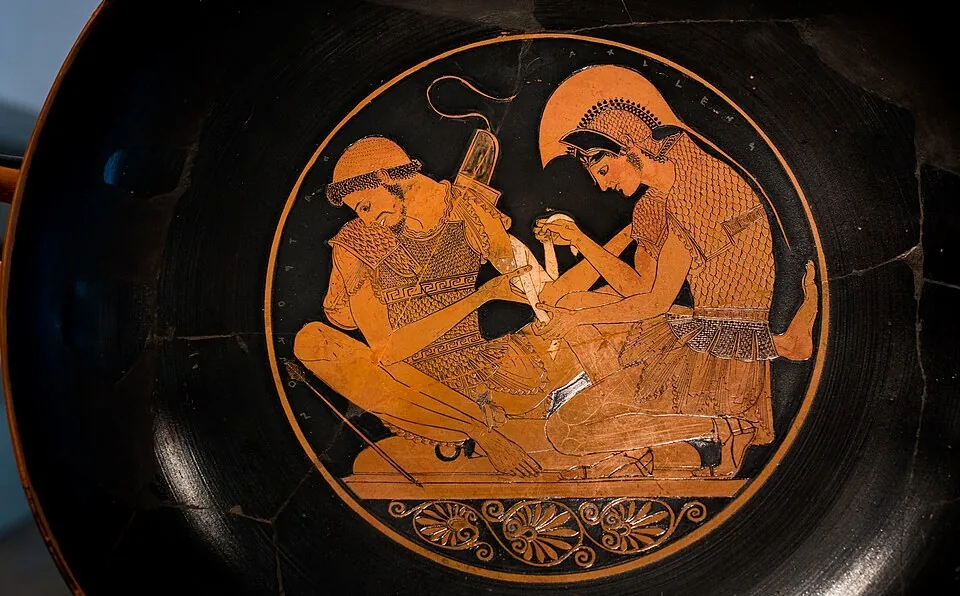
Ancient pottery shows Achilles dressing Patroclus's wounds. Such illustrations represent care and close cooperation, not direct illustrations of the moment of death in Volume 16. It reminds us that in addition to charging and weapons, heroic themes can also show the action of lowering the head to deal with wounds. By juxtaposing the healing scene with the loss in the epic, we can more clearly see the daily reliance that once existed behind revenge, as well as a relationship between people that armor cannot preserve.