Guests beside a silent warship
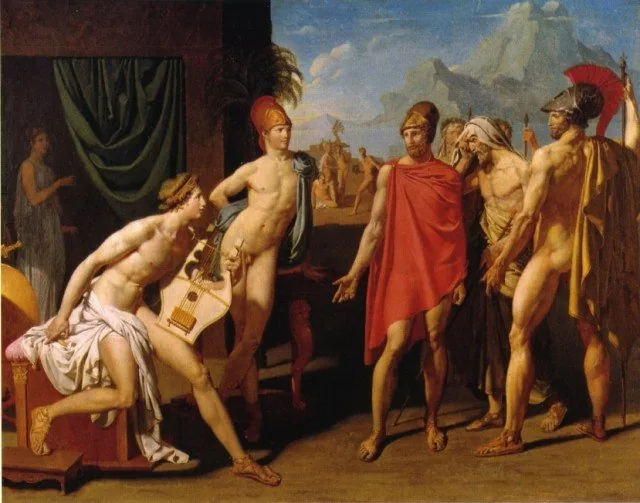
In Book 9 of the Iliad, the Achaeans face severe danger and send chosen envoys to Achilles. Odysseus, Phoenix, and Ajax approach the man whose withdrawal has weakened their army. They find him enjoying a lyre while Patroclus attends nearby. Achilles receives them warmly and arranges a meal. The scene matters because his later refusal is not a refusal to recognize every human bond. He can welcome friends, offer food, and still reject the task they bring. Hospitality opens a conversation without settling its outcome. His tent becomes a place where opposing expectations can be spoken rather than immediately reconciled.
An offer with an old injury inside
Agamemnon has proposed valuable objects, wealth, the return of Briseis, and further rewards if Achilles rejoins the fighting. The offer includes people treated as part of a distribution of possessions, a feature that should remain visible rather than disappear behind the word treasure. Odysseus presents the proposal alongside the army's need. Achilles hears it through the earlier injury to his honour and through distrust of the leader who took his prize. The quantity offered cannot by itself decide whether the relationship has been repaired. The negotiation concerns the meaning of past actions as much as the value of future compensation.
Three speakers approach different ties
The embassy does not speak with one undifferentiated voice. Odysseus argues through the military crisis and the proposed settlement. Phoenix recalls his relationship with Achilles and uses an extended story to urge responsiveness to appeals. Ajax turns toward friendship and the companions waiting for help. These approaches show that the visitors understand more than one possible reason to return. They also reveal why persuasion is not a simple delivery of information. Achilles already knows that people need him; the disagreement concerns what he owes them and what they have permitted their commander to do. Affection and obligation are present without producing an immediate common answer.
Life cannot be replaced like cattle
Achilles contrasts recoverable goods with a human life that cannot be taken back once lost. He describes the alternatives reported by Thetis: remaining at Troy with enduring glory and a shortened life, or returning home with a longer life and diminished fame. These are possibilities voiced within this conversation, not a universal rule applied to every hero. His answer brings the cost of his body into a discussion conducted through gifts and honours. It makes withdrawal intelligible without guaranteeing that he will carry it through unchanged. The poem continues after the speech, and his future decisions remain exposed to events and relationships.
The later return has another cause
Book 19 shows Achilles reconciling publicly with Agamemnon after Patroclus' death. Gifts and an oath still matter to the community, but Achilles is impatient to fight, while Odysseus insists that the men must first eat. This is not proof that the earlier offer quietly succeeded all along. Loss has transformed the circumstances and redirected the warrior's anger. Reading the two books together preserves both the failure of the embassy and the later work of restoring public relations. A welcome, a promise, a payment, and a return to action are distinct events. The Iliad gives each its own time and human cost.