The horses stop for someone who cannot return
In Iliad Seventeen, Achilles' horses stand apart from the fighting after Patroclus' death. Automedon cannot persuade them to move, whether he urges them gently or uses the whip. Their lowered heads and falling tears give grief a bodily form outside human speech. The poem compares their stillness with a monument above a grave, placing remembrance inside a battlefield that keeps demanding movement. Their immortality has not made them untouched observers of mortal loss. For a moment the familiar picture of a chariot carrying a hero forward becomes a picture of beings unable to continue, despite the pressure of the person holding their reins.
A god gives movement without removing sorrow
Zeus notices the horses and pities their connection with suffering mortals. He will not allow Hector to capture them, and breathes strength into them so that they can carry Automedon from danger. Divine help restores their capacity to move; it does not reverse the death that stopped them. This distinction keeps the renewed action from becoming proof that grief has been solved. The horses remain part of a threatened relationship between immortal animals and mortal companions. The gift originally made to Peleus now carries a cost that cannot be measured only by speed, valuable ownership or the number of warriors the team can transport.
Driving and fighting require different hands
Once moving, Automedon finds that he cannot manage the horses and use his spear effectively at the same time. Alcimedon approaches, questions the danger of his position and takes the reins while Automedon fights on foot. The exchange gives the episode a practical problem and a practical adjustment. Courage does not supply an extra pair of hands. The driver recognizes another person's ability with the team, and that recognition makes a different arrangement possible. Calls for help then draw further comrades toward the threatened chariot. Survival depends on a distribution of tasks, rather than on the image of one exceptionally capable body performing everything alone.
A horse answers an accusation
Book Nineteen returns the team to Achilles himself. Preparing for battle, he tells Xanthus and Balius not to leave him dead as they left Patroclus. Hera gives Xanthus speech, and the horse rejects the blame: divine action and fate, not the horses' laziness, caused the earlier loss. He also foretells Achilles' death before the Erinyes stop his voice. The answer briefly allows a being normally commanded by a warrior to describe the limits of its responsibility. Extraordinary speed cannot guarantee a mortal driver's life. Achilles hears the warning and continues, already aware that his own return from Troy will not be a homecoming.
Look behind the mounted hero
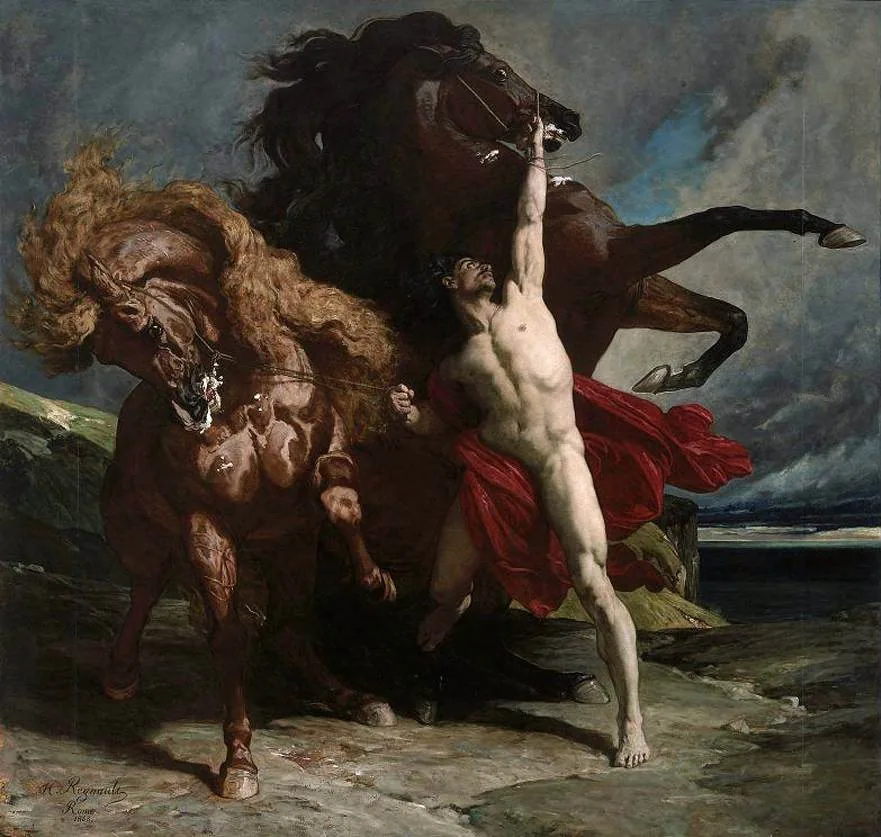
Read together, the books give the horses grief, renewed strength and a short opportunity to answer. They also make Automedon's work visible beside the more famous warrior. The painting illustrated here is Henri Regnault's later interpretation of Automedon with Achilles' horses; it should not be treated as an ancient eyewitness record. The poems supply a sequence around such an image: the team stops, a god intervenes, another driver helps and a horse speaks against an accusation. Following those stages changes what we notice in a chariot scene. Behind the heroic departure are vulnerable bonds, divided labour and a speed that still cannot outrun every loss.