Who chooses to sleep?
Pseudo-Apollodorus's Library, at 1.7.5, first places Endymion within a family and a migration. He is the son of Aethlius and Calyce, leading Aeolians from Thessaly to establish Elis; the author also records the alternative that his father was Zeus. The Moon then falls in love with his beauty. Zeus allows him to choose what he wants, and he chooses everlasting sleep while remaining immortal and ageless. This short account assigns the choice to Endymion, rather than describing Selene secretly putting him to sleep. Readers may find his decision puzzling without supplying the author with an elaborate psychological explanation. The passage establishes several clear narrative conditions. Why someone might prefer unchanging sleep to a changing life remains open to interpretation.
A different clock for a royal family
When Pausanias describes the early rulers of Elis, he also records a tradition in which the Moon loves Endymion and bears fifty daughters. He then lists different names for a mortal wife, treating that account as a more plausible genealogy. Sons Paeon, Epeius and Aetolus, and daughter Eurycyda, belong to this royal narrative. Endymion makes his sons race at Olympia with the throne as their prize; Epeius wins and succeeds him. This is not a family timetable completing the Library's sleeping story. The works have different interests: one briefly preserves an extraordinary immortal condition, while the travel narrative organizes local origins and succession. Fitting every child and race into the same period of endless sleep conceals distinctions that the ancient evidence retains.
A tomb and a mountain sanctuary
Pausanias explicitly records disagreement about Endymion's end. The people of Elis show his tomb; the people of Heracleia near Miletus say that he withdrew to Mount Latmus, where he had a sanctuary and received honors. The author does not make those communities agree, or turn the sight of a tomb into archaeological proof that the mythical man existed. One name connects kingship, local memory and a sacred mountain location, reminding us that mythology traveled through more than books. A careful approach identifies who tells each account and where, rather than choosing one place to erase the others. In particular, a tomb tradition, immortal sleep and withdrawal into the mountains should not silently become a single contradiction-free ending.
The painted youth is awake
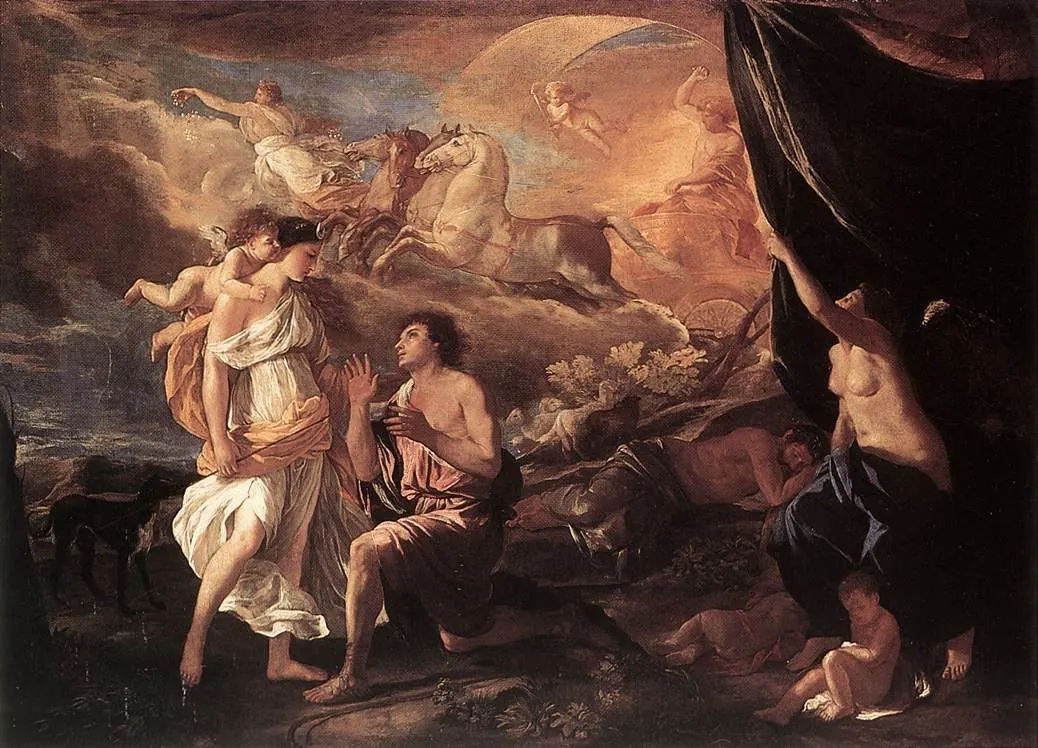
Nicolas Poussin's painting Selene and Endymion, made around 1630, offers another viewpoint. The Detroit Institute of Arts interprets the scene as the end of a nocturnal meeting, when the lovers must part. The young man kneels toward the goddess, who rests a hand on his shoulder; Night draws back a curtain at the right, while the sun's chariot prepares the coming day behind them. This Endymion responds to Selene with open eyes, rather than appearing as a silent sleeping body. The later painting need not be dismissed as a faulty illustration of ancient prose: the artist selects an encounter and departure. Nor does it prove that the Library described him waking every day. Comparing image and text means distinguishing artistic choices from a source's narrative, while noticing that a figure associated with stillness can be given a gaze and a gesture.
What does stopping time remove?
Immortality, agelessness and endless sleep can look like a perfect way to preserve love: beauty never alters, and meetings seem free from an ending. Yet the Library's brief account does not detail a jointly negotiated future or supply rules for modern partnerships. We can enjoy the moonlit imagery and ask what responses, decisions and shared experiences sleep makes impossible. Those are reading questions, not medical judgments or claims that antiquity held one view of love. Pausanias's succession story lets time move forward; Poussin lets morning interrupt a meeting. Preserving those different rhythms leaves us more than a romantic picture. It helps distinguish keeping someone's image unchanged from accompanying a person who can change and answer us.