A familiar name in another city
A siege brings us to Megara at the opening of Metamorphoses 8. Minos, king of Crete, attacks the territory of Nisus, whose white hair contains a purple lock on which the kingdom’s safety depends. Nisus has a daughter named Scylla. She is the protagonist here, a different figure from the sea monster who snatches sailors from a cliff in the Odyssey. Her father’s name and the location help us identify the story from the beginning. Ovid places armies, walls, and a lock of hair together, making enormous military power depend on something very small and deeply private. We learn the secret that protects the kingdom before discovering who can reach it. Before the siege, Scylla used to strike the resonant stones where Apollo was said to have rested his lyre. The same elevated place that once offered play now provides a view of the enemy.
Watching from a tower does not establish a relationship
As the war continues, the princess often climbs the tower and learns to recognize the enemy commanders’ weapons, clothes, and horses. Above all she watches Minos, admiring his fighting gestures and his appearance on horseback. This familiarity comes from repeated observation; the text gives no established mutual love. In a long speech she argues with herself. Initially unwilling to betray her homeland, she then reasons that, if defeat is inevitable, helping to end the war might spare bloodshed. She imagines delivering the city as her own dowry. Follow this change carefully. She invokes peace without asking the citizens’ wishes, and without receiving any promise of a future together from Minos. Desire gradually replaces an agreement that has never existed.
The severed lock does not secure an exchange
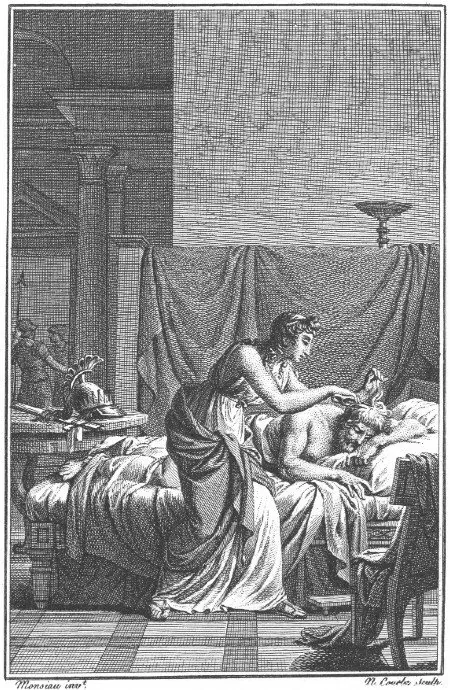
At night Scylla enters her sleeping father’s room and takes the fateful purple lock. She crosses the enemy camp and offers it to Minos, asking only for him in return. What she hands over, she explains, includes her father’s life. Minos recoils, condemns the betrayal, and refuses to admit her to Crete. Yet he benefits from the changed military situation, imposes terms on the conquered people, and orders his fleet to depart. Refusal and advantage sit uncomfortably beside one another. The exchange she imagined has never been accepted as a marriage agreement; the king’s disgust does not restore the world before the cutting. The inhabitants bear the public consequences of a private wish.
The pursuit continues in changed bodies
When the fleet leaves, Scylla begs, then angrily accuses Minos of forgetting her help. She acknowledges guilt toward father and country, while asking why the beneficiary condemns her too. Unable to return easily to the city she betrayed, and unwelcome in her imagined new home, she leaps into the sea and clings to the stern. Nisus has meanwhile become a sea eagle and dives toward his daughter, threatening her with his beak. Frightened, she lets go, but feathers appear as she falls toward the water. She becomes a bird called ciris, a name Ovid connects with cutting hair. Transformation preserves the event’s memory and carries the family conflict into the air, without a reunion that cancels the damage.
Another text ends the story at the stern
Pseudo-Apollodorus offers a shorter, different account in Library 3.15.8. An oracle says Nisus will die when his purple hair is pulled out; Scylla removes it because she loves Minos. After capturing Megara, Minos ties her feet to his ship’s stern and drowns her. This passage has no Ovidian ending of two transformed birds. Combining the accounts into a single adventure of binding followed by rescue would obscure their differences. Ovid gives the princess long arguments and eventual wings; the Library swiftly returns her to Minos’ history of conquest. Both leave a difficult question: giving away a homeland as a gift cannot ensure that the giver will also be welcomed.