The best portions have a history
In Book 12 of the Iliad, Sarpedon asks Glaucus why they receive special honours in Lycia: good seats, choice food, full cups, and valuable land. These details are not a decorative inventory of royal wealth. They establish a relationship between leaders and the people who recognize them. Sarpedon argues that the privileges should have a visible counterpart in battle. The men who eat best cannot simply let others carry all the danger. His speech begins with what is received, then asks what conduct could make the community acknowledge those advantages as deserved. Honour is made into a question about action.
Leading where others can see
Sarpedon says that they must stand among the foremost Lycians so that people can call them worthy rulers. The audience imagined inside the speech is therefore the community itself, not only the enemy. This is a demand to expose leadership to judgement through shared risk. Yet it is not a modern promise that every person's circumstances are equal. The speakers remain aristocratic warriors with estates and followers. Their argument works within that hierarchy while giving it a burden. Glaucus accepts the appeal, and the two lead the Lycians toward the Achaean wall. The words have consequences for where their bodies will be placed.
Mortality changes the calculation
Sarpedon adds that, if escaping this battle could secure everlasting youth and life, he would neither fight at the front nor urge Glaucus to do so. But death has many forms and cannot be escaped forever. He therefore proposes advancing, either to gain glory or give it to another. The speech does not deny fear or make death a small matter. Its force comes from admitting a limit that privilege cannot purchase away. The imagined alternative also matters: he is not simply declaring danger enjoyable. The front is chosen within a mortal condition, and the possibility of losing remains inside his own account of courage.
Glaucus needs help to answer
In Book 16, Sarpedon falls to Patroclus. Glaucus wants to defend his companion, but an earlier wound makes his arm painfully unusable. He prays to Apollo, who eases the pain and restores his strength. He then calls the Lycian leaders together and challenges Hector to support the allies fighting far from their homes. Responsibility now extends beyond the dead man's earlier speech. Glaucus needs assistance before he can assist, and the Trojan leader is asked to recognize obligations to those who came for his cause. The poem makes loyalty physical and practical, involving an injured arm, a prayer, and people summoned around a threatened body.
Honour after the speech is over
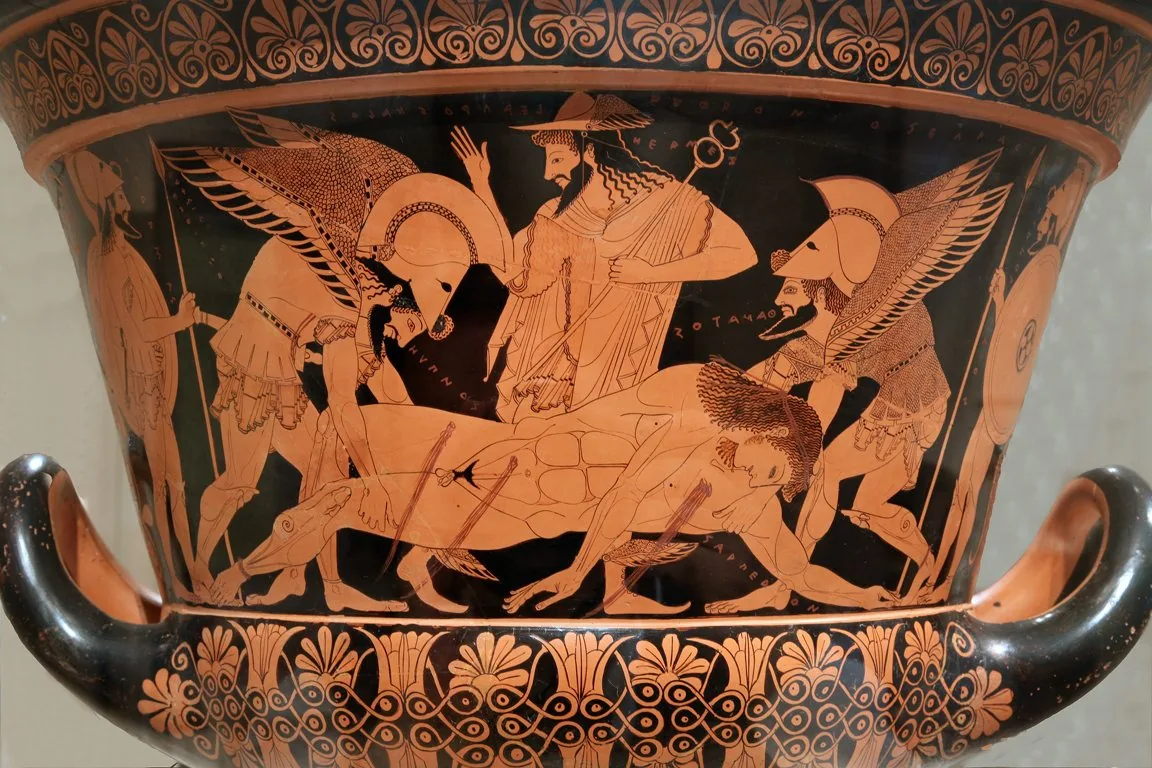
The struggle around Sarpedon's body shows that recognition does not end when a leader can no longer speak. Apollo later prepares the body for its return, and Sleep and Death carry it home. The ancient vase chosen here presents that carrying and also includes Hermes; its visual arrangement should not be treated as a word-for-word illustration of Book 16. Read beside Book 12, the scene turns a public claim about earned honour into a question for survivors. What do they still owe the person who took the front place? The poem's answer involves defence, care, and return, as well as the memory of brave words.