A question interrupts the duel
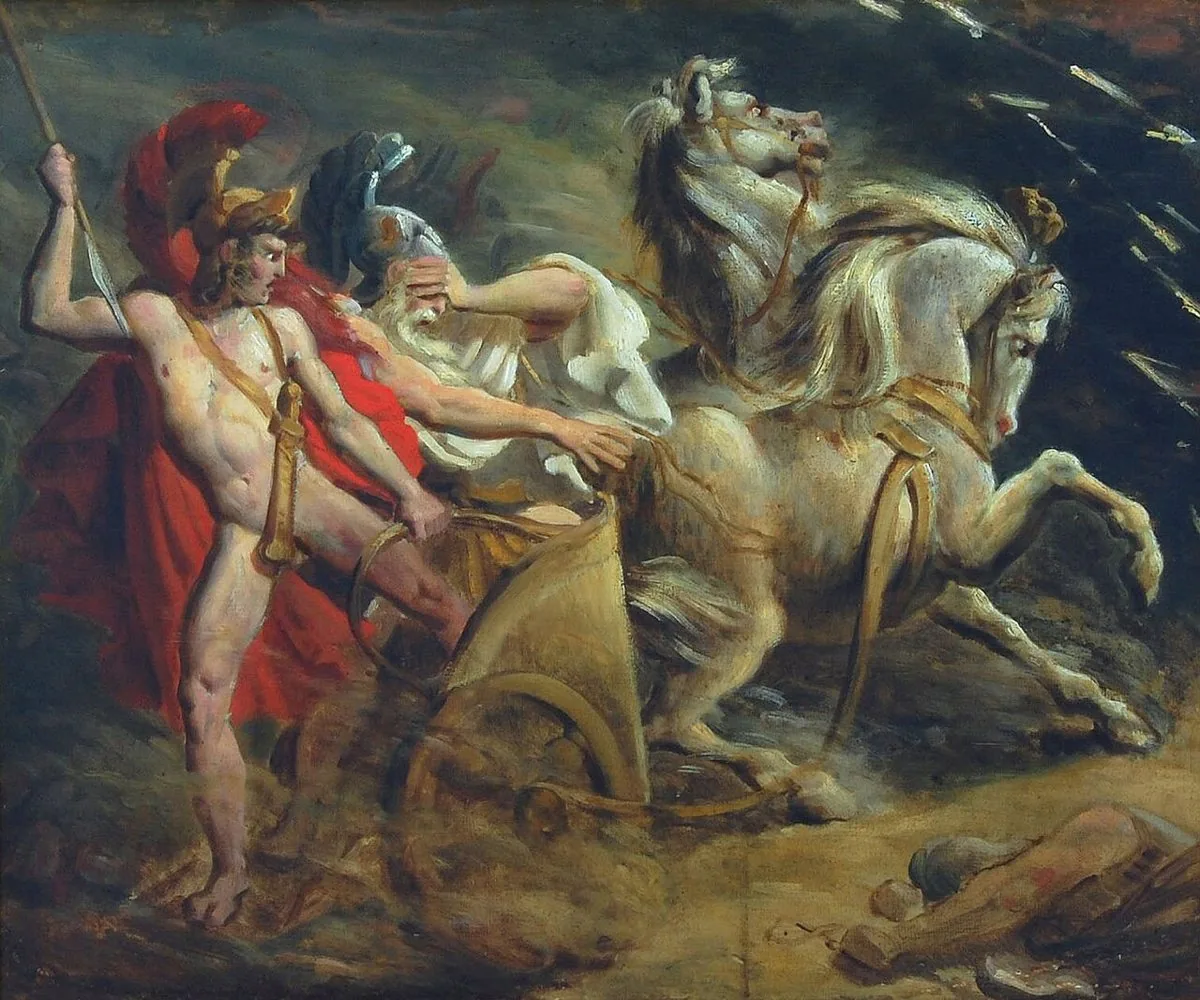
In Iliad Six, Glaucus and Diomedes move into the space between the armies to fight. Glaucus comes from Lycia to support Troy; Diomedes fights with the Achaeans. Before attacking, Diomedes asks who his opponent is. His question contains a threat, but also a limit: if this stranger is a god, he does not want the encounter. He recalls Lycurgus’ disastrous attack on the followers of Dionysus and the punishment imposed by Zeus. The opening is therefore not already a peaceful greeting. It measures a possible opponent while admitting that some powers should not be challenged. Yet asking a question also creates a delay. For a moment, the man facing a spear can answer with something other than another blow.
Leaves fall, but a family story remains
Glaucus begins by comparing generations of people to leaves: one growth is scattered, another appears. The image places both warriors inside a life larger than their individual strength. He then tells a long family history, centred on his grandfather Bellerophon. The passage can seem to postpone the duel, but it also provides information that a name alone would not give. The scholar Edward Lowry’s study at Harvard’s Center for Hellenic Studies stresses the episode’s connected acts of challenge and storytelling. We need not adopt every proposed allusion to notice the practical consequence of this account. Glaucus speaks about the dead, and the living listener discovers a relationship. An ancestral story changes the categories through which Diomedes sees the armed man standing before him.
Twenty days remembered through gifts
Diomedes is delighted. His grandfather Oeneus once welcomed Bellerophon for twenty days, and the two exchanged gifts: Oeneus gave a purple belt, while Bellerophon gave a double cup. Diomedes says he left that cup at home when he sailed to Troy. The object is absent from the battlefield, yet its remembered place helps an earlier welcome remain active. He also says that he scarcely remembers his own father Tydeus, who left while he was small. Family connection here does not depend on personally witnessing every meeting that created it. A visit, a gift, and a story can bind people born later. What might have sounded like a warrior’s boast about ancestry becomes a reason to acknowledge an obligation that reaches across opposing armies.
A friendship made visible between armies
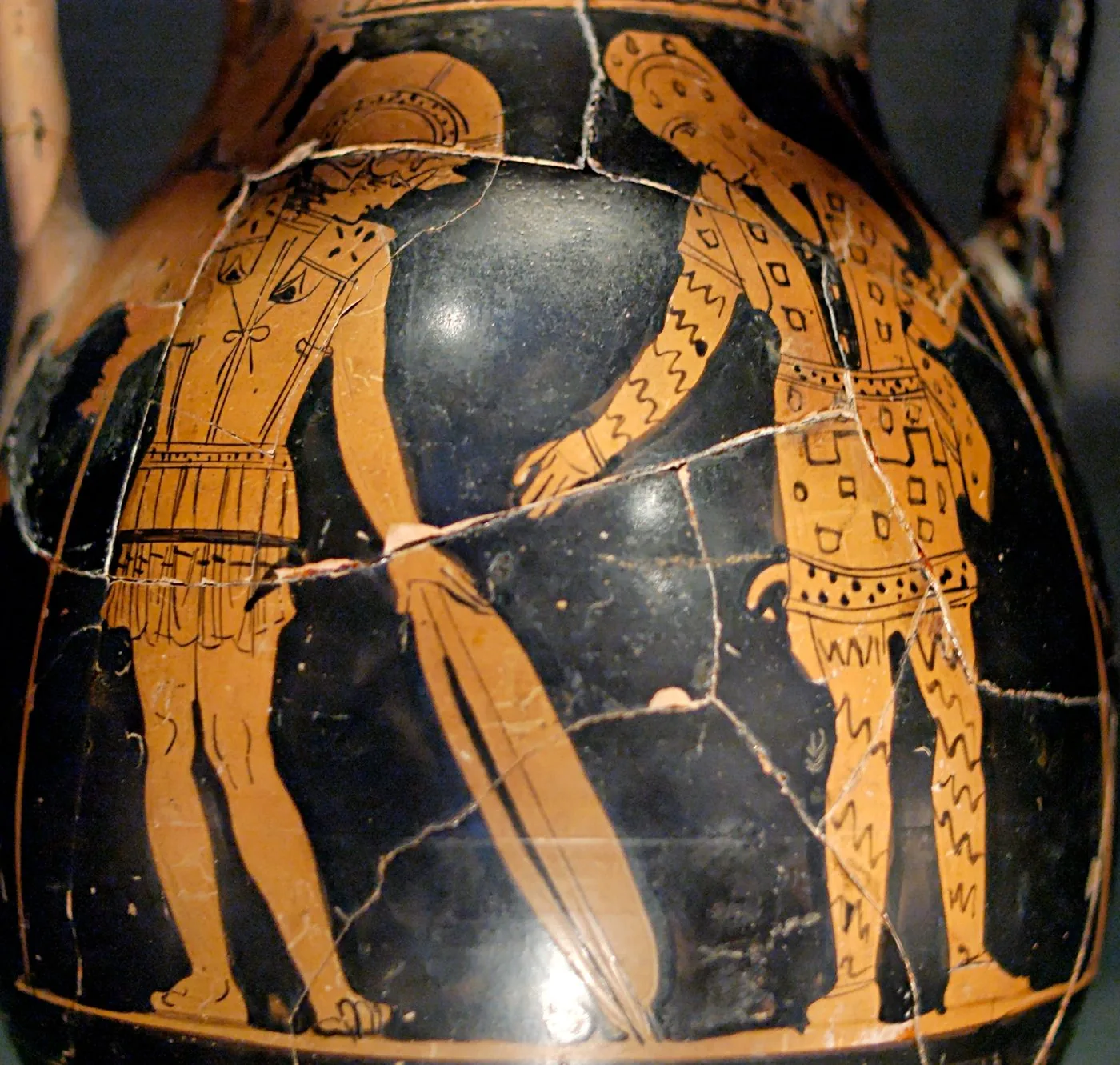
Diomedes plants his spear in the ground and offers reciprocal hospitality: Glaucus will have a host in Argos, and he will have one in Lycia. They agree to avoid each other’s weapons, exchange armour, and clasp hands. Diomedes explains that the exchange will make their inherited bond visible to others. A protective object thus becomes a public sign of a changed relationship. This is a pause with definite limits, however. He also says there are other Trojans and allies for him to kill, and other Achaeans for Glaucus. Their agreement does not end the war or grant safety to everyone nearby. The scene shows the force of a particular friendship while also exposing the narrow boundary of the protection it can provide.
Gold and bronze do not weigh the same
The narrator ends with an awkward calculation: Zeus takes away Glaucus’ judgement, and he gives golden armour valued at a hundred oxen for bronze worth nine. The poem itself insists on that inequality. Calling the exchange simply a fair trade, or confidently explaining it as deliberate generosity, would erase the narrator’s intervention. Calling Diomedes a proven swindler would claim a motive the passage does not clearly supply. We can instead hold two features together: a real bond has been renewed, and the material exchange is strikingly uneven. Friendship does not make every action within it transparent. The scene leaves us with hands joined and values unsettled, inviting attention both to what a remembered welcome can preserve and to what an attractive account of reciprocity might overlook.