A name already joins two gods
In Book 4 of the Metamorphoses, Hermaphroditus is the child of Hermes and Aphrodite, and his name combines theirs. Nymphs raise him on Mount Ida. At fifteen he leaves familiar surroundings because he wants to discover distant places. In Caria he reaches a pool so clear that its bottom is visible, with no tangle of reeds around the edge. Such an opening may suggest rest and a welcome encounter, but beautiful scenery does not guarantee safety. One of the daughters of Minyas tells the tale while they continue weaving and exchanging stories. It is also an explanation nested within another narrative, not an account outside storytelling.
A refusal is a statement, not a puzzle
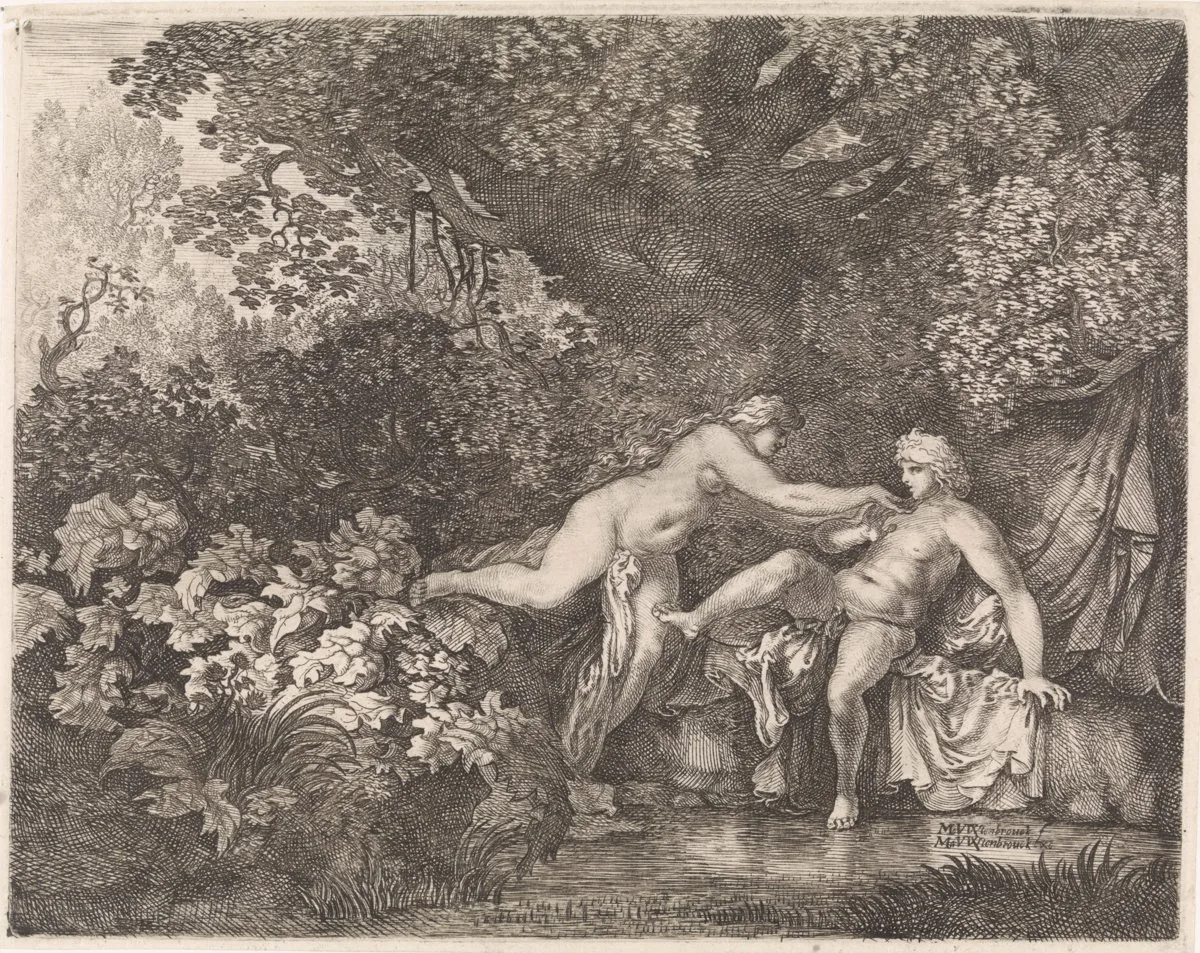
The water nymph Salmacis prefers grooming and life beside her pool to hunting. When she sees the youth, she openly seeks his love and even proposes marriage. Hermaphroditus blushes, but does not accept her repeated demands for kisses. He asks her to stop or he will leave. Embarrassment should not automatically be read as agreement. His unfamiliarity with love does not make his refusal invalid either. Salmacis appears to withdraw, but actually hides among the bushes and watches. A dangerous distance opens between the solitude he believes he has obtained and the surveillance the reader already knows is continuing. Her apparent retreat has not respected the boundary he stated.
Desire becomes a hold he cannot escape
Believing himself undisturbed, the youth enters the water and swims. Salmacis follows, seizes him and winds herself tightly around him. He struggles and tries to escape. The poem compares her grip to a serpent, clinging ivy and an aquatic creature holding its prey. These comparisons do not demonstrate two lovers naturally coming together: they emphasize the difficulty of getting free. She asks the gods never to separate them. They grant her request, and two bodies become one. The outcome fulfils one person’s prayer without establishing that the other made the same wish. Calling this a harmonious union erases the resistance that the preceding action has explicitly described.
The final voice does not rewrite the earlier refusal
After the change, Hermaphroditus can still pray to his parents, asking that future male bathers undergo a similar alteration. Ovid describes his feelings through ancient hierarchies of masculine strength and feminine characteristics. We can recognize that language without adopting it as a measure of anyone’s bodily worth today. The final prayer shows that he retains a voice; it does not retrospectively turn a coercive encounter into mutual agreement. This is not a medical explanation of real differences in bodies or gender, and it should not make real people into the supposed products of punishment. Close reading preserves questions about power and experience, rather than assigning labels to people outside the story.
Other ancient accounts need not share this origin
Diodorus Siculus, Library of History 4.6.5, also connects Hermaphroditus with Hermes and Aphrodite. He describes a deity combining different bodily characteristics and reports other ancient views, without telling Ovid’s pursuit in the pool. The name and its images consequently have a wider history than one transformation narrative. Not every related statue must automatically illustrate this assault, and the deity’s meaning cannot be reduced to a single moment of violation. Reading the accounts together gives name, body, divinity and narrative their own space. Understanding an ancient story can begin with hearing a refusal that was not respected, while declining to make that incident the whole history of the person represented.