The guide who brings someone back
In Book 14 of the Metamorphoses, Aeneas asks the Cumaean Sibyl for passage to his father's shade. She directs him toward the golden branch and guides him through the realm of the dead. On their return toward daylight, he offers to honour her as divine, promising a temple and incense. His gratitude is understandable, but she corrects the identity he has assigned her: she is not a goddess. The person who can lead another through extraordinary territory still has a mortal body and a history of her own. Her story begins when the successful visitor makes room to listen to the guide.
Counting a life in grains
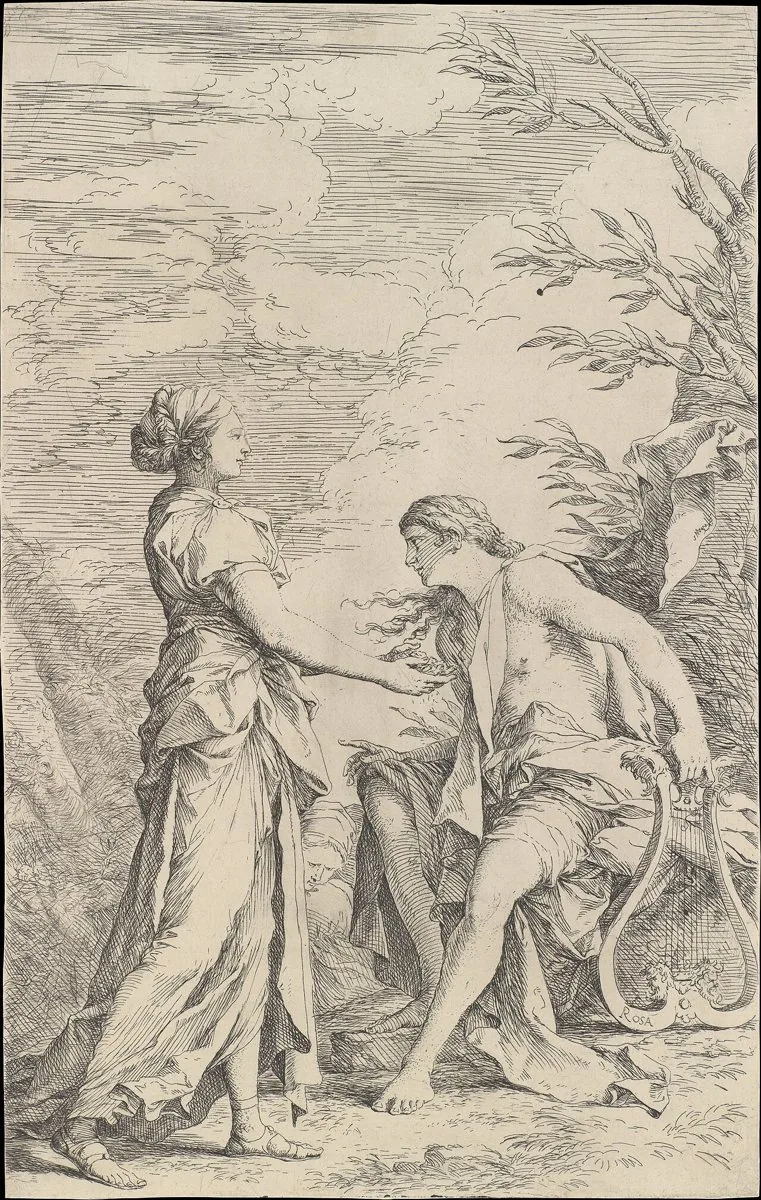
The Sibyl recalls Apollo offering a gift while seeking her affection. She points to a heap of dust or sand and asks for as many birthdays as there are particles. She forgets to include continuing youth. The wish therefore concerns duration, not an unlimited immunity to every consequence of time. Ovid's account should not be flattened into the statement that she simply received eternal life. She has a number of years to live, however immense that number seems to an ordinary listener. The image of small grains also makes the mistake easy to grasp: counting units of time does not describe what living through them will feel like.
The offer she does not accept
Apollo gives the requested longevity and offers youth as well if she will grant his desire. She refuses and remains unmarried. This detail prevents a reading in which she has no decision at all after the first wish. Her refusal does not make the resulting bodily decline fair, nor does the god's power create an obligation to accept intimacy. The story lets extraordinary opportunity coexist with unequal bargaining. She can choose not to yield, while still facing a future shaped by what was granted and what was withheld. Reading that distinction preserves her action without pretending she controls every condition around it.
A voice beyond recognition
The Sibyl tells Aeneas that seven centuries have passed and three remain before the promised count is complete. She imagines her body shrinking until nobody could believe that a god once found her attractive. Even Apollo may fail to recognize her or deny that he loved her. Yet she expects her voice to survive. This is not a claim that physical deterioration leaves every part of a life untouched. It makes recognition painfully uncertain while retaining the capacity to speak. Ovid gives the prophecy personal stakes: the woman who describes other people's futures can also articulate the losses awaiting her own body.
Virgil's public voice, Ovid's private history
Aeneid 6 introduces the Cumaean priestess as Deiphobe and gives her inspired speech an overwhelming physical force. Apollo's presence changes her face, voice, and movements; Aeneas appeals for guidance concerning his people's future. Ovid revisits this famous guide from a different angle, allowing conversation on the return journey to reveal her private past. The two treatments are not mutually exclusive instructions for reconstructing an actual woman's biography. They make different aspects of prophecy visible. One amplifies a voice carrying a community's destiny; the other asks the listener to hear what that voice says about the person through whom it passes.