A distant story told during weaving
In Book Four of the Metamorphoses, Ovid leaves the daughters of Minyas indoors at their weaving instead of attending the festival of Bacchus. They take turns telling stories to ease the hours of work, and one chooses Pyramus and Thisbe. This Roman poem sets their love in Babylon within a world that also contains many Greek myths. The young people live next door, and acquaintance deepens into love, but their fathers forbid marriage. Ovid gives the prohibition without a detailed history of an inherited feud between the families. Neighbourhood therefore means both easy proximity and impossible union. Living so close, they must nevertheless find a way to speak that their households cannot detect. The first adventure is a search for communication.
One wall blocks bodies and admits voices
A narrow crack runs through the old dividing wall. Unnoticed by others for years, it allows the lovers to stand close and exchange quiet words. They blame the wall for preventing an embrace, then thank it for leaving a passage for speech; their farewell kisses reach only their own sides of the stonework. The object both restricts meeting and sustains their secret. Eventually they agree to leave home at night, pass beyond the city, and meet beneath a mulberry tree near Ninus’s tomb and a spring. They specify the place to avoid losing one another in open country. Words that once crossed a crack now become a route both must travel, although neither can see the other’s entire journey.
Blood on a veil, while its wearer lives
Thisbe arrives first. A lioness approaches the spring with blood from a recent cattle kill on her jaws, and the frightened girl escapes into a nearby cave, dropping her veil. After drinking, the animal encounters the fabric, tears it, stains it with blood, and leaves. Readers know Thisbe has escaped, but Pyramus arrives later to find animal tracks and the familiar, bloodied veil. He joins two genuine traces into an account of death that never happened, blaming himself for exposing his beloved by arriving late. The mistake is painful because the blood is real and the garment really belongs to her. It occurs in the step from truthful fragments to a complete conclusion, while the person who could explain them is absent.
She returns to a tree that has changed colour
Pyramus ends his life in grief, and his blood darkens the previously white mulberries. Still remembering their agreement, Thisbe leaves her refuge, eager to tell him how she escaped. The changed fruit briefly makes her wonder whether she has found the wrong tree. Only when she sees his fallen body does she understand. At Thisbe’s name, Pyramus briefly opens his eyes before he dies. Ovid puts recognition at the point when conversation is almost impossible: the experience she hoped to share has lost its listener. Thisbe subsequently ends her own life. Before dying, she asks both families to bury them together and the tree to remember their fate with dark fruit. Remembrance reaches toward both parental decisions and the surrounding landscape.
One urn, and a later sculpture
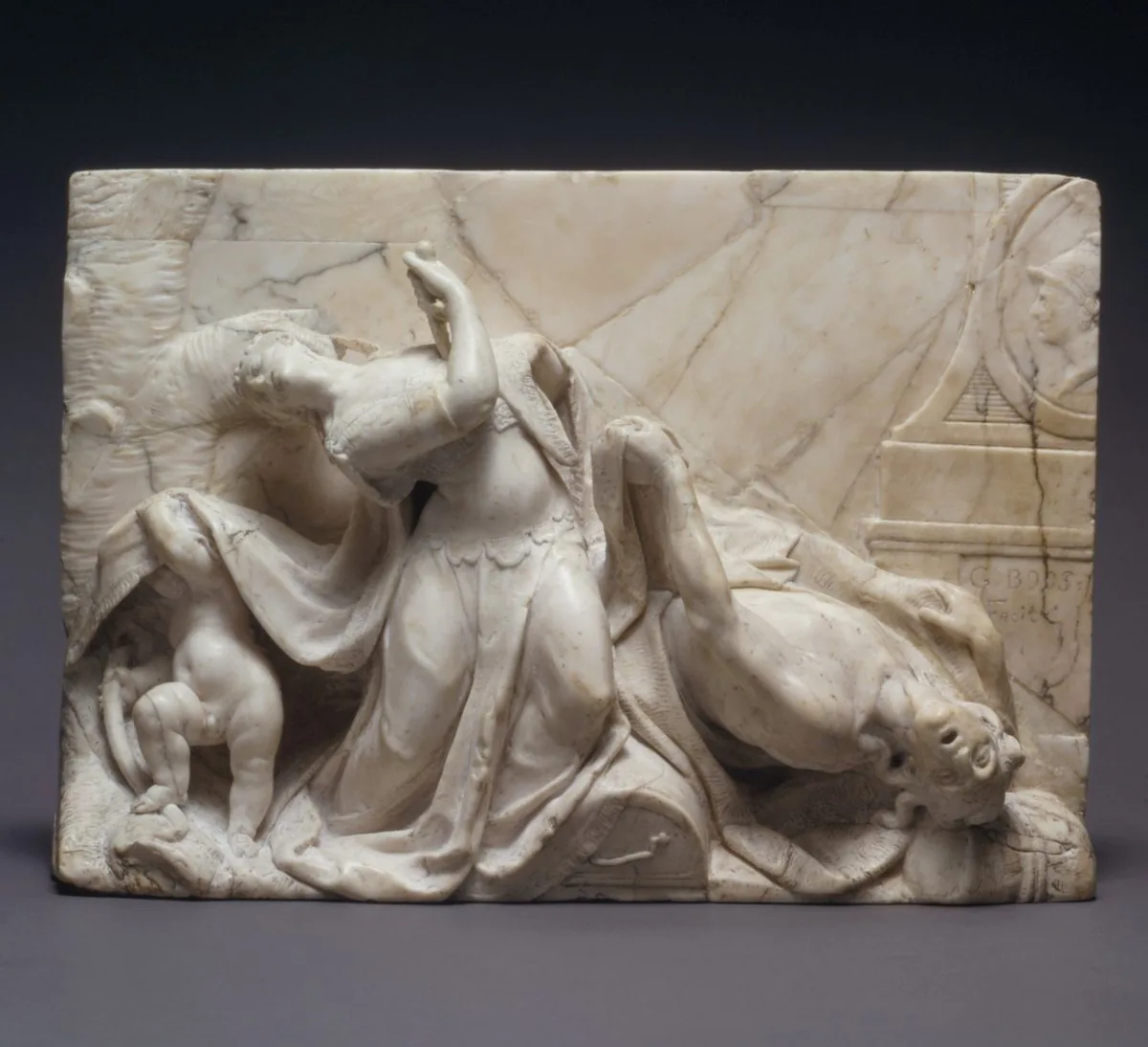
Ovid concludes that gods and parents answer Thisbe’s requests. Ripe mulberries remain dark, and the lovers’ ashes are gathered into one urn. The shared place denied at the beginning is finally granted by their families, but it can no longer become a shared life. The Met preserves Gebhard Boos’s alabaster Pyramus and Thisbe, made around 1775–80, showing the story’s later passage into sculpture. An artist’s chosen moment influences whether viewers first encounter love or loss. Returning to the poem, we can look again at the wall: the mutual listening possible at its crack disappears beside the veil. Changed fruit preserves the outcome, while the story follows the prohibitions, fear, and premature certainty that progressively narrow the time left for speaking.