A life protected before a miracle
In Book 9 of the Metamorphoses, Ligdus tells his pregnant wife Telethusa that a daughter cannot be kept alive. The poem connects his demand with poverty, but his tears do not make the order harmless. Before the birth, Isis appears to Telethusa and tells her to raise the child regardless. When a daughter is born, the mother protects the infant by presenting the child as a son. Survival therefore begins with care and a refusal to obey, long before the later transformation. The goddess's instruction matters because it supports a life that an ordinary household decision has already placed in danger.
One name holds different expectations
The child receives the name Iphis, which the narrator says can be used for either sex. Telethusa welcomes that small space within the concealment. Iphis grows up alongside Ianthe, and the two fall in love; their families arrange a marriage. Yet they approach the ceremony with different knowledge. Ianthe expects to marry a man, while Iphis fears that the promised future cannot occur. Their affection is mutual, but their confidence is not. This difference allows the poem to make anticipation and anxiety occupy the same household, instead of treating an arranged wedding as proof that everyone already understands the situation equally.
An anxious speech is not a universal verdict
Iphis argues painfully about desire, bodies, and what seems possible. The speech includes claims about nature and animals that belong to the character's distress and to the ancient poem's assumptions. They should not be repeated as scientific facts or used to condemn people today. Nor does the story require us to assign a single modern identity label to its protagonist. Its specific circumstances deserve attention: mutual attachment, a concealed childhood, a threatened marriage, and a young person's fear. Reading closely means hearing the argument without allowing its harshest judgments to become the reader's only available language for understanding love or bodily difference.
The mother asks for help again
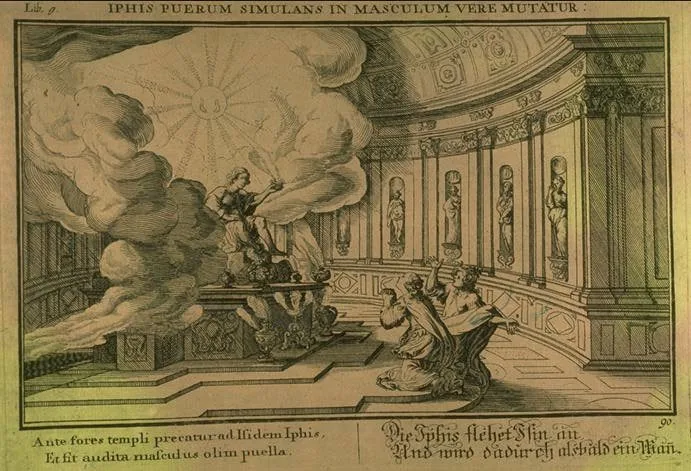
Telethusa delays the ceremony until excuses fail, then brings Iphis to Isis' altar. She recalls the earlier promise and asks for help for them both. Signs answer: the temple moves, and the goddess's sacred instrument sounds. As they leave, Ovid describes changes in Iphis' body and movement, presenting a transformation into a man. The narrative does not say that affection first becomes real at this point; that affection has already been shared. What changes is the future the poem permits the pair to enter. The mother's continued involvement also prevents the ending from becoming a story of solitary will accomplishing everything unaided.
A fulfilled ceremony within one particular story
Offerings acknowledge the transformation, and the marriage follows. This is one narrative arrangement, not a general prescription for how every body or relationship should change. Book 4 offers a contrasting transformation in the story of Hermaphroditus, where resistance and force remain central to the encounter. The outcomes should not be combined into a single lesson that bodily change always expresses agreement. Iphis' story instead preserves the sequence of threatened life, maternal protection, mutual love, prayer, and a particular divine answer. The wedding closes that sequence, while the reader can still remember the care that made it possible for the child to reach the altar at all.