The celebration has a disputed past
Book 4 ends with Perseus rescuing Andromeda and receiving her parents' agreement to marriage. Book 5 continues in the palace, where the wedding celebration is interrupted by Phineus and his armed followers. This Phineus is connected with Cepheus' household, not the blind seer helped by the Argonauts in another story. The distinction matters because a familiar name can otherwise make two very different scenes appear continuous. The feast has begun, but agreement within the royal family is incomplete. A rescue has changed the proposed marriage without removing every older claim or guaranteeing that those claims will be expressed through peaceful negotiation.
Cepheus distinguishes a claim from assistance
Phineus presents himself as someone deprived of a promised bride. Cepheus answers that he did not help when Andromeda faced death and that Perseus actually saved her. Their exchange sets an earlier arrangement against an action performed in an emergency. Neither speech should make Andromeda disappear into a prize possessed automatically by the better fighter. What the poem foregrounds is a dispute among men over the consequences of rescue and prior betrothal. Attending to that structure lets a reader recognize the argument without treating marriage as simply another form of military reward. The person whose future they discuss remains more than the object around which their speeches compete.
The hall loses its ordinary use
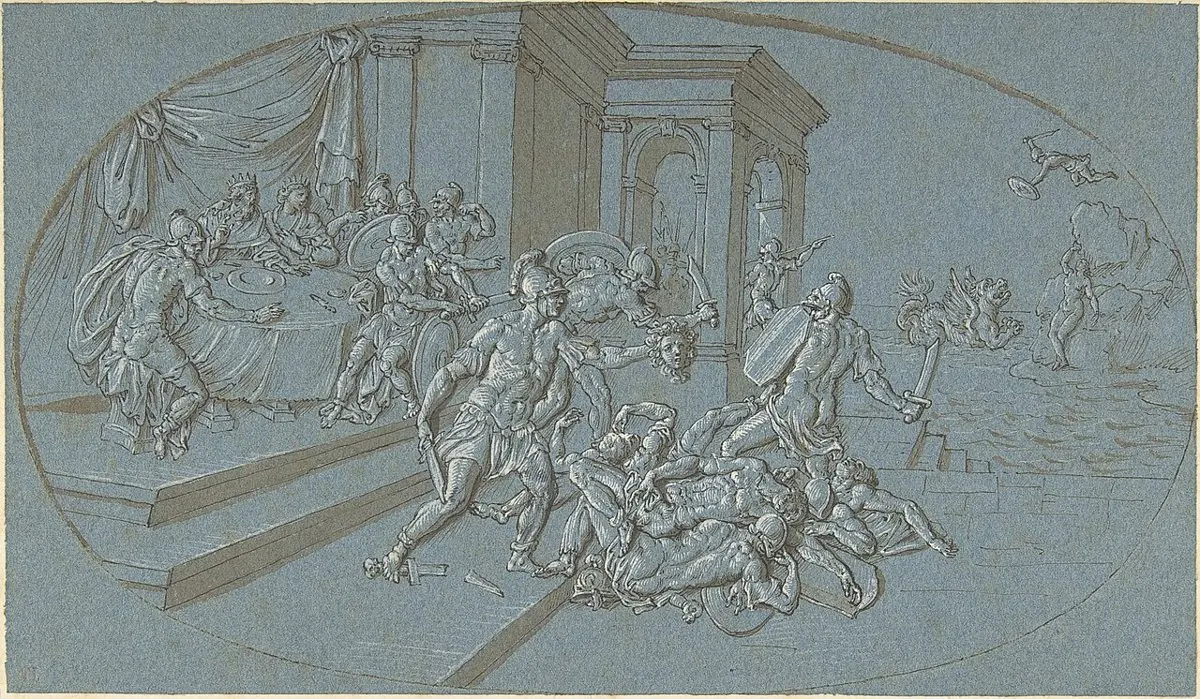
The challenge becomes fighting, and the space prepared for a meal turns into a battlefield. Ovid gives names and individual actions to many of the people caught in the violence. The length of the account matters: the disturbance is not just a brief obstacle between the wedding and a happy conclusion. Objects, bodies, and movement reorganize the room around immediate danger. A reader can follow that change without reproducing every injury. The feast's failure reveals how little a place's intended purpose can guarantee its actual use when armed participants decide to enforce their claims inside it. Hospitality alone does not prevent a contest over power.
Medusa's head does not recognize a friend
When numbers overwhelm him, Perseus warns his companions to turn away and raises Medusa's head. Opponents become stone in the middle of their actions, but Aconteus, who fights on Perseus' side, also sees it and is petrified. That detail prevents the weapon from becoming a perfectly selective instrument that only harms deserving enemies. Safety depends on where someone looks, not simply on allegiance. The earlier warning matters, yet it does not eliminate every consequence. The Gorgon's power remains dangerous within the rescue of Perseus himself. The episode thus carries an accidental loss inside the movement toward the hero's survival and eventual victory.
A monument is not a reconciliation
Phineus eventually begs for life and tries to avoid looking. Perseus turns the head toward him, making him a permanent stone figure in the palace. The hero frames the result as a kind of enduring memorial, but remaining visible is not the same as being allowed to continue living. The conclusion transforms a speaking claimant into a fixed image instead of producing agreement between the rivals. Read with Book 4, it shows that rescue, marriage, celebration, and safety are separate achievements. One does not automatically deliver all the others. The statues preserve interrupted actions, keeping the violence of the wedding inside the room after the fighting has stopped.