A journey seeking rest
After taking Medusa's head, Perseus travels through the air in Book 4 of Ovid's Metamorphoses. As evening approaches, he reaches the far western kingdom of Atlas and asks for somewhere to rest. Atlas is immense, wealthy in herds, and surrounded by land that other peoples cannot easily disturb. His orchard has golden leaves and fruit. The meeting joins a travelling hero with a ruler whose power seems rooted in one vast place. Perseus has a dangerous object with him, but the conversation does not begin as a contest over who can carry the sky or obtain the apples.
The prophecy behind the refusal
Perseus presents his descent from Jupiter and the deeds he has accomplished as reasons to receive him. Atlas instead remembers a warning from Themis that a son of Jupiter will take his golden fruit. He has enclosed the orchard and placed a dragon on guard. A description intended to support the visitor's claim to welcome therefore sounds like confirmation of danger to the host. Atlas refuses him and attempts to drive him away. The poem makes their different uses of the same information important: a distinguished parentage can be an appeal for recognition and, to another listener, a reason for exclusion.
The head still has power
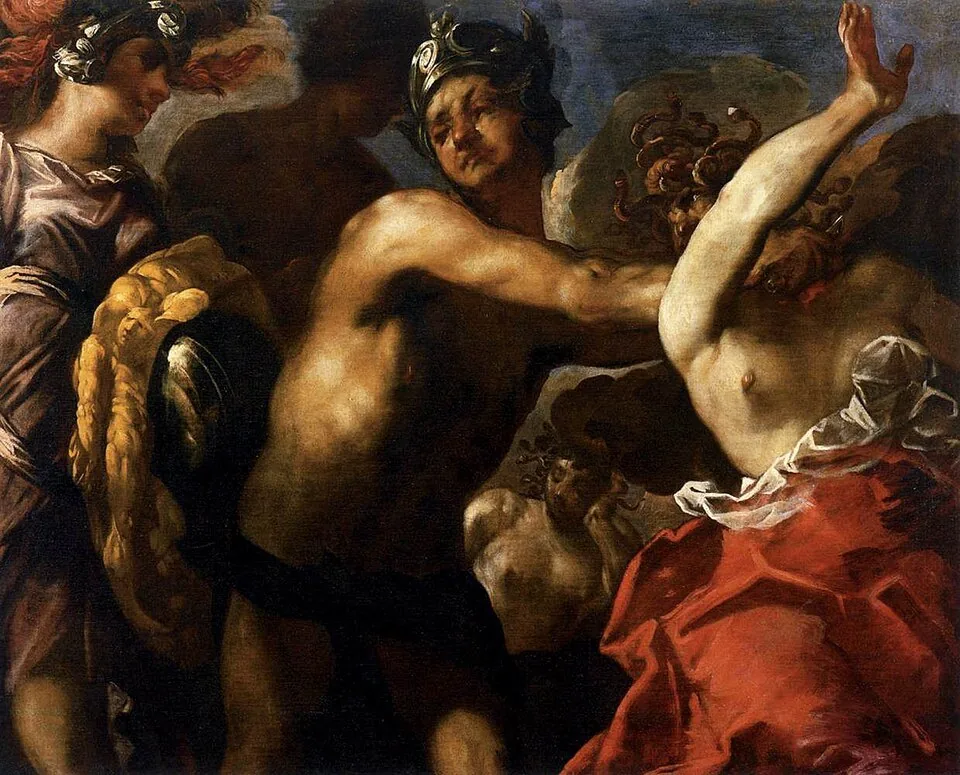
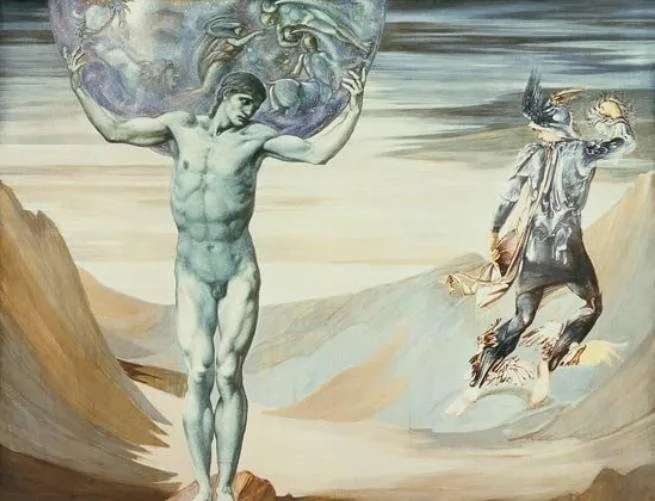
Perseus cannot match Atlas in physical strength. He turns his own face away and shows Medusa's head. Atlas becomes a mountain. The severed head has retained a power that operates beyond Medusa's death, allowing a smaller figure to overcome someone whose size would otherwise make resistance impossible. This is not an ordinary wrestling victory and should not be illustrated in words as one. The encounter also complicates a simple account of heroic generosity. The traveller seeks a modest night's shelter, but the response to refusal permanently transforms the person controlling the land. The scale of the consequence exceeds the scale of the original request.
Reading a landscape anatomically
Ovid describes the transformation part by part. Hair and beard become forest; shoulders and hands form mountain ridges; the head becomes a summit and bones become rock. The body grows until it supports the heavens and their stars. These correspondences invite us to imagine a landscape through familiar bodily forms. They are poetic ways of organizing what is seen, rather than geological explanations that modern observation can verify. Atlas' name can now identify an immense place, while the narrative preserves the shape of the person within it. Stillness replaces a ruler's ability to speak and act, but not every trace of his former appearance.
Another Atlas in another account
In Library 2.5.11, attributed to Apollodorus, Heracles meets an Atlas who can leave his burden, collect golden apples, and negotiate about taking the sky back. That scene belongs to a different arrangement of the traditions. It should not be forced into a single timetable after Ovid has already petrified Atlas during Perseus' travels. The difference is useful rather than embarrassing: ancient storytelling could make one figure a mountain in one context and a speaking participant in another. Reading each account with its own purpose lets the mountain episode remain about movement arrested in a body, without requiring every myth to fit a continuous modern biography.