Before the fruit, notice the work of care
Metamorphoses 14 places Pomona in the Latin region of Italy, during the reign of Proca. She belongs to the Roman world Ovid explores near his poem’s end; we need not invent an identical Greek counterpart. The poet introduces her through work: trimming excessive branches, inserting a graft into opened bark, and directing water to small, twisting roots. She loves an orchard and fruits that require continuing attention. Her curved pruning knife distinguishes her from a hunter carrying a spear. This opening gives the goddess skills, rhythms, and interests of her own. The garden matters before any suitor arrives. Treating its ripe fruits only as symbols of desire would overlook her labor in enabling them to grow. Her care extends below the visible branches, toward the thirsty fibers that support the life above them.
A closed entrance and a changing visitor
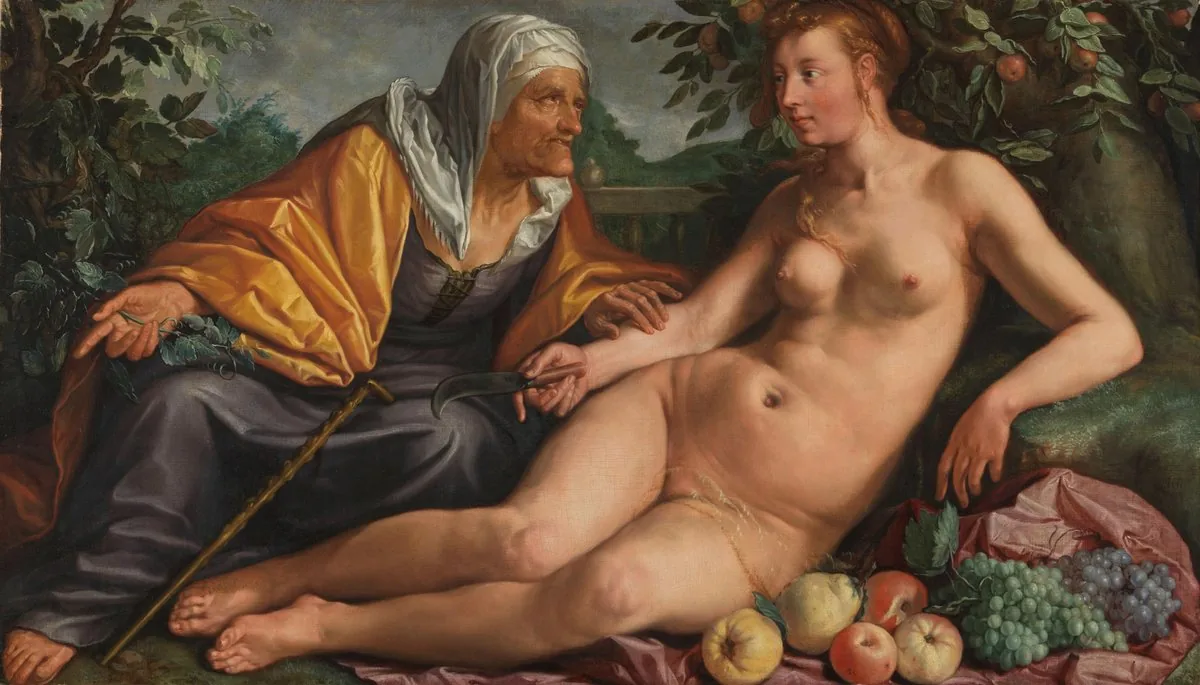
Pomona has no interest in courtship and fears violence from rustic males, so she closes her orchard and avoids male visitors. Vertumnus loves her more deeply than the other suitors, yet enjoys no greater success. Using his changing shapes, he appears as a reaper, a haymaker, a farmer, and a pruner, or as a soldier or fisherman, gaining opportunities to approach her through these identities. Finally he assumes white hair, a head covering, and a walking stick to become an old woman. Inside the garden, he praises its fruit and its owner and gives kisses unlike those a real old woman would give. Disguise changes whom Pomona believes she is meeting. Readers know his identity and can therefore see the unequal knowledge that makes their conversation possible.
An elm and vine become an argument for marriage
The disguised visitor points to an elm with a vine growing around it, praises their dependence on each other, and uses that scene to recommend a partner. This is the visitor’s analogy, rather than a natural law obliging the orchard’s owner to marry. He particularly recommends Vertumnus, claiming unrivaled knowledge of the god and praising his youth, faithfulness, nearby home, and shared interest in fruit. Readers hear a suitor recommending himself through another voice. He even says the petitioner stands before her, speaking through his mouth, almost allowing the truth to emerge from the disguise. The appeal combines common interests, an intimate tone, and concealment, while directing our attention to who gets to interpret the trees before them.
A window in the story becomes a warning
When a gentle analogy is insufficient, the visitor invokes divine retaliation and tells of Iphis and Anaxarete in Cyprus. A young man of humble birth pursues a noblewoman with letters and garlands, meeting contempt and mockery. In despair he takes his life. As his funeral passes her house, she watches the body from an upper window and gradually turns to stone. The speaker claims Salamis still preserves her statue and a temple of Venus Looking Forth. Within this courtship, the inserted tale warns that continued refusal may bring punishment. We can acknowledge its suffering without treating it as a duty to reciprocate someone’s desire. Remembering who tells this death to whom reveals the pressure it places on the orchard conversation.
Read the sentence before the mutual desire
Ovid says the long speech in the old woman’s shape has failed. Vertumnus resumes his youthful appearance, shining before Pomona like sunlight emerging from clouds. The Latin then explicitly says he prepares violence, immediately adding that force is unnecessary: she is attracted by his appearance and feels desire in return. The ending narrates neither completed violence nor a detailed wedding. Calling it an accomplished assault changes the text; keeping only beauty and fulfilled love deletes the preceding intention and pressure. Holding the neighboring sentences together preserves the story’s difficulty. Closed gates, disguises, persuasion, and revelation have changed the conditions of this meeting. Pomona’s final response cannot retrospectively endorse every action that brought the suitor into her garden.