A king who makes visitors fight
At the opening of Argonautica 2, Amycus rules the Bebrycians and imposes a brutal condition on arrivals: someone must box him before the visitors may leave. Apollonius says that he does not begin by asking who the travellers are or why they have come. That missing conversation is important. A host should first establish a relationship with strangers; Amycus replaces recognition with a compulsory contest. His rule makes the shore dangerous before any personal quarrel arises. Polydeuces, the skilled boxer among the Argonauts and brother of Castor, steps forward as the crew’s champion rather than allowing the threat to remain unanswered.
The difference between force and practice
Apollonius contrasts the opponents through their bodies, movement, and handling of the contest. Amycus is imposing, but Polydeuces has the trained judgment to respond to his attacks. The preparation with leather hand-straps makes this a recognizably athletic encounter, although its compulsory conditions are far from a friendly sporting meeting. Watching the champion avoid and answer a blow matters more than simply counting strength. The poem asks readers to notice controlled action within a frightening situation. It is an ancient poetic account, not a modern rulebook or a recommendation to reproduce its dangerous blows in recreational sport.
The ending in Apollonius
In Apollonius, Polydeuces’ decisive strike kills Amycus. The result does not immediately bring peace: the Bebrycians rush against the victor, and the other Argonauts defend him. The boxing match expands into collective fighting. This consequence complicates any easy claim that a single champion can settle every conflict cleanly. The king’s violent treatment of outsiders has made the encounter unstable from the start, and his defeat releases further hostility. A retelling that stops at the winning blow misses that widening danger. The passage belongs to the expedition’s repeated question of how travellers can survive shores whose rulers set destructive terms for meeting them.
The different ending in Theocritus
Theocritus treats the encounter in Idyll 22, a hymn to the Dioscuri. His Polydeuces defeats Amycus but spares him when he acknowledges defeat. The condition is an oath by Poseidon that he will no longer mistreat strangers. This is not the moment after Amycus’ death in Apollonius, nor a second stage that can be attached to that poem. It is a different ending, with a different emphasis. Victory creates an opportunity to change the defeated man’s conduct. The oath brings the opening problem of hospitality back into focus and gives restraint a place beside the boxer’s celebrated ability.
How to compare without merging
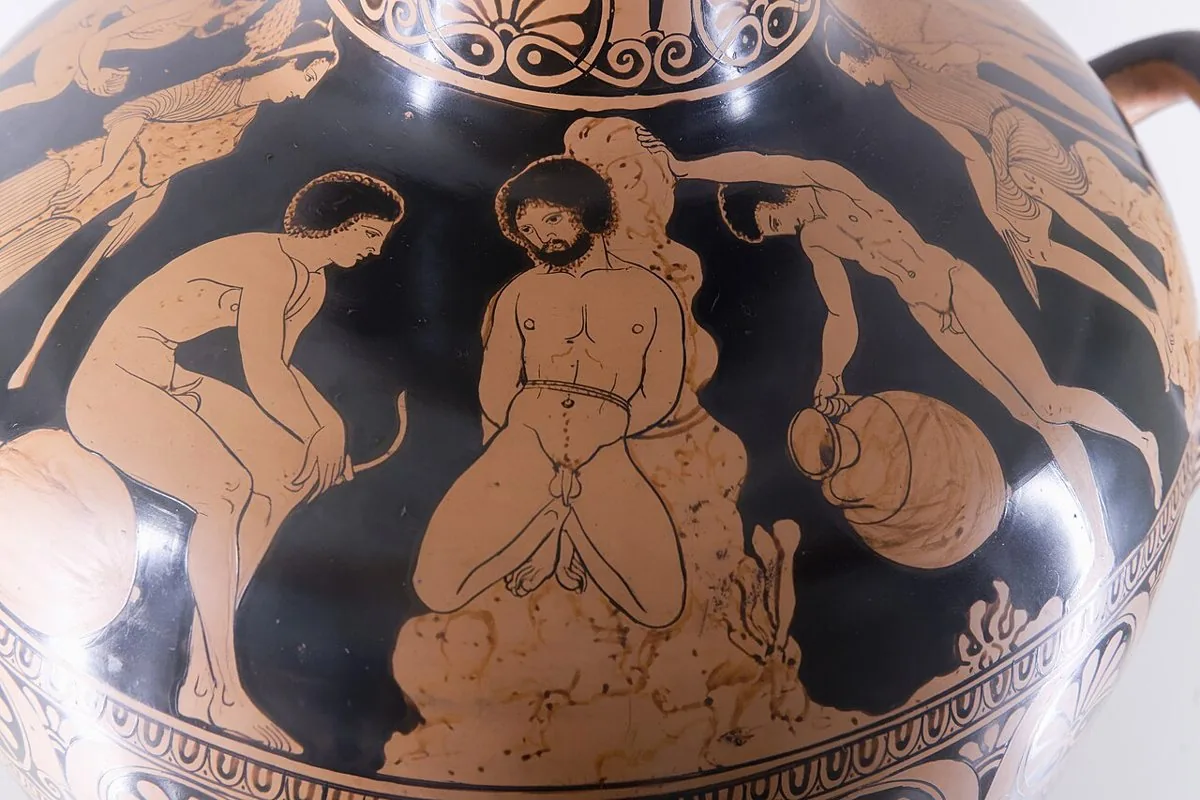
Read the two versions by asking what each victory accomplishes. Apollonius connects the lethal result with a wider fight; Theocritus brings the champion’s success toward a promise of future safety for visitors. Both make Amycus’ handling of strangers central, but they do not give him the same fate. The ancient hydria pictured here belongs to the artistic tradition of Amycus and the Dioscuri; a vase image should not automatically be treated as an illustration of either poem’s exact sequence. Explore Castor and Polydeuces alongside the other Argonauts, and notice how the same named encounter can support distinct ideas about the proper use of exceptional strength.