An extended night and a delayed birth
The Bibliotheca tells how Zeus takes the form of Alcmene’s husband while Amphitryon is away and visits her. Heracles and Iphicles are then born as brothers with the same mother and different fathers. Book XIX of the Iliad offers another background to Heracles’ later obedience to Eurystheus: Zeus declares that a descendant of Perseus born that day will rule over everyone, but Hera hastens Eurystheus’ birth and delays Alcmene’s delivery. Birth timing changes the beneficiary of the divine promise, so the stronger must obey the weaker. Already the birth story separates strength from authority; being a god’s son does not automatically confer a throne.
The miracle his mother sees
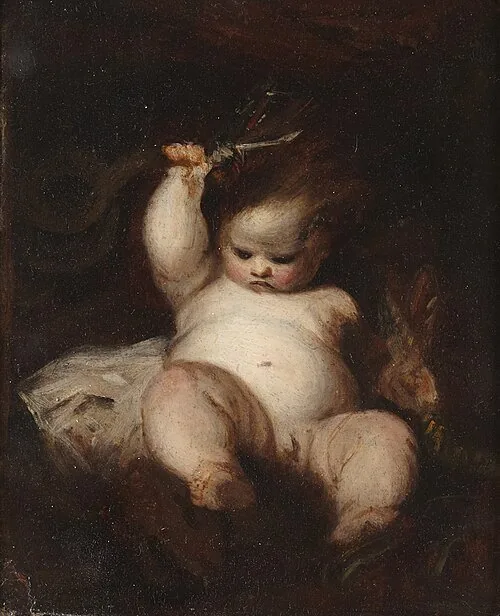
The infant Heracles encounters two snakes in his cradle, seizes one in each hand, and strangles them. The Bibliotheca preserves the account in which Hera sends the snakes, while also recording another in which Amphitryon uses them to test the children’s parentage. Theocritus’ Idyll 24 contrasts the household’s nighttime terror and the mother’s cry with the infant’s composure. Adults normally provide protection, yet now see the child overcome danger unaided. The wonder lies both in his immense strength and in their response: they are safe, but recognize that the child before them does not belong to the ordinary scale of life.
A prodigy does not explain an entire character
Strangling snakes proves physical ability, but does not guarantee sound judgment in adulthood. Heracles must still learn music, archery, chariot driving, and fighting, and will commit grave mistakes in anger. The cradle image is therefore a beginning to a hero’s biography, rather than a guarantee that all his actions are justified. Ancient texts offer distinct accounts of parentage, the snakes’ origin, and interference with childbirth. Those differences should remain, rather than being assembled into a seamless single version. In a sculpture or painting of the infant with snakes, the adults’ fear, the child’s pose, and the snakes’ curves determine whether the moment appears as a threat, a miracle, or the shock of a new power entering the household.