A bird appears beside a burial
In Book 8 of Ovid’s Metamorphoses, a partridge watches nearby and calls while Daedalus buries Icarus. The poem then moves backward to explain the bird’s connection with the craftsman. This is more than an episode making two falls into a simple formula of punishment. The father now losing his son once endangered another family’s child. Different identities occupy the same person: ingenious maker, grieving father and teacher who failed to protect a pupil. Remembering only one identity loses the tension the narrative preserves. The bird does not let the reader’s compassion for a bereaved parent erase the earlier experience of someone entrusted to his care.
Invention begins with ordinary things closely observed
The nephew is sent to Daedalus to learn, and shows a quick inventive mind. Looking at a fish’s serrated backbone, he models an iron saw upon it. He also joins two iron arms at a hinge: one stays fixed while the other turns and describes a circle. Tools do not suddenly appear from nothing. Observation, comparison and experiment allow ordinary materials to perform new actions. Moving from a fish bone to cutting, and from a pivot to a circle, does not mean a pupil no longer needs instruction. It does mean that he has discoveries of his own. Successful learning can involve more than reproducing what the teacher already knows.
Envy makes a relationship dangerous
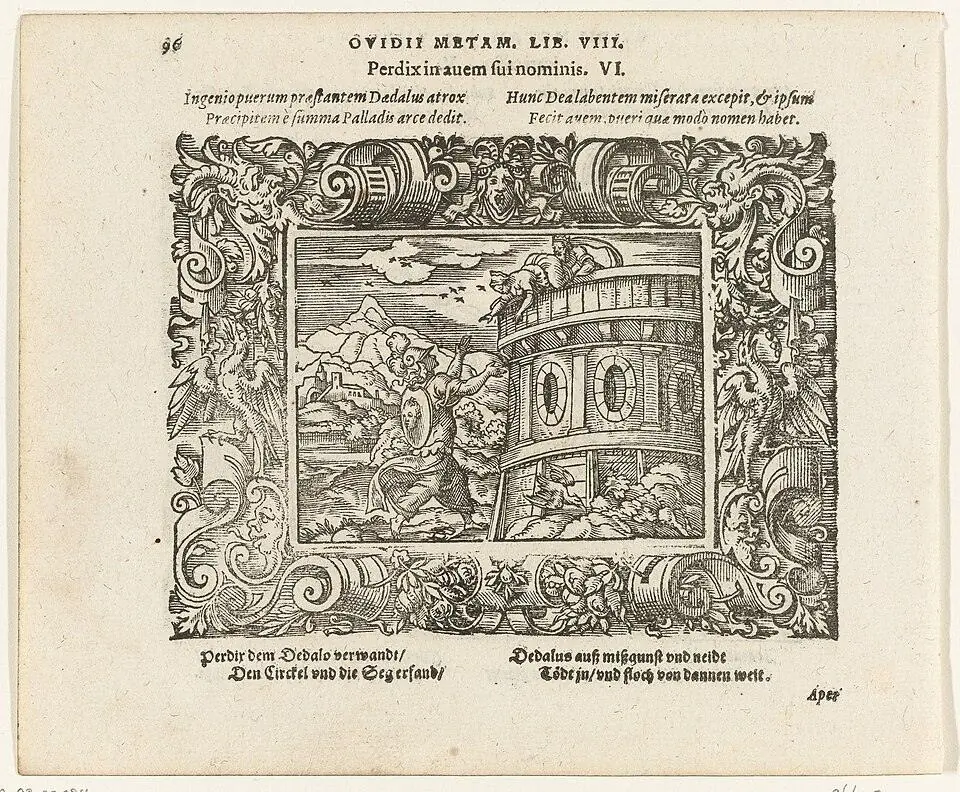
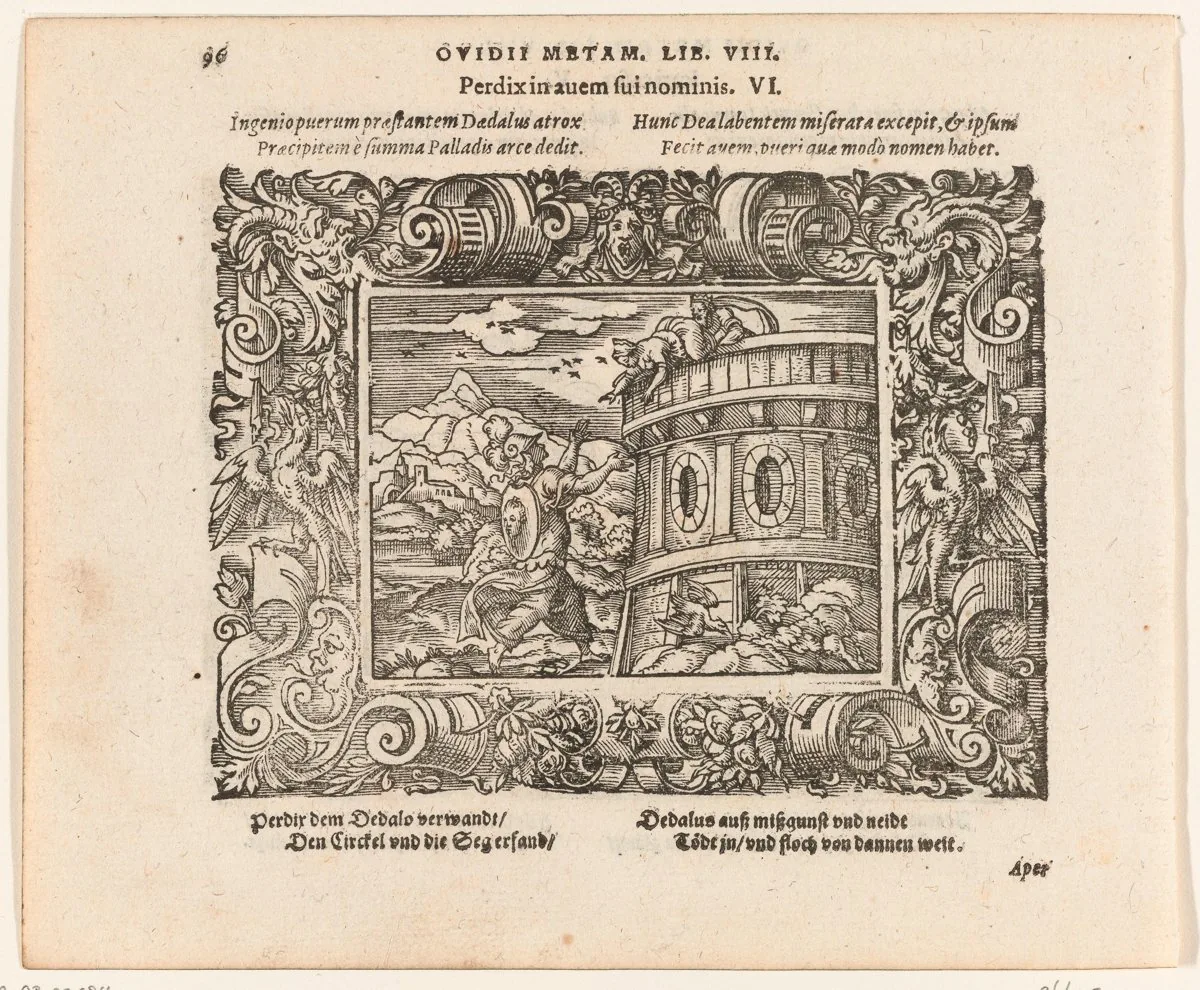
Afraid of being surpassed, Daedalus tries to throw his nephew from Athena’s high temple and spread a story of an accident. This differs from the fatal flight of Icarus. The teacher’s action is intentional; both episodes cannot be summarized as disobedient young people receiving punishment. Inventing a tool has not given the nephew power to injure his uncle. The danger lies with someone who controls the conditions of learning and treats another person’s development as a threat to remove. A craftsman’s reputation and technical ability do not automatically make him equally reliable in care or teaching. The workshop needs more than excellence of manufacture to become a safe place for discovery.
Rescue retains the memory of falling
Athena saves the falling youth, giving him feathers and changing him into a partridge. Ovid transfers his former quickness into wings and feet. He also explains the bird’s reluctance to fly high and its preference for sheltered, low nesting places: the earlier fall remains within its habits. This is a poetic origin assigned to animal behaviour, not a finding of modern ornithology. Rescue does not erase the injury that made rescue necessary. Life continues through another body and a changed relationship to height. We can hold the goddess’s help alongside the consequences of the teacher’s violence, without assuming that survival has restored everything the pupil previously possessed.
Another account changes names and outcome
Apollodorus’ Library 3.15.8 calls the nephew Talos and his mother Perdix, and gives a snake’s jaw as the model for the saw. A body is discovered and Daedalus flees after trial; Ovid’s explicit rescue into bird form is absent. Combining the texts cannot produce one seamless sequence. Nor is this Talos the bronze guardian of Crete. Their differences clarify what each account does. A teaching relationship can explain exile, or return through a bird beside a father’s burial. Invention deserves remembrance, but so do a young person’s safety and a teacher’s responsibility. A famous name should not occupy all the space in the history of a useful tool.