A marriage arranged around a warning
Before Achilles becomes the most formidable fighter at Troy, his parents’ story already raises a question about power. In Apollodorus’ Library, Zeus and Poseidon withdraw from pursuing Thetis after a warning that her son will surpass his father. The divine rulers avoid a danger to themselves. The solution places a sea goddess in a marriage with a mortal, Peleus, rather than granting her an equally powerful voice.
The Library also records alternative explanations, including Thetis’ refusal of Zeus out of regard for Hera. We should not turn those alternatives into successive episodes of a single courtship. What they share is attention to the interests of more powerful gods. Asking who chooses the marriage, and who bears its consequences, is more revealing than treating the pairing as an inevitable romantic reward.
Changing shape is an attempt to escape
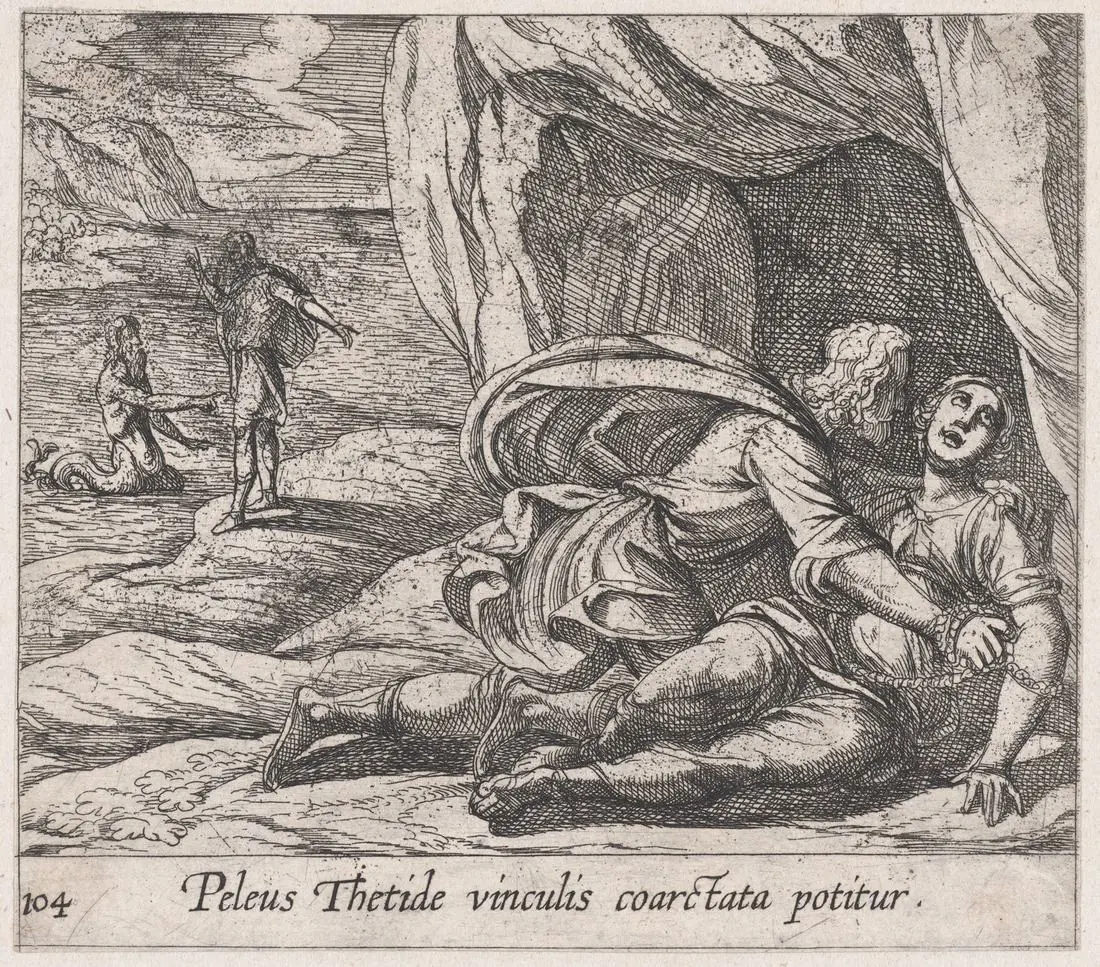
Chiron advises Peleus to seize Thetis and keep holding her despite her transformations. She becomes fire, water and a beast before returning to her earlier shape. The changes are not decorative demonstrations performed for an admirer. Within this encounter they prevent a captor from keeping an easy hold. Her divine ability makes resistance visible, even though the narrative gives Peleus the eventual success.
We can recognise the familiar storytelling pattern of endurance without accepting its treatment of another person as a prize. Remaining firm in a dangerous struggle is not the same as receiving consent. The story offers no basis for telling readers that persistence will turn refusal into love. Its unsettling force comes partly from the difference between the hero’s achievement and the goddess’ constrained choice.
What a victory song chooses to praise
Pindar’s Fourth Nemean Ode handles the encounter differently. Composed to celebrate the young wrestler Timasarchus, it recalls Peleus overcoming fire and the claws and teeth of lions before marrying a Nereid. The gods’ wedding gifts follow. Within a victory song, these dangers help shape a picture of heroic endurance and the distinguished family associated with the athlete’s island, Aegina.
This compressed praise is not a complete account of Thetis’ experience. Noticing the occasion of the song helps explain its emphasis without forcing Pindar to say what the later mythographic narrative says in detail. We can listen to the admiration directed at Peleus and still ask what becomes harder to hear when a struggle is retold chiefly through the language of a successful man.
Fire beside the cradle
The Library then moves into the household. Thetis tries to make their infant immortal, placing him in fire at night to remove the mortal element inherited from his father and using ambrosia by day. Peleus sees the child in the flames and cries out. The interrupted attempt is followed by Thetis’ departure to the Nereids and the child’s upbringing with Chiron.
This is a fire-and-ambrosia account, not the later familiar dipping in the Styx. Keeping the stories separate lets the domestic conflict remain visible. Two parents do not share an understanding of the same act: one attempts to change the child’s mortal condition, while the other reacts to the danger he sees. The narrative does not give us their conversation or permission to invent a reconciliation.
A mother who cannot remove mortality
In Iliad 18, Thetis speaks of the unhappiness of a marriage to a mortal and of the son she will not welcome home from Troy. Homer is not presenting a sequel that must reproduce every detail in Apollodorus. His scene gives the goddess a voice beside the traditions that celebrate Peleus, making the unequal duration of divine and human lives painfully immediate.
Following these tellings together does not require smoothing away their differences. Thetis can change her own appearance, seek help from Hephaestus and care intensely for Achilles, yet she cannot simply transform every relationship or cancel his death. Her story asks us to distinguish power from freedom and care from control. That distinction leaves more to consider than the splendid wedding at which so many retellings stop.