A guest who depends on purification
Before the marriage to Thetis, Apollodorus places Peleus in a sequence of exile and refuge. After an accidental killing during a hunt, he comes to Acastus at Iolcus and receives purification. The relationship gives Peleus more than temporary lodging. He depends on the person who has admitted him and restored his place within a religious and social framework. That dependence makes the later betrayal especially pointed. Acastus is not simply an enemy waiting in the wilderness. He is someone whose earlier action has created expectations of protection, and whose reluctance to kill his guest directly will not prevent him from arranging another danger.
A false report changes the household
Apollodorus names Acastus’ wife Astydamia. When Peleus rejects her proposal, she sends destructive messages and falsely accuses him to her husband. The narration identifies a deliberate deception in this particular story; it gives the reader knowledge that Acastus does not properly test. Pindar’s Nemean 4 recalls the plot with the wife named Hippolyta. Keep that difference between sources rather than inventing two successive women to make a single continuous biography. Both tellings connect the threat against Peleus with a household’s hidden intentions, although the victory ode compresses what the mythographer develops into a longer sequence.
A hunt with more than one contest
In Apollodorus, Acastus takes Peleus hunting on Pelion. When others claim the game he has taken, Peleus produces evidence of his own success and answers their mockery. That small dispute can be settled through things he has kept. The larger plot cannot. After Peleus falls asleep, Acastus conceals his sword and leaves him behind. The change from competition to abandonment is crucial: the guest is no longer simply being challenged to demonstrate his ability. He has been deprived of the equipment with which he could defend himself. An apparently shared expedition has become a setting in which danger can be made to look indirect.
Chiron returns what was taken away
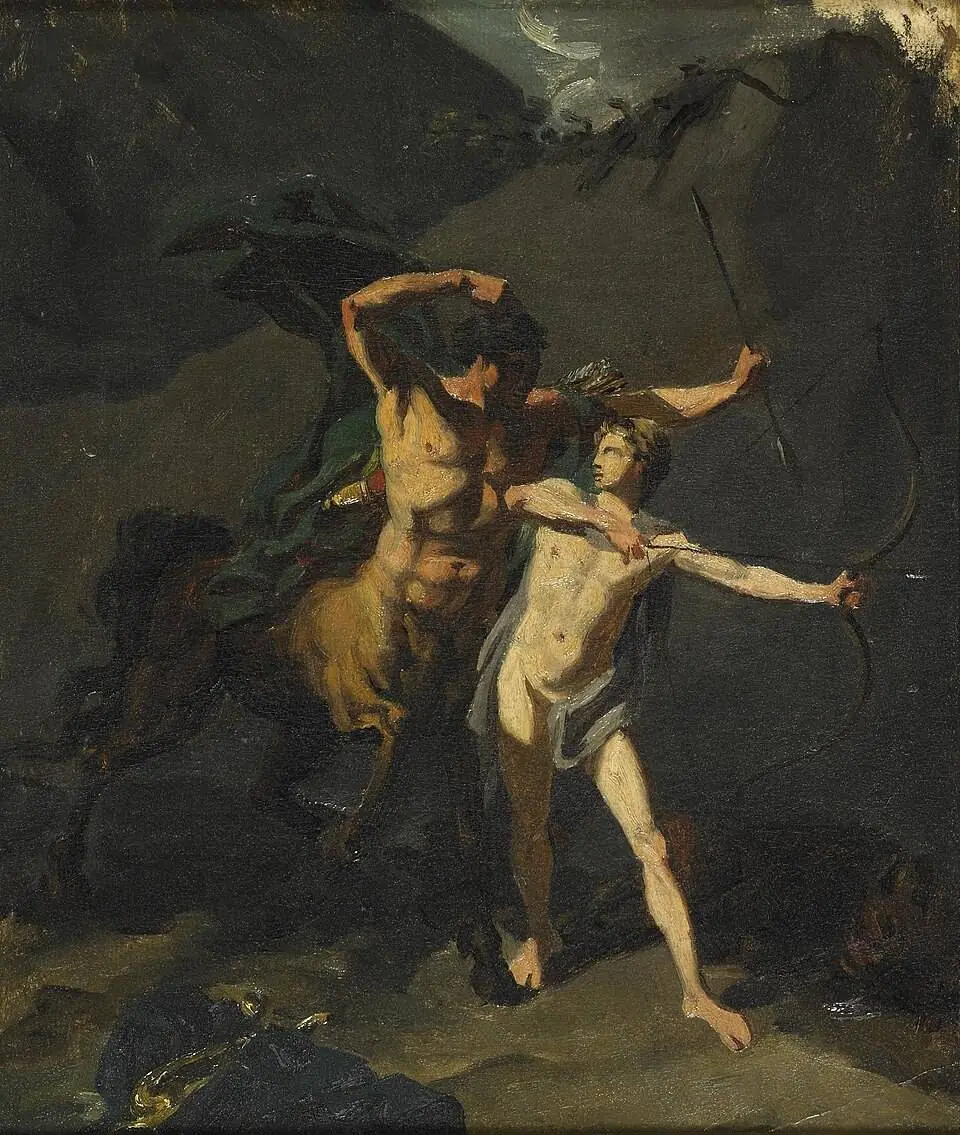
Peleus wakes and searches for the missing weapon. Threatened by the centaurs, he survives through Chiron’s intervention; Chiron also finds and restores the sword. This is a different use of the centaur’s knowledge from the familiar image of a teacher instructing the young Achilles. Here help answers an immediate deprivation. The restored object allows us to see that Peleus’ predicament was produced by someone else’s concealment, not simply by his own lack of strength. Pindar likewise credits Chiron with averting the trap, while referring to a divinely made hunting weapon. The two sources meet in the importance of rescue without matching every detail.
Reading refuge and betrayal together
The episode asks what happens when a protector keeps the outward boundary against direct killing but undermines the person entrusted to him. Acastus’ restraint is therefore not equivalent to care. Peleus requires help from outside the human household that has received him. Read the Library’s extended story beside Pindar’s brief use of it in a victory song, and beside the site’s other accounts of Chiron and Peleus. The sources should remain distinct, especially in their naming and narrative purpose. What connects them is a hero whose survival depends on someone recognizing and undoing a trap, rather than on another display of solitary invulnerability.