An errand interrupted by a person
In Iliad 11, Achilles sends Patroclus to discover which wounded man Nestor has carried from the fighting. The errand brings him into contact with the Greek army’s losses rather than leaving him at a distance beside Achilles. After speaking with Nestor, he hurries back along the ships and encounters Eurypylus, who is wounded and struggling away from battle. This is Eurypylus the son of Euaemon, not the figure who uses the same name in stories of the Argonauts. The pause is important: Patroclus has something urgent to report, but urgency does not make the injured person before him invisible.
A request that changes the question
Patroclus first asks about the army’s prospects. Eurypylus answers with a bleak account, then asks to be helped himself. The conversation moves from the fate of the whole force to the immediate needs of one body. Eurypylus recalls the knowledge Patroclus received from Achilles, who learned from Chiron. That chain matters because an inherited skill becomes useful through attention and action. It is not only a prestigious connection to a celebrated teacher. The site’s Chiron article follows the transmission of knowledge; here the focus is the moment when a traveller with another destination agrees to put that knowledge to work for someone nearby.
Making time for relief
The poem describes Patroclus helping Eurypylus into shelter and tending the wound. These details belong to an ancient literary representation of care, not to instructions for treating an injury today. What matters for this reading is the interruption of movement: the messenger becomes a companion who stays. Book 15 returns to the scene and shows that care includes conversation as well as attention to the injury. The suffering man needs more than an efficient gesture followed by immediate departure. By giving time to this relationship, the epic places ordinary human dependence beside the public language of glory, rivalry, and command.
Why staying cannot continue indefinitely
When the fighting reaches the Greek defences and the danger at the ships becomes immediate, Patroclus tells Eurypylus he must go to Achilles. He acknowledges that the wounded man still needs him and says an attendant will continue the care. The departure is therefore neither proof that the earlier help was insincere nor an uncomplicated completion of every obligation. A larger emergency presses upon an unfinished local responsibility. The scene makes that conflict audible rather than pretending that every good task fits neatly beside every other. Patroclus leaves because he hopes to persuade his friend, not because Eurypylus has ceased to matter.
Seeing more than the famous armour
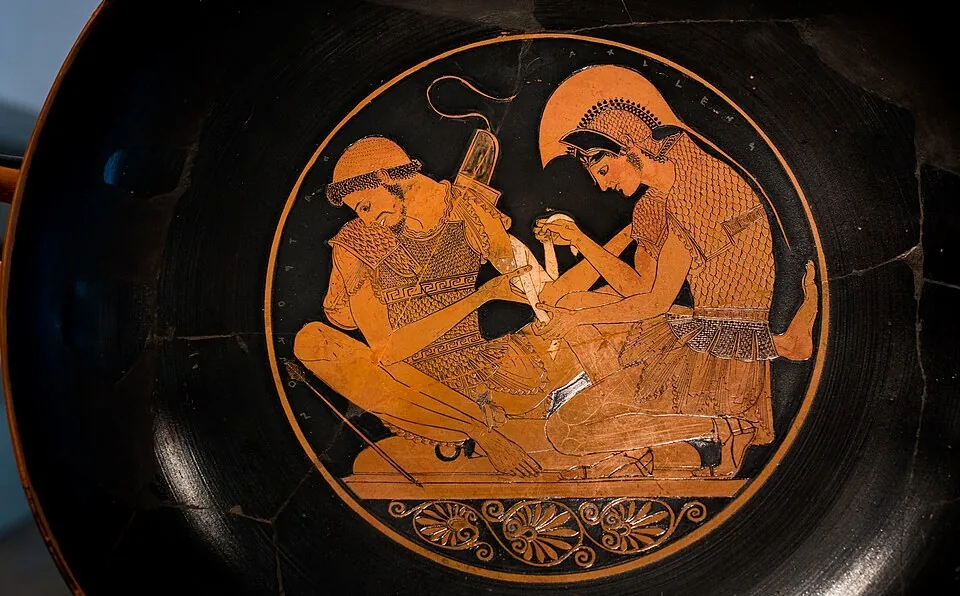
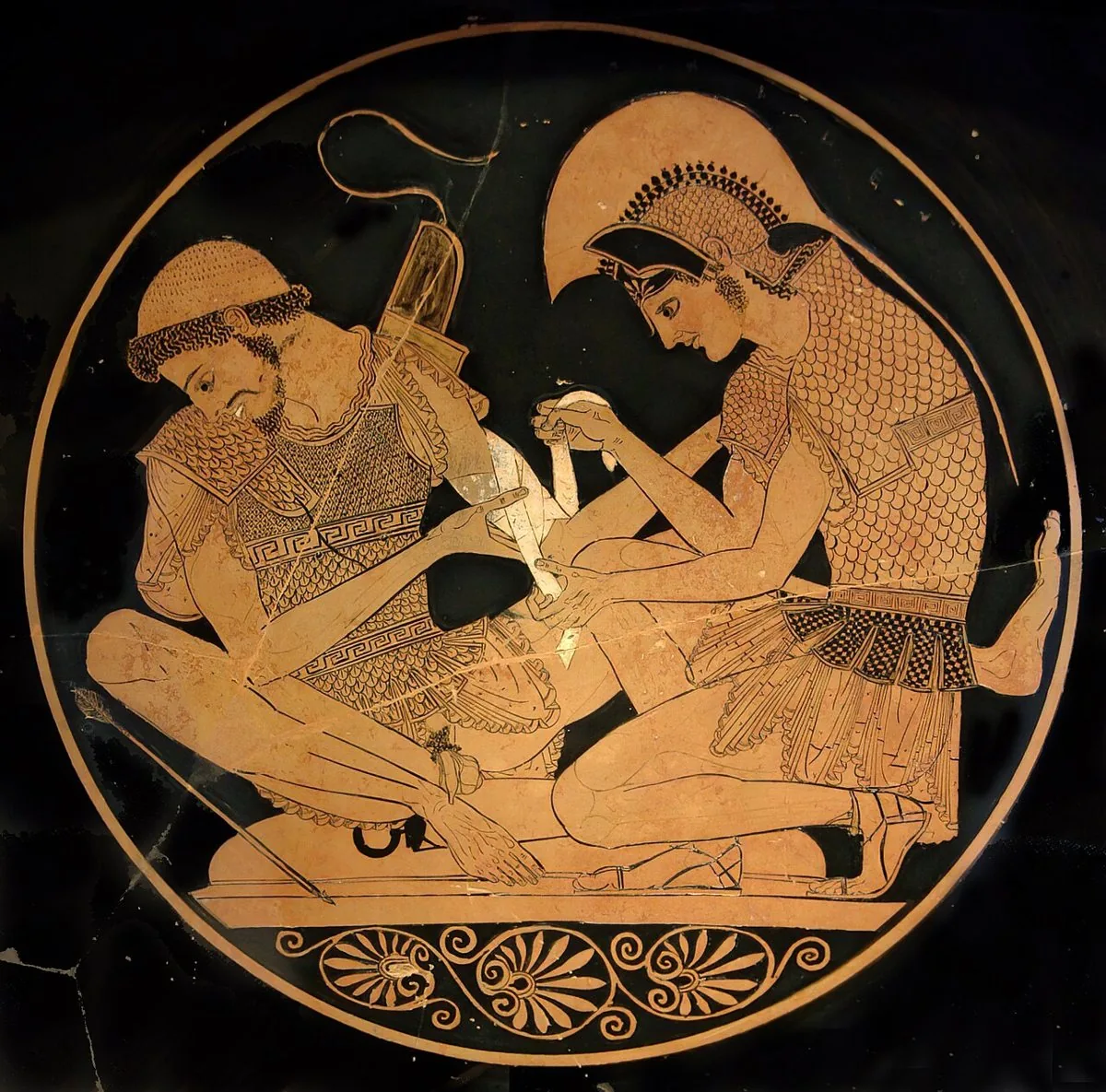
Read Books 11 and 15 before following Patroclus into the more familiar story of Achilles’ armour and his death. They establish a person who responds to suffering before the battlefield grants him a central role. The accompanying ancient cup shows Achilles tending Patroclus, another scene of care between companions; its named figures must not be relabelled as Eurypylus. An image can illuminate the broader theme of companions caring for one another without depicting this particular meeting. These quieter passages ask what heroism looks like during the time when someone is still alive, still hurting, and asking another person not to hurry past.