Two wishes in the forest
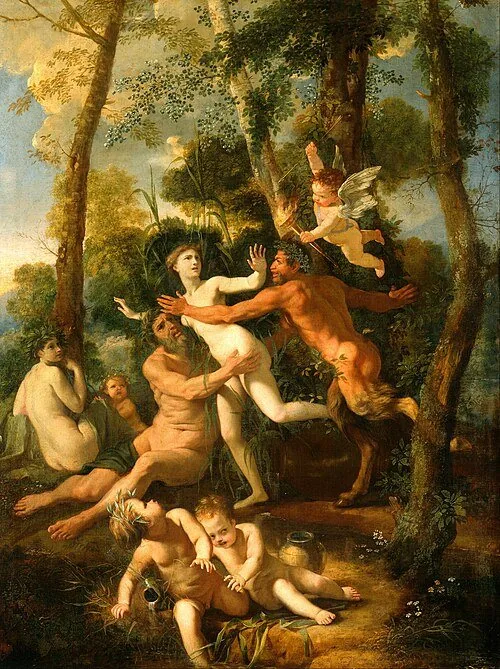
Book I of Ovid’s Metamorphoses says that Syrinx lives in Arcadia, loves hunting, worships Diana, and refuses suitors. Pan sees her and tries to approach her. She immediately flees, reaching the River Ladon. When the water blocks her escape, she asks the river nymphs to change her form. As with Daphne, transformation serves to preserve a boundary against an unwanted relationship when there is no safe way out, rather than to satisfy the pursuer.
The reeds’ sound depends on air passing through hollow stems, unlike the nymph’s human speech. Pan gains a sound he can play repeatedly, yet cannot obtain her consent from it. Her name remains on the instrument, her body among the waterside plants. Pursuer and fugitive are connected by a material while remaining separated by a distance that cannot truly be closed.
An embrace finds only reeds
When Pan catches up, he thinks he can embrace the nymph, but finds only riverside reeds in his arms. His sigh sends air through their hollow stems, producing a delicate, moving sound. He cuts reeds to different lengths and joins them with wax to make a panpipe, naming it for Syrinx. The object takes shape through specific materials and actions: the stems’ lengths affect their sound, and their joining makes several pitches into a portable instrument. The figure’s disappearance and the voice’s emergence thus happen together.
The narrator pauses the story
This episode is embedded in the account of Mercury trying to lull the guardian Argus to sleep. Argus falls asleep partway through the tale, and the poet then supplies the ending involving reeds and the instrument. The story both explains an instrument and demonstrates how narration itself can change a listener’s state. This article follows Ovid’s Roman text, in which Pan is a mountain god and Syrinx does not consent to union with him. Calling the panpipe a memorial to successful love would overlook her clear flight. It is a more complicated ending that preserves a voice while losing the person with whom to converse.