Entering the dead’s country for one person
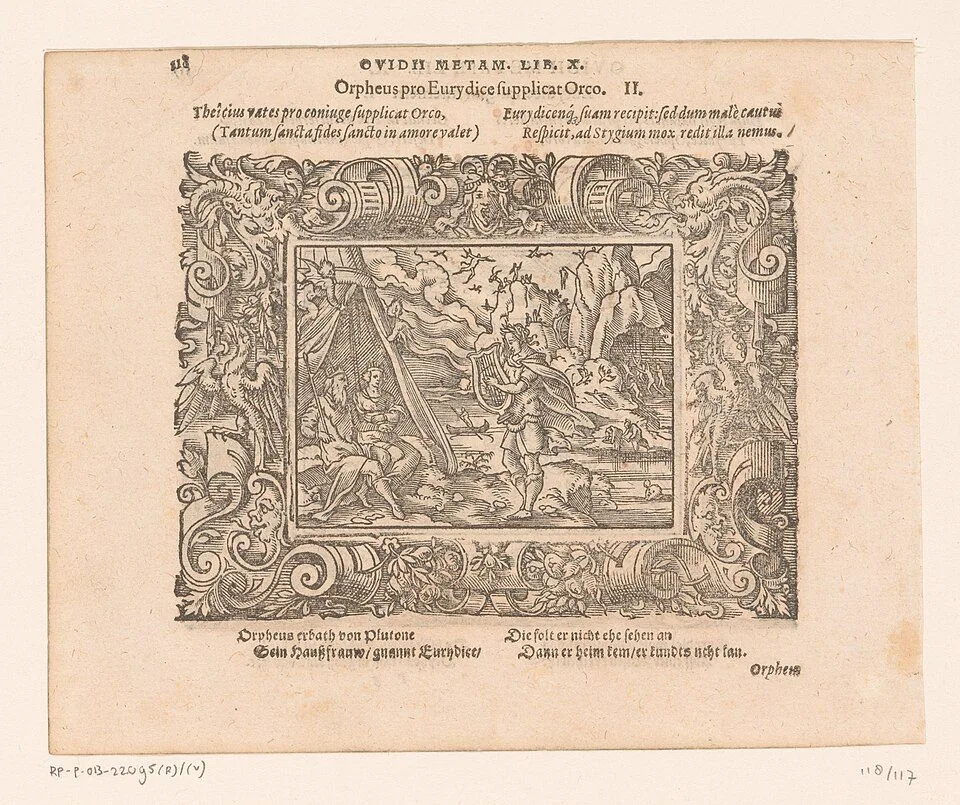
After Eurydice dies from a snakebite, Orpheus sings to the underworld to request his wife’s return. In Book X of Ovid’s Metamorphoses he explains that everyone will eventually arrive there: he asks only to extend temporarily a life interrupted too soon, not to abolish death’s rule. His music stops the punished in their labors and moves Hades and Persephone. Book IV of Virgil’s Georgics connects her snakebite with flight from Aristaeus’ pursuit. The poets arrange the circumstances of her death differently, and accounts should identify each separately. A woman’s death must not be treated merely as an anonymous opening supplying a singer with grief.
Continuing together without seeing
The underworld permits her return, provided Orpheus does not look back before emerging. They climb the dark, steep path, but fearing that she has not followed and longing to see her, he turns. Eurydice immediately recedes into the underworld. The condition demands action without visual proof, and the power his music established cannot complete this waiting for him. Ovid says she does not reproach her husband and leaves a final farewell. Virgil gives her a cry against a fate ruined once again. These voices change how readers understand the glance: as love’s panic, an uncontrolled impulse, or an action whose consequences fall again upon someone else.
The power and limits of song
Orpheus tries to enter again but cannot persuade the gatekeeper a second time. One miracle does not turn an exception into a permanent rule, and his songs after failure become continuing lament. Later paintings may show the pair at the moment of the glance or the singer sitting alone. One magnifies the instant when the condition collapses; the other emphasizes time continuing after loss. A warning not to doubt a lover cannot contain this story, whose characters face death, divine permission, and an unverified path. Readers may bring their own unease to the glance, but the text also directs attention to Eurydice’s footsteps, wound, and departing voice. She is a particular life whose return is requested, rather than a prize proving art’s power to move.