A guest arrives with more than a body
In Book Eight of the Odyssey, the Phaeacians invite their unnamed visitor to join athletic contests. Laodamas sees physical promise in him, while also recognizing the damage a difficult sea journey can cause. Odysseus answers that his thoughts concern suffering and the return home. The exchange places two understandings of the occasion beside one another. For hosts enjoying games, competition can appear a natural invitation; for a traveller seeking assistance, the same request can feel like pressure to prove himself. His body is visible to the gathering, but the experiences that have exhausted it remain largely unknown. The invitation begins before those differences have been adequately understood.
An insult supplies a false explanation
Euryalus interprets the refusal as evidence that the stranger lacks athletic skill, comparing him dismissively to a merchant concerned with cargo and profit. His speech treats a guessed occupation as a measure of personal worth. Odysseus responds by separating appearance, eloquence and judgement: a fine-looking person need not speak wisely. This reply matters before any discus moves. It exposes how quickly a host can replace curiosity with a ready-made account of someone else's limitations. The visitor's anger does not prove that every wounded pride deserves a contest. It shows how public words can change a gathering's purpose, turning an offer of recreation into a demand for an answer.
A mark needs someone willing to witness it
Still wearing his cloak, Odysseus selects a larger, heavier discus and throws beyond the earlier marks. Athena, appearing in human form, marks the distance and speaks in support of him. Skill, an object and an acknowledged result come together. The god's involvement gives the achievement a witness inside the narrative rather than leaving it as the hero's unsupported claim. Odysseus then challenges other athletes, while excluding Laodamas because of their relation as guest and host. Even in anger he recognizes a boundary within competition. The scene holds bodily excellence and social judgement together, without suggesting that success in one automatically guarantees wisdom in the other.
A sword accompanies the words of repair
Alcinous redirects the occasion toward gifts and requires Euryalus to make amends. Euryalus offers a valuable sword and speaks wishes for the stranger's safe return. Odysseus accepts both the gift and the conciliatory words. This exchange gives the insult a response beyond defeating its speaker at a sport. A public relationship has been damaged, and its repair needs an act that others can recognize. The sword does not establish a universal price for offensive speech. Within this particular visit, it turns a hostile encounter into a contribution to the guest's onward journey, allowing the day's hospitality to continue on changed terms.
Other throwing games ask different questions
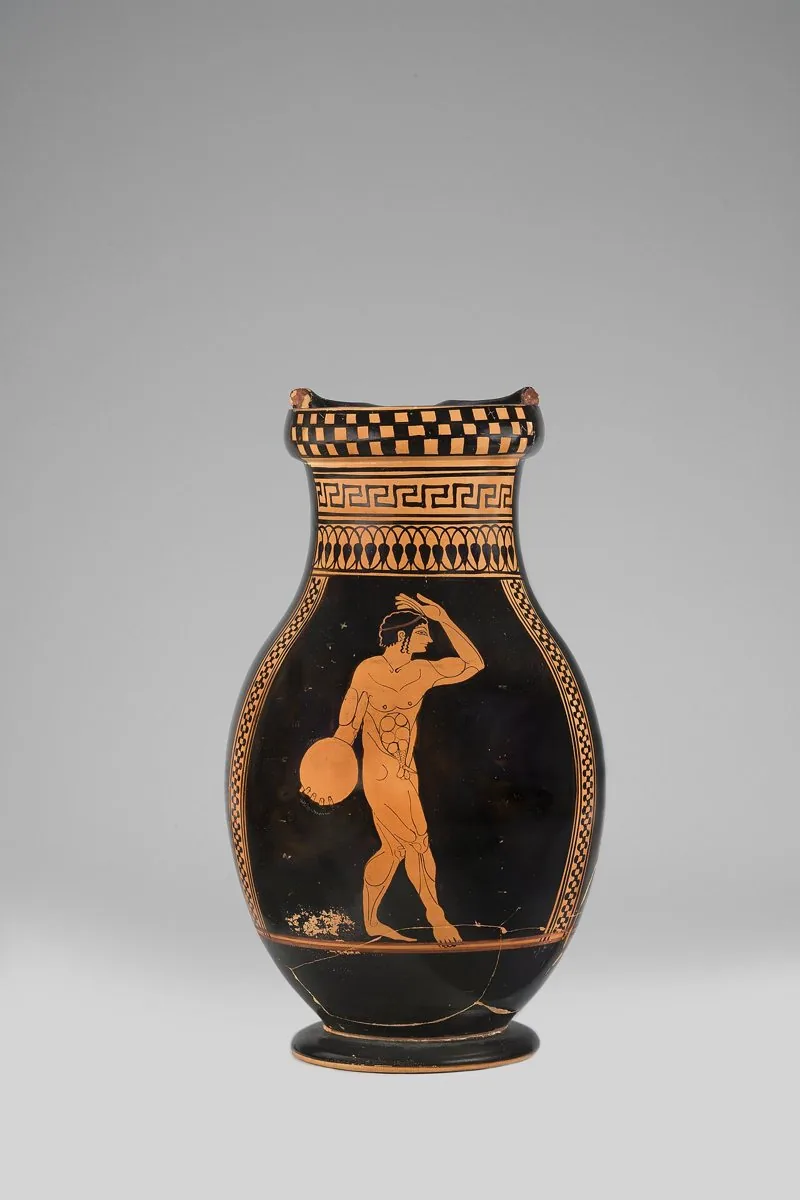
Iliad Twenty-Three presents a separate throwing contest at the funeral games for Patroclus. Its heavy iron object has a history as captured property and a promised usefulness for the winner's household. That scene concerns a different gathering, prize and set of participants; it should not be folded into the Phaeacian competition. Comparing the two reminds us that a throwing event gains meaning from its setting and objects. The classical discus thrower illustrated here represents athletic movement rather than a portrait of Odysseus or Euryalus. The poem adds what such a figure cannot show alone: exhaustion before the throw, a witness at the mark and an apology after the result.