The guest and the owner of the cave
In Book 9 of "The Odyssey", Odysseus and his companions entered the cave of Polyphemus, expecting to be welcomed by their host. When the giant came back, he sealed the entrance of the cave with a huge boulder and treated the guests as food. The relationship between the two parties regarding the rules of hospitality suddenly breaks down: the hero appeals to the gods' tradition of protecting strangers, but the other side refuses to accept the constraints. There are cheese, sheep and daily work in the cave. It is not a purely chaotic space; the scary thing is that the owner controls all entrances and exits, but does not recognize the rights of visitors.
The name Nobody
Odysseus used strong wine to make the giant unconscious, called himself Nobody, and with his companions, drove a wooden stake into the giant's single eye. When the other Cyclopes heard the call for help, they mistakenly thought that since no one was harming him, there was no need to intervene. Pseudonym here is not an ordinary disguise, but a tool to exploit the ambiguity of language. The hero's resourcefulness requires the cooperation of his companions. Therefore, escape does not only rely on individual cleverness, but also relies on cooperation in danger, waiting for opportunities, and enduring uneasiness.
The body is hiding under the sheep
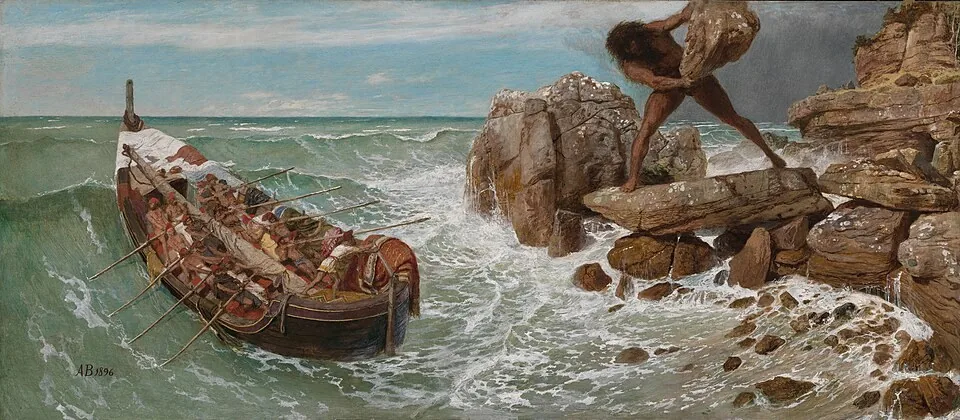
The blind Polyphemus ran his hand over the sheep's back, trying to check who had left the cave, but Odysseus hid his companions beneath the sheep's bellies. This approach borrows from the giant's daily grazing order, turning familiar movements into gaps in the defense. If the accompanying picture depicts the escape on the ship and the stone-throwing by the giant, it should be understood as the stage after escaping from the cave. Polyphemus belongs to the shepherd Cyclops in the epic and should not be confused with the three Cyclopes described by Hesiod who forged Zeus's thunderbolts without explanation.
Real name invites pursuit
After being out of danger, Odysseus couldn't help but announce his name to ensure that the merit and fame would go to him. Polyphemus was thus able to seek vengeance from his father, Poseidon. In the first half, he was saved by hiding his identity, but in the second half, he paid the price for revealing his identity. This reversal shows the conflict between wisdom and competitiveness. The moral of the story is not that wit is useless, but that one success does not guarantee that the next judgment will be equally clear; the pursuit of honor may allow the danger that has been resolved to come back in another form.