A guest before a wish
Midas does not begin with an empty treasury. In Book 11 of Ovid’s Metamorphoses, the elderly Silenus has become separated from the company of Bacchus, the god known in Greek tradition as Dionysus. Phrygian country people bring the unsteady old companion to their king. Midas recognizes a friend from the god’s rites and entertains him for ten days and nights. On the eleventh day he returns Silenus to the grateful god, who offers him a reward of his own choosing. Before judging the wish, notice what Midas already possesses: the ability to recognize a companion, provide food, and restore someone to his community. His later mistake does not erase this hospitality. It reveals how easily a person can overlook the value of relationships when invited to imagine unlimited personal gain.
A world reduced to one value
Midas asks that everything his body touches become gold. This is no talent for finding treasure; it is conversion without exceptions. Ovid makes the king test the gift on a branch, a stone, earth, grain, an apple, and palace doorposts. Each change seems to confirm success. Yet a reader can notice a gap before Midas does: these things had different uses before the same gleam covered them. This is one way to interpret the scene, rather than an economic law stated by the poet. The power allows only one measure of value. Midas can accumulate wealth with astonishing ease, while losing contact with a world that remains different from his desires. The more completely the wish works, the fewer possibilities it leaves him.
The feast that cannot feed its host
The turning point comes at a meal. Bread hardens at his touch, meat becomes gold between his teeth, and wine mixed with water cannot quench his thirst. Ovid calls bread the gift of Ceres, the grain goddess, while wine belongs to Bacchus himself. Divine gifts that sustain ordinary life become unusable through another divine gift. Calling this simply a punishment for greed captures only part of its force. Midas still has a body. Hunger and thirst depend on things that have not been remade into treasure. Riches do not free him from those needs; his new power blocks the means of meeting them. The table that once made hospitality possible now becomes a place its own host cannot share.
Following the water upstream
Midas admits his mistake and asks Bacchus to release him. The god directs him to the Pactolus, which flows past Sardis, and tells him to follow it to its source and immerse his head and body. The power leaves the king and passes into the river. Ovid connects its gold with a reward that has been withdrawn: a poetic explanation of a landscape, rather than geological evidence or a biography of a historical ruler. For this reading, the important movement is from changing everything he touches to placing himself in something he must accept as it is. Recovery involves listening, moving, and allowing water to remain water, able to do what gold cannot.
Looking beyond the glitter
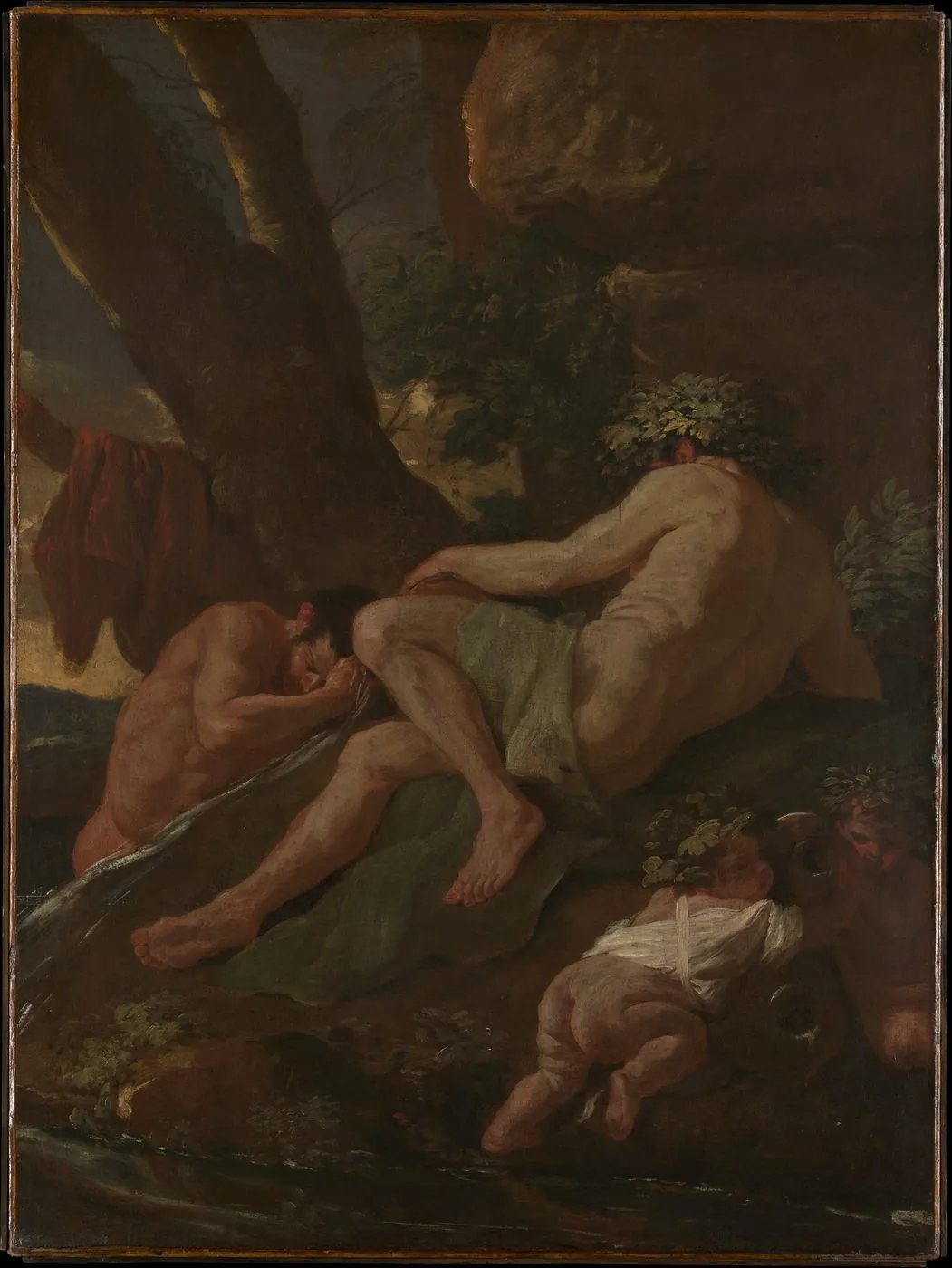
Nicolas Poussin’s painting Midas Washing at the Source of the Pactolus, made around 1627, chooses the moment of release. The Metropolitan Museum of Art identifies the humbled king as the smaller figure behind a reclining river god and two putti with vessels. Look at who occupies the space and who must approach the water: royal power no longer controls the composition. This is a later interpretation of an ancient story, rather than an eyewitness record. Familiar retellings also need care. A child transformed into gold by her father does not appear in the Ovid passage read here; food and drink already make the danger clear. Midas leaves us a practical question: when pursuing one admired result, do we still leave room for the differences, relationships, and everyday needs that make life possible?