After the gold, Midas still has to listen
In Book 11 of the Metamorphoses, Midas has washed away his golden touch in the Pactolus and turns from wealth towards Pan and the woods. Ovid does not make that change a certificate of wisdom. Another mistake follows, although the test now concerns sounds entering his ears rather than objects meeting his hands. Pan boasts to the mountain nymphs that his pipes surpass Apollo’s music and accepts a contest under the judgement of Tmolus. It helps to place everyone carefully: Pan and Apollo are the performers, the mountain god Tmolus is their agreed judge, and Midas is a listener already pleased by Pan. He is not the sole appointed referee in this account. The earlier golden adventure supplies a transition; the new episode asks what happens when listening becomes a public judgement.
The mountain clears his ears before judging
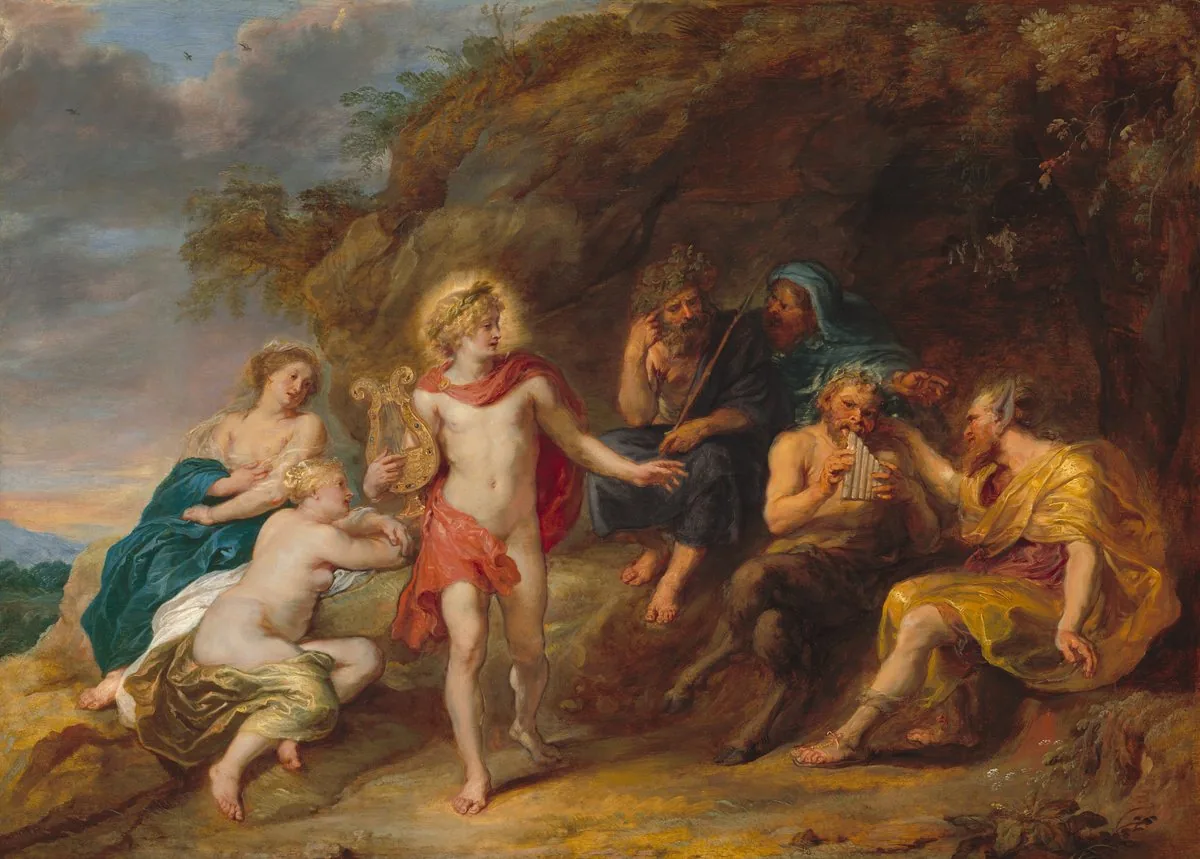
Tmolus sits on his own mountain and clears the trees from his ears, retaining a crown of oak leaves and acorns. God and landscape overlap in a delightful physical action: woodland belongs to him, but it can also obstruct his hearing. Pan begins on reeds joined with wax, and his rustic music delights Midas. When Tmolus turns towards Apollo, the forest turns with him. Apollo wears laurel and a trailing purple robe, holding an elaborate stringed instrument in his left hand and a plectrum in his right. His posture announces a practised musician. Tmolus awards him the victory and asks Pan to acknowledge it. The contrasting clothes, instruments and sounds belong to Ovid’s staging; they do not establish an identical hierarchy of musical taste for every ancient audience.
One dissent changes a listener’s body
Everyone present accepts the verdict except Midas, who calls it unjust. Ovid presents his judgement as foolish, and Apollo makes that judgement visible. He stretches the king’s ears, covers them with grey hair and gives them an ass’s movable shape, leaving the rest of him human. Notice that Midas has neither competed nor accepted a bargain allowing a victor to punish a defeated performer. His offence is disagreement with the judgement. We can recognize the poem’s joke about defective listening while noticing the god’s power to write his victory onto a spectator’s body. This is separate from the contest and flaying of Marsyas: a different challenger and a different narrative. Pan is not flayed here, and the altered ears do not renew the golden touch.
The barber gives his knowledge to the ground
A purple covering conceals the ears, but hair still grows. The servant responsible for cutting it eventually sees what the king hides. Ovid supplies neither a personal name for this barber nor a scene in which Midas explicitly threatens him with death. The man fears disclosure, yet struggles to contain what he knows. He digs a shallow hole, whispers the shape of his master’s ears into it and replaces the soil. No second human listener receives the confidence; nevertheless, the words have left his body. An intimate service has placed knowledge of a ruler in a dependent person’s hands. Reading him only as someone fond of gossip misses that uncomfortable relationship. The little hole offers an imagined compromise between speaking and keeping silent.
The reeds speak without anyone playing them
About a year later, reeds have grown above the buried words. Moved by a gentle south wind, they repeat the secret. No barber cuts them into a flute, and Midas himself does not become this bed of plants. At the opening, Pan deliberately plays reeds; at the end, reeds sound without a musician’s decision. Later images can complicate identification: the Rijksmuseum’s painting by Hendrik de Clerck and Denis van Alsloot was formerly catalogued as Apollo’s contest with Marsyas, and is now identified as the contest with Pan. Checking the figures against the text helps keep those stories distinct. The verdict has settled the competition, but it has not settled who controls the sounds that follow. A ruler can cover his ears; he cannot make the landscape keep his confidence.