Leaving the line has a concrete cause
In Iliad Thirteen, Meriones strikes Deiphobus' shield with a spear that breaks instead of piercing it. He leaves the immediate fighting to obtain another weapon. When Idomeneus meets him near the tents, he asks whether his companion is wounded or has come with a message. The answer is simpler: the spear has failed. The exchange matters because an absence from the front can have several causes. Neither a distant observer nor a reputation alone explains what a fighter needs at that moment. The poem pauses the larger battle long enough for equipment, location and a direct question to enter its account of continued participation.
Spoils become a nearby supply
Idomeneus offers spears standing against his tent's wall, boasting that he has taken them from defeated Trojans. Meriones also possesses captured equipment, but it is not close at hand. Having something and being able to reach it now are different conditions. A shared cause does not make the battlefield's resources equally accessible. The offered weapon solves an immediate problem through proximity and another person's willingness to provide it. At the same time, these supplies have a violent history: they are not neutral goods appearing from an invisible store. The conversation keeps material support and the warfare that produced the objects within the same small scene.
Recognition answers more than a request
Meriones reminds Idomeneus that he has always fought bravely and that his companion knows this. Idomeneus agrees, describing how courage would become apparent in an ambush. We can hear both confidence and a concern to remain recognized when asking for help. A broken spear has not erased the user's skill, yet the user still names his record. The reply assures him that needing a weapon has not cancelled what another person knows of him. This is a relationship expressed through speech as well as a transfer of equipment. The spear can be replaced quickly; maintaining an understanding between comrades requires its own answer.
Choose a place, then return together
The conversation ends with a decision about where to fight, and the two move back toward the conflict. Assistance therefore leads into coordination rather than simply restoring an isolated man to his previous position. Their exchange has included cause, supply, reputation and direction. None of it makes the battlefield safe, and the poem soon resumes its violence. Nevertheless, the pause has shown how participation is repaired when a tool no longer works. We can attend to this ordinary sequence without turning the warriors into an ideal modern organization. Its details remain particular to armed companions whose readiness depends partly on objects taken from other people's bodies.
The same man handles another kind of weapon
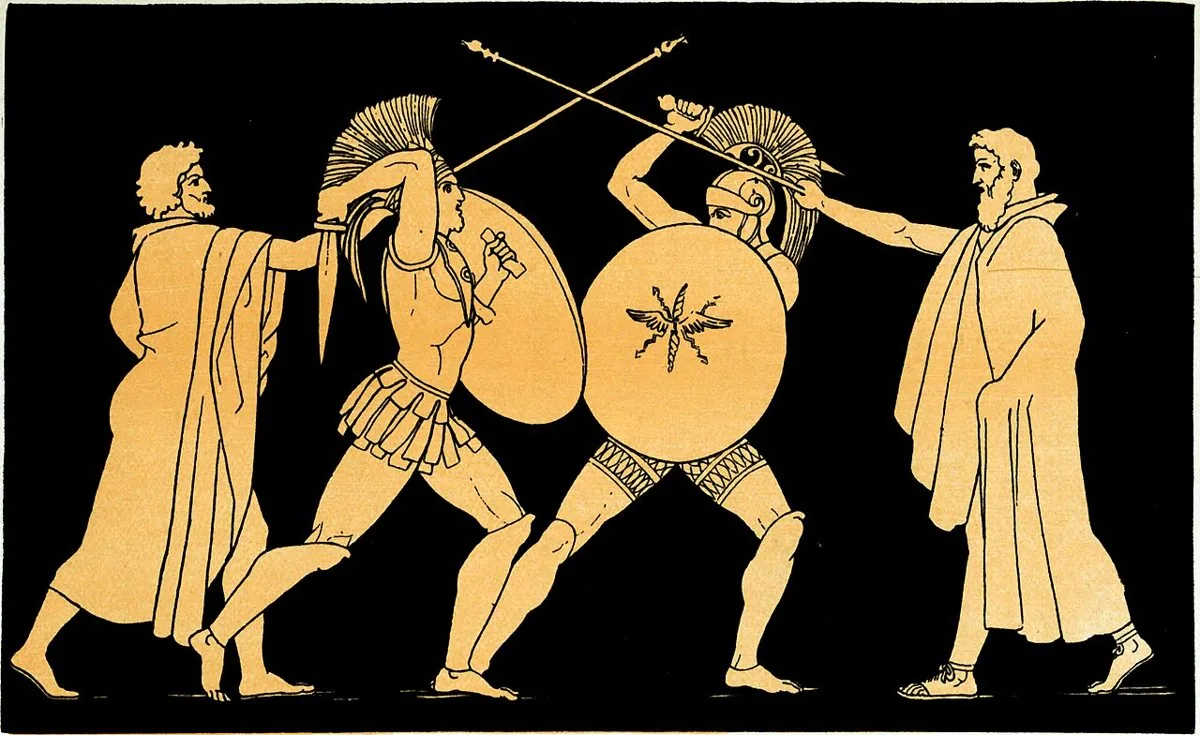
Iliad Twenty-Three later places Meriones in an archery contest and then in the distribution of a spear among funeral-game prizes. His success with the bow includes a promise to Apollo, while the final spear is allocated without the proposed throwing contest taking place. These are different settings from the broken weapon in Book Thirteen. Together they show that skill, divine acknowledgement and public distribution do not always operate in the same way. The illustration presents a later image connected with Idomeneus, not a documentary view of this exchange. The text lets us recover the quieter action behind martial equipment: asking, providing, acknowledging and finding a place beside someone again.