The rescuer has a mortal name
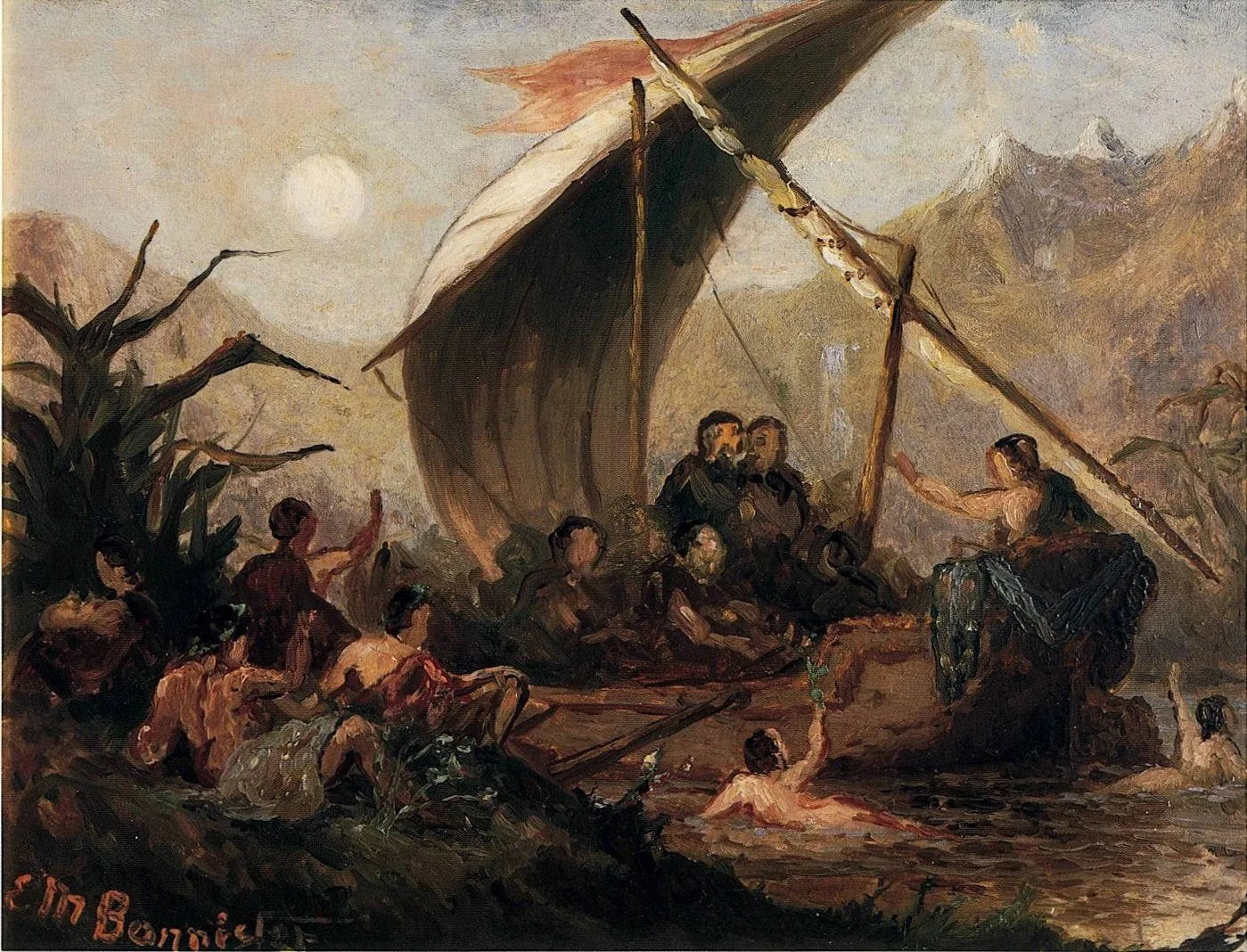
In Book 5 of the Odyssey, the divinity who notices Odysseus struggling among the waves is Ino, also called Leucothea. Homer identifies her as Cadmus’s daughter, formerly mortal and now honoured among the sea’s divinities. He does not unfold her entire history here. The Library, at 3.4.3, separately tells of madness afflicting Ino’s household and her entry into the sea with Melicertes; under the names Leucothea and Palaemon, they help storm-tossed sailors. These texts illuminate one another without making the Library’s whole narrative part of Homer’s account. Within this encounter, a deity once belonging to the human world notices a suffering body. Her pity is not justified through the hero’s ancestry or military achievements. The immediate object of attention is his distress, before any recognition of a celebrated identity.
Instructions attached to the veil
The goddess lends Odysseus a sacred veil to fasten beneath his breast. He must remove his clothes, abandon the raft, and swim toward the Phaeacians’ land. Once safely ashore, he must throw the fabric back into the sea and turn away. The object therefore has instructions and an ending, rather than becoming a permanent possession. It will not swim for him or move the coast closer. Rescue changes the conditions of action without removing the effort his body must make. We need not invent a complete system of magical rules for this fabric: the poem supplies a clear purpose. By joining safety to return, the instructions make responsibility toward the helper part of the loan from the beginning, alongside the advantage received by the person in danger.
Why he does not jump immediately
Odysseus does not obey immediately. Suspecting another divine trap, he decides to remain aboard while the raft holds together and swim only when it breaks. Given his exhaustion and the distant shore, his hesitation is understandable. Yet caution cannot make damaged timber reliable forever. Poseidon sends a wave that scatters the raft; Odysseus then removes Calypso’s clothing, binds on the veil, and enters the water. Altered circumstances require altered judgement. The episode neither makes every suspicion a mistake nor allows suspicion to excuse endless inaction. Watch when he gives up his first method. His skill here is not an advance knowledge of every deity’s trustworthiness. It is a capacity to keep observing and use the assistance still available when the support already in his hands has disappeared.
Another request at the shore
Approaching land does not complete his safety. Athena manages the winds and helps him think at the dangerous rocks; he must still find a workable landing. At a river mouth he appeals to an unnamed river god, whose water becomes calm enough to receive him. Leucothea’s veil belongs within a sequence of assistance: every step cannot be credited to the same deity. Survival involves fabric, wind, observation of terrain, and a river’s welcome. Almost powerless when he lands, Odysseus recovers enough to unbind the veil and let the river carry it seaward, where Ino receives it. Its destination completes the earlier request. Successful help does not give its recipient an unlimited right of possession. Returning something is itself an action that this encounter requires him to finish.
Returning protection and caring for a body
After returning the veil, Odysseus still faces cold, dew, and the possibility of wild animals. He chooses interwoven bushes, heaps leaves around his body, and receives sleep from Athena. The ending presents rescue as a process needing further care. Coming ashore alive does not immediately restore his former position or strength; finishing with one divine object does not finish every need. Remembering only the miraculous fabric would miss the quiet decisions to find shelter and allow himself rest. Leucothea leaves no trophy for a hero to display. Her assistance leaves a person who can still act. The poem sends borrowed protection back into the sea and gives the next step to an exhausted body, together with the people and divinities willing to keep helping it.