Arrival after exhaustion
The Laestrygonian episode in Book 10 begins after a failed return to Aeolus and days of exhausting rowing. On the seventh day, the fleet reaches the country associated with Lamus and the city of Telepylus. Before any attack, Homer describes a place with herders, a road, a spring, and a royal household. These ordinary signs make it more than an empty monster's lair. The sailors are trying to learn what community they have reached. We need not settle the harbour on a modern map to follow the danger: the poem gives a precise spatial arrangement even while its geographical identification remains uncertain.
The attraction of enclosure
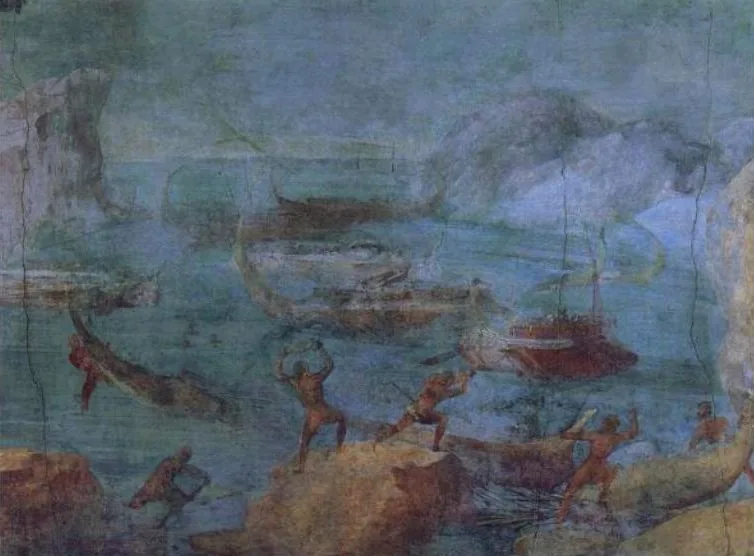
Most of the captains take their vessels into a harbour enclosed by steep cliffs, with a narrow entrance between headlands. Inside, the water is exceptionally calm, and the ships lie close together. Odysseus alone keeps his own vessel outside, moored at the end of a point. This difference is established before the visitors discover the inhabitants' hostility. The narrative does not give us a detailed calculation explaining his choice, so it should not be embellished into a complete strategic plan. What matters is the consequence: the very enclosure that appears to promise protection will limit the fleet's ability to escape.
A road toward the palace
Odysseus climbs a height and sees smoke, then sends two men with an attendant to investigate. They meet a girl going to the spring of Artacia and ask about the ruler. She directs them to her father Antiphates' house. There they encounter his enormous wife, and Antiphates soon attacks one of the men; the others flee. The sequence changes the meaning of familiar social signs. A spring, a household, and a ruler do not guarantee a welcome. Yet the girl's directions should not automatically be rewritten as a secret ambush: the passage reports the encounter without providing that additional motive.
When cliffs become weapons
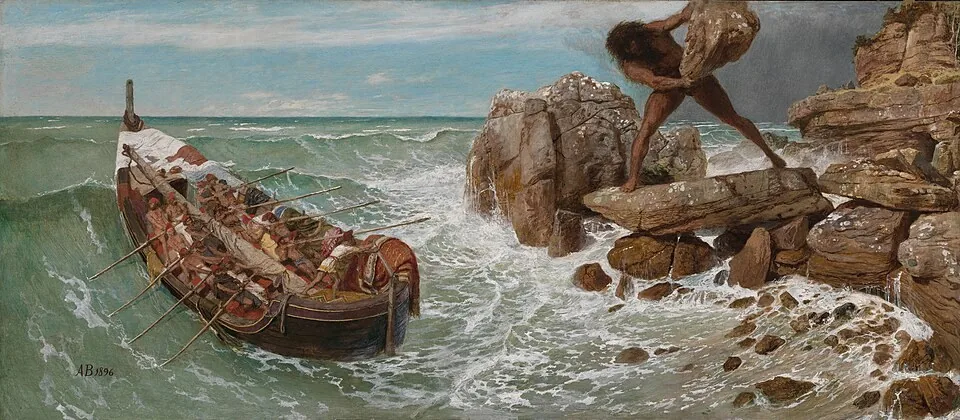
The alarm brings a multitude of Laestrygonians to the cliffs. They throw great rocks down onto the crowded ships, and the enclosed fleet is destroyed. Odysseus cuts his own mooring rope and orders his crew to row away. Only his vessel escapes. The comparison with the Cyclops in Book 9 is useful but limited: there a stone blocks a cave's exit; here the scale is a whole harbour, and many attackers exploit its heights. These are different peoples and episodes, not interchangeable names for one monster. The harbour's calm has offered no protection against danger descending from above.
One ship and a changed story
The survivors sail toward Circe carrying grief as well as relief. The loss is not merely another exciting obstacle: it reduces a fleet to a single ship and changes the scale of every subsequent decision. Reading the episode through its landscape helps explain that severity. Shelter and exposure are not fixed qualities of a place; they depend on who controls its entrances and surrounding heights. This observation comes from the scene's arrangement, not from a universal rule that suspicious travellers always survive. The other captains are not given individual trials or speeches. Their disappearance leaves Odysseus' remaining crew with a far smaller margin for another disaster.