The army waits for the wind to blow
The army assembled at Aulis is unable to sail smoothly, and the prophet declares that Agamemnon must sacrifice his daughter Iphigenia. Euripides' tragedy places decisions at the intersection of military, familial, and general responsibilities: Agamemnon summons his daughter on the pretext of marrying Achilles and then attempts to prevent her arrival. The orders that change back and forth show that he is not always convinced that he is right, but still holds power that can harm others.
The engagement turned into a trap
Clytemnestra believed that her daughter’s wedding would take place, and Achilles did not know that his name was being used to deceive them. As misunderstandings about identity gradually come to light, the girl and her mother must face the sacrifice required by the military. A wedding is supposed to mean a new life, but the altar turns it into the end of life. Tragedy exploits the similarity between the two rituals to create shock while also bringing to light the gap between a hero's reputation and his actual ability to protect: a famous name does not automatically make the weak safe.
Two Traditions of Death and Rescue
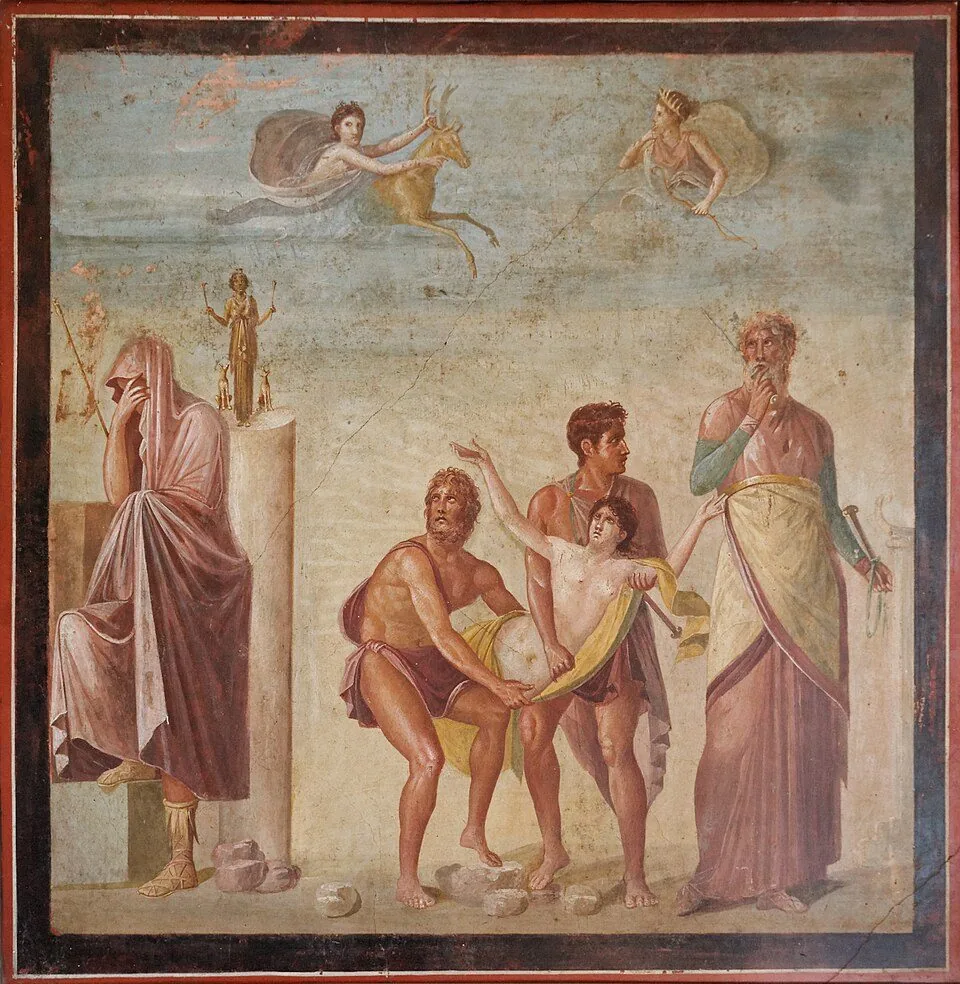
"Agamemnon" uses the past story of the father's sacrifice of his daughter as an important background to the royal family's blood debt. "Iphigenia in Tauris" clearly adopts the tradition of Artemis replacing the maiden with a deer and taking her to a foreign place. There is also a rescue scene in the transmitted ending of Iphigenia at Aulis, but there are complex problems in textual transmission. Therefore, when introducing the story, the work on which it is based should be stated. You cannot say that she was definitely killed while treating her life in a different place as an undisputed sequel to the same version.
The altar and the father with his face covered in the picture
The sacrificial fresco from Pompeii gathers figures around the altar, with the father with his face covered being particularly noticeable. The image chooses to use physical gestures to express the unbearable pain, and the appearance of the goddess and the deer reminds the tradition of a substitute victim. It belongs to the Roman period's representation of Greek themes and cannot be taken directly as a photo of Euripides' stage. Reading the picture alongside different texts, one can see that ancient art also selects, compresses and rearranges the ending of a myth.