Making a stranger bear a country’s hunger
The Bibliotheca attributed to Apollodorus places Busiris on Heracles’ journey to find the golden apples. Crossing Libya, the hero reaches Egypt, ruled by Busiris, a son of Poseidon and Lysianassa. The compiler says that the country suffered nine years of scarcity. Phrasius, a seer arriving from Cyprus, proposed ending it by sacrificing a foreign man to Zeus every year. The king killed the adviser first and continued killing visitors who arrived afterward. A measure supposedly protecting a community thus makes someone without local kin or protection expendable. This is a reading of the arrangement, rather than proof that the proposed remedy worked. The account does not actually show food returning because a stranger has died. A public need and the violent solution claimed for it remain different things.
The intended victim begins to act again
Heracles too is seized, bound, and brought to the altars. He breaks his bonds and kills Busiris and the king’s son Amphidamas. The Bibliotheca tells this briefly, without staging a lengthy trial or giving the hero a preliminary speech about hospitality. The reversal happens first through a body: someone expected to stop acting can move again, while those directing the sacrifice lose control. Strength saves this particular visitor. That does not make earlier, weaker victims responsible for their deaths, or turn his escape into an answer available to everybody. We can feel the relief of release while noticing a more extensive danger. When foreignness itself becomes a reason for killing someone, the problem reaches beyond whether one unusually powerful traveler can win a fight.
The same king on another itinerary
Diodorus’ Library of History, at 4.18.1, also says Heracles executes Busiris for killing visitors, but places the event in the expedition toward the western cattle. At 4.27 the king appears again in a discussion of the Hesperides, with another act of force. Wanting Atlas’ daughters in his possession, Busiris sends pirates to abduct them. Heracles later encounters the pirates on a shore, hears the young women’s account, kills their captors, and returns them to their father. These passages need not be repaired into a single seamless travel schedule. They associate a ruler with two ways of treating people as obtainable objects: a visitor is seized for sacrifice, and distant women are ordered to be delivered. The hero interrupts routes imposed by someone else’s power.
Objects preserve the moment of reversal
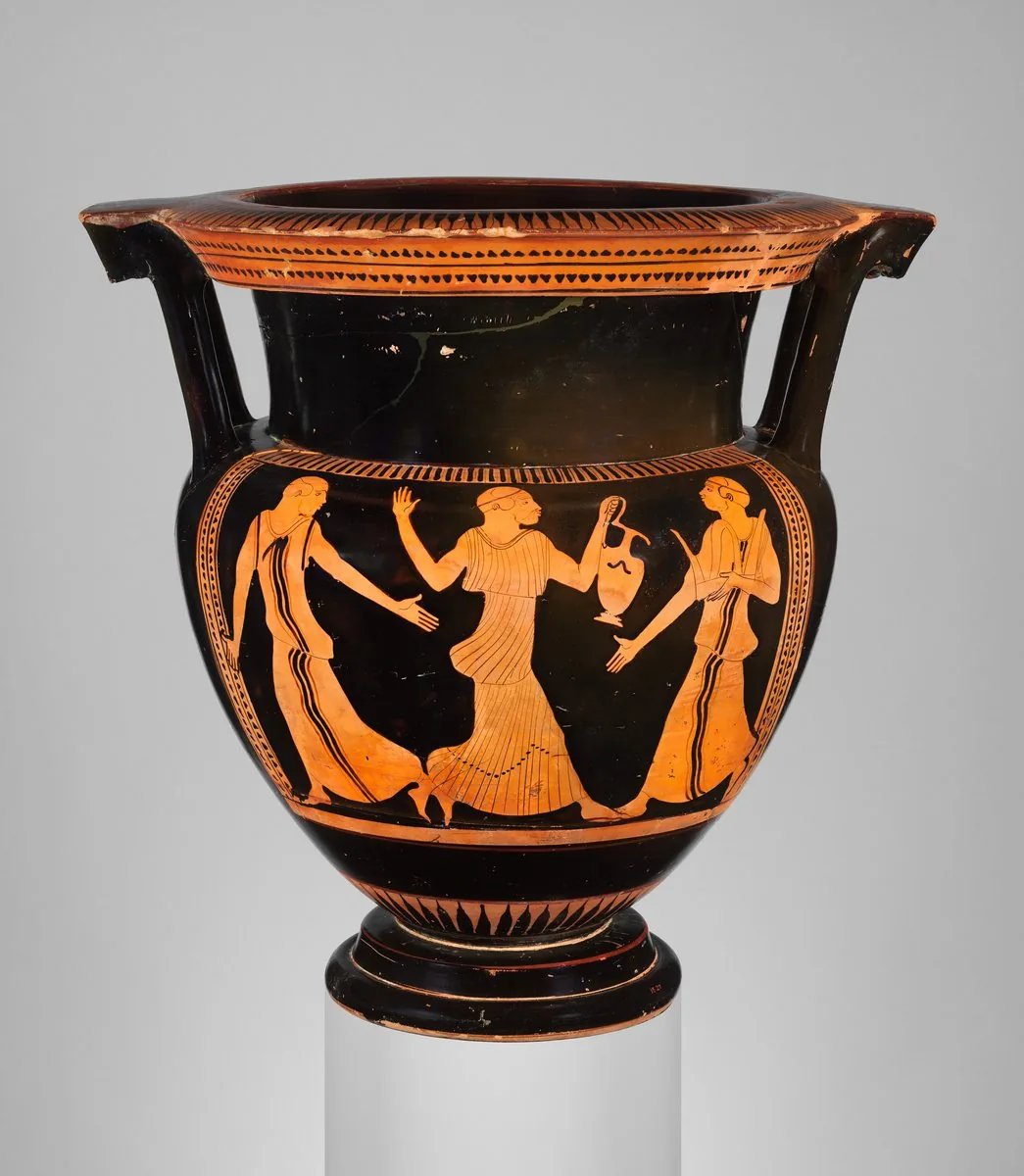
The illustration here is the Metropolitan Museum of Art’s terracotta column-krater numbered 15.27, attributed to the Agrigento Painter and dated about 470–460 BCE. Its front shows Heracles killing Busiris; its back shows the king’s priests and attendants fleeing. Different surfaces of one vessel preserve confrontation and retreat. Looking need not stop with the hero’s swinging arm. We can ask how people previously directing another person’s fate suddenly begin seeking their own escape. The image makes the reversal recognizable, while a written account explains how the danger arose. This remains a myth represented by a Greek artist, rather than an Egyptian eyewitness record. However precise its clothing, bodies, and gestures appear, they cannot establish that Egyptian society actually practiced the sacrifice described in the story.
An ancient reader who refused to believe
In Histories 2.45, Herodotus explicitly criticizes a Greek story in which Egyptians crown Heracles, lead him to Zeus’ altar, and encounter resistance only when the ceremony begins. This passage does not name Busiris, although its danger clearly resembles this episode. Herodotus argues that the tale misunderstands Egyptian sacrificial customs and questions how one still-mortal man could kill a countless multitude. His objection is itself an ancient argument, rather than a modern archaeological investigation. What matters here is that antiquity did not speak with one accepting voice. Ending with the objection lets us read a stranger’s escape and ask how storytellers make unfamiliar places seem frightening. The reversal at the altar deserves attention; so does the origin of alarming stories told about other people.