The wife sees another battlefield
In the sixth volume of "The Iliad", Andromache reminded Hector that her father and brothers had died in the war, and her husband had become almost her entire support. She also made suggestions for defending the city, showing that she was not just a bystander waiting. To the commander, the city wall is a line of defense that needs to be defended; to the wife, every loss on the battlefield leaves an empty space at home. The same city thus accommodates two different scales of public responsibility and private trauma.
The scary helmet
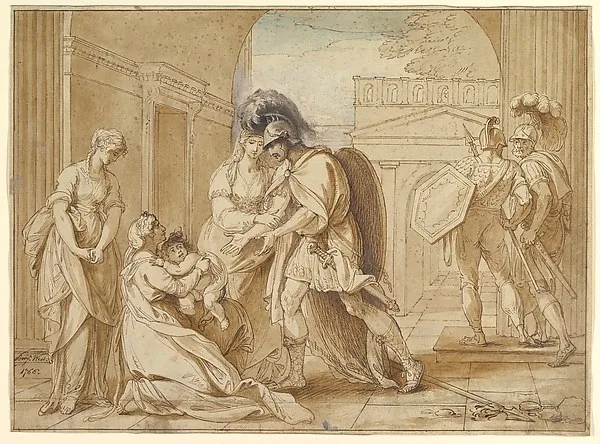
The little Astyanax was horrified to see his father's helmet and horsehair crest, so Hector took it off and took the child up again. This action temporarily separates the identity of the warrior and the father: the equipment that scares the enemy can also make his own child fail to recognize a familiar person. The epic does not represent this moment through grand battle, but rather allows majesty to give way to gentle physical movements. It allows the reader to see the person behind the armor, while also feeling that such short-lived family security is difficult to maintain.
A prayer and the future known to readers
Hector prayed for outstanding strength and glory for his son, hoping that he would one day surpass himself. However, the readers gradually learn that the hero defending the city is going to die, and the future of his wife and child is also threatened by the war. Andromache in Volume 22 is still busy indoors, and her husband's death will not be immediately reported in a way that she can control. The distance between the two volumes makes the earlier prayers sting all the more: the language of love proposes possible futures, and the war shrinks the space within which that future can be realized.
Emotional choices for farewell paintings
The farewell paintings of later generations usually organize the couple and their child into a tight group of characters, so that the outstretched hands, looking back gestures and weapons create conflicts. They rearrange the scene according to the epic and can express the fleeting rather than static family affection in the poem. There is no need to view Andromache's persuasion as cowardice; her judgment comes from the experience of losing a family member. This story allows the hero's responsibility to be tested from a family perspective, and allows bravery and sadness to simultaneously become the entrance to our understanding of the characters.