An old woman agrees to care for a stranger
In Odyssey 19, Penelope offers the apparently foreign beggar the care due to a guest. Odysseus refuses to have the younger women wash his feet and accepts an older woman accustomed to suffering. Penelope summons Eurycleia, who received him at birth and nursed him as an infant. She mourns her absent master while speaking kindly to the stranger before her. This matters: she does not first demand proof of an important name before agreeing to help. She also notices that his appearance, voice, and feet resemble Odysseus’. The scene begins with resemblance rather than certainty. Washing requires a closer encounter than conversation across a room, and a form of knowledge created by years of care is about to defeat a disguise designed for looking eyes.
A wound carries an earlier story
Odysseus turns away from the firelight, fearing that Eurycleia will discover his scar. Darkness cannot prevent her hands from finding it. The poem then pauses the washing to tell how the wound was made on a boar hunt on Parnassus with the sons of his maternal grandfather Autolycus. The young Odysseus attacks with a spear; the boar wounds him above the knee, and he kills it. His companions bind the injury and stop the bleeding with an incantation. Once healed, he returns home, where his parents ask about the mark. This is neither a Trojan battle wound nor a magical guarantee of invulnerability. The scar connects the returned traveler to a life before the long absence, through a particular injured and tended body.
The basin interrupts the disguise
Back at the basin, Eurycleia recognizes the leg in her hands and drops the foot. It strikes the vessel; the basin rings, overturns, and spills its water. The sound makes recognition an interruption in ordinary work, not simply a declaration of a correct answer. Joy and grief fill her eyes as she addresses the man she nursed. She looks towards Penelope, wanting to share what she knows, but Athena directs Penelope’s attention elsewhere. Knowledge remains unevenly distributed inside one room. Readers know more than Penelope at this moment, yet the older woman’s discovery threatens the plan of the man they have followed home. The poem asks us to remain with that uncomfortable overlap between a welcome reunion and an unwelcome disclosure.
Silence is demanded through force
Odysseus takes Eurycleia by the throat, draws her close, and orders her to tell nobody. He threatens not to spare even his own nurse if she exposes him and he later kills the women of the household. His need for secrecy explains his fear; it does not remove the force or the threatened killing from the scene. Eurycleia answers that she will be as firm as stone or iron. Her loyalty has a voice of its own, but she has just spoken under a master’s threat. Both facts belong in the reading. She offers to identify the women who have remained loyal and those who have not; he says he can judge them himself. Recognizing someone does not give her equal control over what follows.
The work resumes after recognition
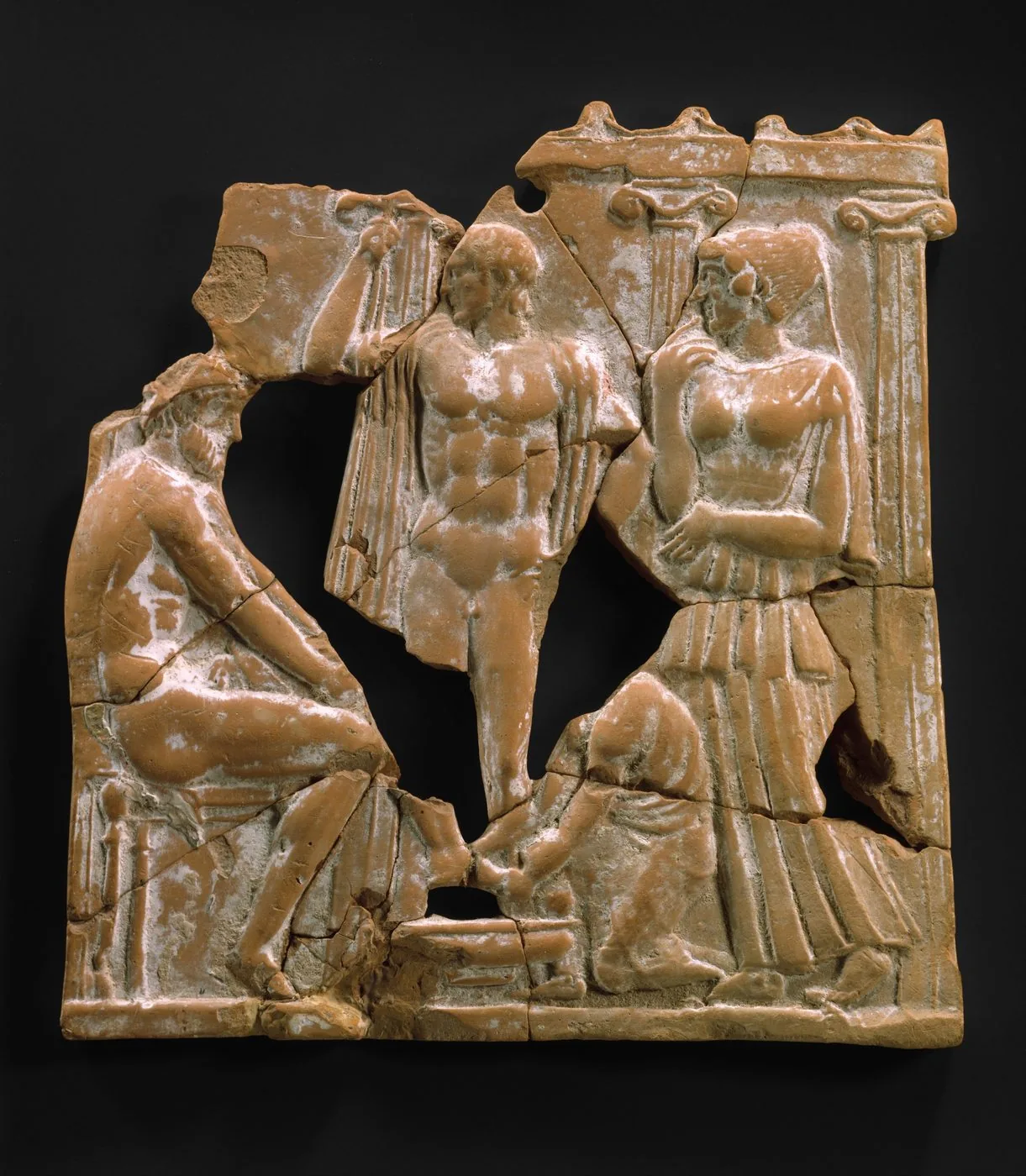
Eurycleia fetches fresh water, completes the washing, and anoints him with oil. Odysseus covers the scar again, and conversation continues. The labor that disclosed the truth must also restore the scene that conceals it. A Melian terracotta plaque in the Metropolitan Museum, dated about 450 BCE, chooses this footwashing as its subject. Its compact composition places the kneeling nurse with Odysseus, Penelope, and Telemachus before a palace facade. Art gathers figures into a readable image; it need not reproduce the poem’s precise staging or each person’s awareness. Looking at the small act of care can redirect attention from the hero’s weapons to the people who sustain his household. This recognition preserves an old bond, while the hand at the throat prevents that bond from becoming an uncomplicated picture of affection.