The hosts who were already friends
In the first book of the Argonautica, Cyzicus receives Jason and his companions among the Doliones. He supplies food and wine and shares information useful to their voyage. Apollonius presents him as a young ruler recently married to Cleite, so the meeting begins with the promise of an ordinary future rather than a hostile challenge. Apollodorus preserves the same essential welcome in a shorter form. Neither account requires readers to imagine a secret betrayal by the king. Establishing his friendliness is the foundation of the tragedy: the people who later fight have already shown that they can meet as guests and hosts.
Two encounters that should stay separate
Apollonius also describes the six-armed Earthborn who threaten the ship in this region. Their assault and the heroes’ resistance belong to a separate encounter. They should not be confused with the Doliones, whose king has offered hospitality. The distinction prevents the later battle from looking like another straightforward victory over monsters. Place names and rapid movement can make these episodes blur in a brief retelling, but the poem gives them different moral shapes. One involves a recognizable attack; the other involves a failure to recognize friends. Keeping the groups distinct restores the discomfort that a simple list of heroic achievements would conceal.
A return nobody recognizes
After the Argonauts depart, contrary winds bring them back during the night. The crew does not identify the place clearly, and the Doliones mistake the arrivals for hostile Pelasgians. Both sides act without the knowledge that would have stopped the fighting. Jason kills Cyzicus in the clash. Apollodorus likewise makes darkness and mistaken identity central to the disaster. The scene does not depend on the king withdrawing his welcome or on Jason deliberately attacking his benefactor. Its force comes from a much narrower gap between action and understanding: weapons are used before the earlier relationship can be recognized and named.
What morning changes
Daylight reveals the dead king and makes the error visible to both communities. In Apollonius, the Argonauts and Doliones mourn together for three days, and funeral rites and games follow. The poem also describes the loss suffered by Cleite and connects local remembrance with landscape and ritual. These details turn attention away from the fighters’ prowess toward the people left to live with the consequences. Recognition cannot reverse the night. It changes what the survivors owe one another. Mourning becomes part of the voyage’s record, rather than a short interruption that can be removed to keep the heroes’ progress triumphant.
A voyage marked by responsibility
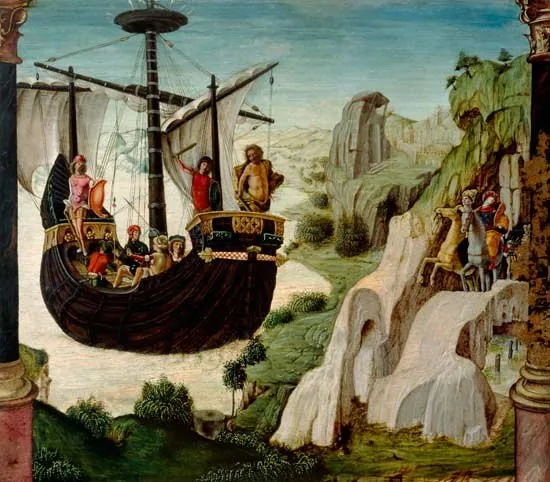
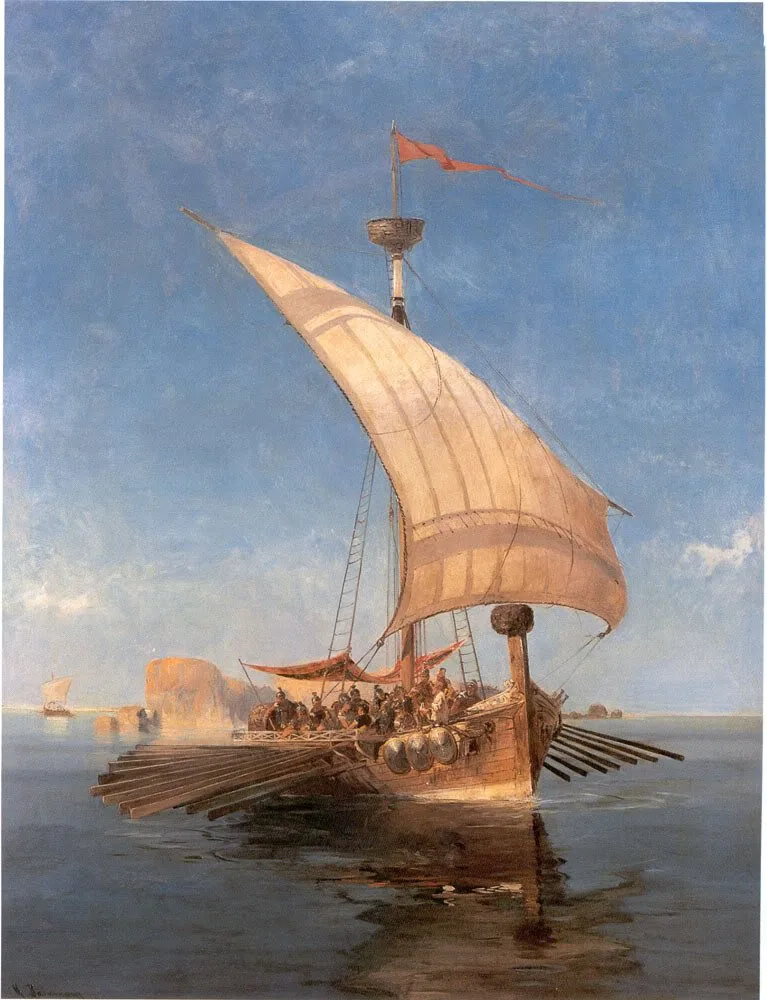
Apollonius develops the shared grief at length; Apollodorus gives a compact sequence of welcome, return, battle, and burial. Reading both makes the episode’s structure especially clear without pretending that their levels of detail are identical. The painting of the Argo accompanying this article evokes the travelling ship, not a documented depiction of the nighttime battle. Follow the story alongside other Argonautic encounters to see how varied the journey’s dangers are. Here the decisive threat is neither an enormous creature nor an impossible task. It is the speed with which uncertain perception becomes violence, and the lasting responsibility that remains after the mistake is understood.