A place already cherished
Callimachus' Hymn to Demeter first presents a dense grove with clear water. The goddess loves it, and nymphs gather beside its tall poplar. Erysichthon arrives with armed attendants to turn trees into a banqueting hall. Ovid's Metamorphoses 8 instead centers the attack on an ancient oak carrying votive gifts. These are different trees in different texts, not interchangeable pieces of evidence from one account.
Both poets give the grove relationships before the cutting begins. It already offers a dwelling, meeting place, or memory of gratitude; it does not acquire a purpose only when someone wants timber. Reading in that order makes the question larger than the damage an axe can do. Who assumes his own project cancels the connections others have already made with a place? That failure to see relationships begins the tension.
A warning offers the chance to stop
In Callimachus, Demeter takes the priestess Nicippe's appearance and urges the young man to spare the sanctuary. He threatens her with his axe and explains his plan to feast his companions. Revealing herself, the goddess spares the attendants because their master compelled them. The poem does not give everyone standing by the tree equal responsibility: giving an order differs from obeying under force.
Ovid instead has an attendant try to stop the felling; Erysichthon turns his axe on him and kills him. A nymph within the tree also speaks, predicting punishment. Refusal of limits becomes both violence against a person and destruction of a tree. Both accounts place warnings before disaster, but arrange different speakers, victims, and power relations. Keeping those differences shows where each poet locates a choice.
No amount of food can complete the feast
Callimachus gives him hunger that eating cannot satisfy. His parents invent journeys and injuries to decline invitations to games and weddings on his behalf. The man who wanted to entertain companions now eats continuously alone. Household stores and livestock disappear, yet ordinary shared banqueting remains impossible. The punishment changes more than his appetite: it also changes his ability to take part in other people's lives.
The irony is precise: planning more feasts destroys the possibility of attending one. Quantities of food cannot replace a lost sense of measure, and family concealment cannot restore relationships. We need not apply this mythical hunger to real people facing food shortages or illness. The poem constructs a particular divine punishment; it does not establish that actual deprivation always results from the sufferer's wrongdoing.
Ovid makes Hunger a visiting power
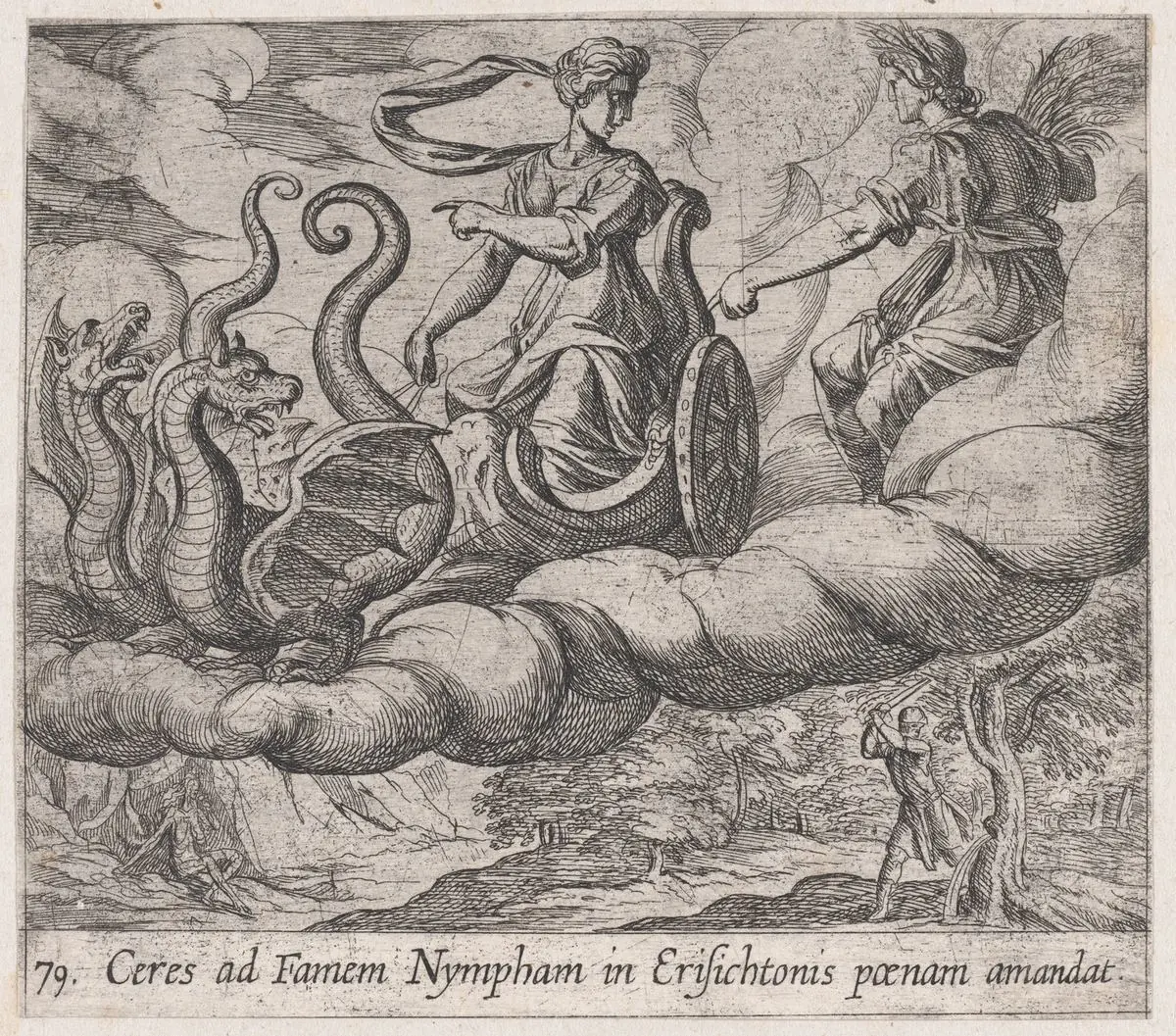
Metamorphoses personifies Hunger. Abundant Ceres, Demeter's Roman counterpart, cannot meet her directly and sends a messenger with instructions. Hunger enters Erysichthon's body while he sleeps; food thereafter only increases desire. This strange visit separates the power sustaining life from the power preventing satisfaction, then brings them into conflict within one person. Feeding no longer leads toward the ordinary end of being fed.
After his property is consumed, Ovid also has the father sell his daughter Mestra. Neptune helps her escape through transformation, but her father exploits that ability to sell her repeatedly for food. Finally Erysichthon begins consuming his own body. This belongs to Ovid's telling. A daughter's power to escape does not make her father stop treating her as a resource: possibility and continuing exploitation coexist.
Two endings, two distances from the damage
Callimachus ends with Erysichthon begging for scraps at a crossroads, without repeated sales of a daughter or self-consumption in this hymn. Ovid carries destruction inside the body; Callimachus places a formerly wealthy prince on a public road. Attaching Mestra's story directly to the hymn erases this choice of ending. One exposes a lost place in communal life; the other turns endless consumption against its consumer.
Both make the original grove matter again. A boundary can protect lives and connections not yet acknowledged. Today, a modest question can guide our reading: before deciding something is available for our use, have we asked who depends on it, who cares for it, and who bears its loss? This is not a modern management rule supplied by myth, but a judgment the texts encourage us to slow down.