The Prophecy About Metis
"Theogony" writes that Zeus's earliest wife Metis was good at strategy. She would give birth to Athena and possibly later sons who would rule the gods. Gaia and Uranus warned Zeus, and the new king swallowed the pregnant Metis. This recalls Cronus swallowing his children: those in power are still trying to control the next generation. However, the thinking that Metis represents is not simply eliminated. The poem says that she will distinguish good from bad within Zeus.
The birth scene also distinguishes Athena from other newborn gods: she appears with an already identifiable function, and the audience does not have to wait for her to grow up to know that she is connected to power and wisdom. Zeus's acceptance of his daughter is in contrast to the previous two generations of fathers' actions of suppressing their children. But the fact that the mother was swallowed remains, and the new order does not get rid of all control and exclusion.
A New Life from Zeus’s Head
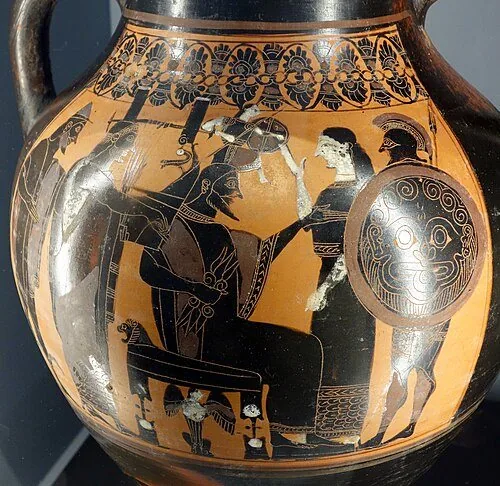
Athena was finally born from the head of Zeus. Homeric Hymn 28 depicts the goddess leaping out in shining armor. The gods are shocked, and the mountains, seas and sky tremble; after she takes off her armor, Zeus is delighted. This short poem focuses on the goddess’s appearance, without specifying who wields the axe. Pseudo-Apollodorus records that Prometheus or Hephaestus helped split the skull. Therefore, the axe-wielding figure on the vase painting is a choice based on textual tradition, and it cannot be inferred that all poems say that the same god took action.
The Body as a Metaphor for Power
Athena not only inherited her mother's strategy, but also appeared in the most thoughtful part of her father's body, so wisdom, war and royal power were closely linked. She is not an infant still to be raised; ancient art often had her emerging above Zeus’s head as a reduced, armed adult for quick identification by the viewer. This composition expresses the goddess’s powers and is not a medical description of birth. You should also keep in mind the swallowed Metis when reading: she does not stand in the center of the most striking image, but she is an important source of wisdom and inheritance crisis in the story.