The nymph who was deprived of the ability to speak
The third volume of Ovid's "Metamorphoses" says that Echo once delayed Juno with a long conversation, giving other nymphs a chance to leave Jupiter's side. The goddess punished her by only allowing her to repeat the end of other people's words and not initiate a conversation. Echo fell in love with Narcissus and hid in the woods waiting for him to speak first, but the repeated sentences had another meaning. The voice remains, but the ability to express one's wishes is limited; her dilemma is not just that she cannot speak loudly enough, but that she remains dependent on the other person to provide the initial words. This setting makes the same words have different meanings between the two people, and also makes it extremely difficult to get close.
The reflection cannot give a real response
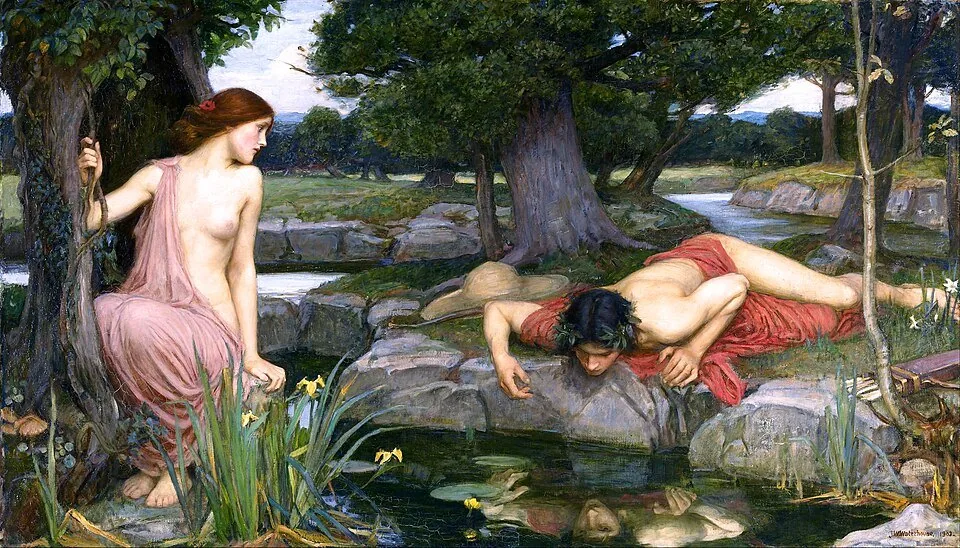
The young man rejected Echo, and she gradually became thinner, until only her voice was left to answer in the valley. Another person whom he rejected asked him to taste what it was like not to have what he loved. Narcissus then saw his own image on the water's edge and mistakenly thought it was an object that could be embraced. Every time he got close, the water surface was disturbed and the image disappeared. The poem later made him recognize that it was himself, and he still couldn't leave. Therefore, the story cannot be summarized with "He is born to love himself very much": the misrecognition happened first, and the wish did not end immediately after realizing the truth. The reflection simultaneously responds to his movements and rejects his touch, making visual congruence an ineradicable barrier to physical distance.
The flowers left behind and the voice that continues to respond
After Narcissus died, people searched for his body and found a flower; Echo still repeated his last lament. Ovid arranges two changes in the same paragraph: a voice remains without a body, while a body is replaced by a flower. Therefore, the two failures have different forms. Later paintings often have the young man leaning over the water, placing Echo on the edge of the woods where it is difficult to notice; if only the reflection is cropped out of the larger scene, the silent bystander in the story will be omitted again. This article uses Ovid's combined narrative of the two characters and does not treat the terminology used by modern psychology as diagnostic of ancient figures. We can think about whether a relationship really responds, but we should remember the specific limitations of the poem: Echo has no beginning, Narcissus has no other person that he can touch, and both lose the distance they need to continue living in the face of what seems to be a response.