From the games to a story of brothers
Castor and Polydeuces are often called the Dioscuri; the latter is also familiar by his Roman name, Pollux. Pindar's Nemean 10 does not begin with their childhood. It celebrates Argos, the victorious athlete Theaeus and his family. The poet says the twins once received hospitality from an ancestor of that household, and associates them with Hermes and Heracles as helpers in athletic contests. Their story therefore emerges from a remembered welcome between humans and gods. This opening matters. It prevents the choice that follows from becoming a detached slogan about friendship. A poem sung for a particular victory and community is considering how divine favour, trustworthy relationships and a willingness to share the burdens of life belong together. The brothers' bond comes into view through those wider connections.
The cattle dispute leaves no innocent blank
Pindar traces the disaster to a quarrel about cattle. Idas grievously wounds Castor with a bronze spear, after sharp-sighted Lynceus has spotted the brothers hiding beneath a tree from Mount Taygetus. Polydeuces pursues the attackers to their father Aphareus's tomb. They throw its stone at him; he strikes Lynceus with his spear, while Zeus fells Idas with a thunderbolt. The poem does not wash all this violence into uncomplicated brotherly tenderness. Cattle, concealment, a grave and vengeance surround the grief with struggles that helped produce it. Theocritus later organizes the conflict differently; the works should not be combined into successive rounds of one fight. Respecting Pindar's chosen details makes it possible to see that the brothers' love does not exempt every action they take from questioning.
Zeus offers no resurrection without a cost
Returning to his brother, Polydeuces finds Castor still struggling for breath. He asks Zeus to let him die too, unwilling to regard a life stripped of those close to him as complete honour. Zeus explains their unequal circumstances: Polydeuces is his own son, but Castor has a mortal father. He then offers a choice. Polydeuces may escape old age and death and live on Olympus alone, or divide everything he possesses equally with his brother, spending half his time below earth and half in the golden heavens. Death is not removed from the universe; a privilege that could have been enjoyed alone becomes a shared arrangement. Polydeuces chooses without hesitation. Zeus then opens Castor's eyes and restores his voice. The transformation ends in a body able to see and answer again.
Homer preserves a different brief account
In Odyssey 11, Odysseus sees Leda, whom the poem says bore horse-taming Castor and the boxer Polydeuces to Tyndareus. Earth covers the brothers, yet they remain alive and honoured by Zeus, passing through alternating days of life and death. These few lines do not reenact Pindar's cattle quarrel, revelation of paternity or conversation about a choice. They also place both sons within Tyndareus's fatherhood. We should not silently replace Homer's words with Pindar's to create a tidy family tree. Pindar explicitly gives the brothers a common change of dwelling between Zeus and the depths of Therapnae, explaining why Polydeuces accepts it. A similar alternation of life and death appears in one source as divine honour received, and in another as a decision involving a cost.
Sharing changes the shape of privilege
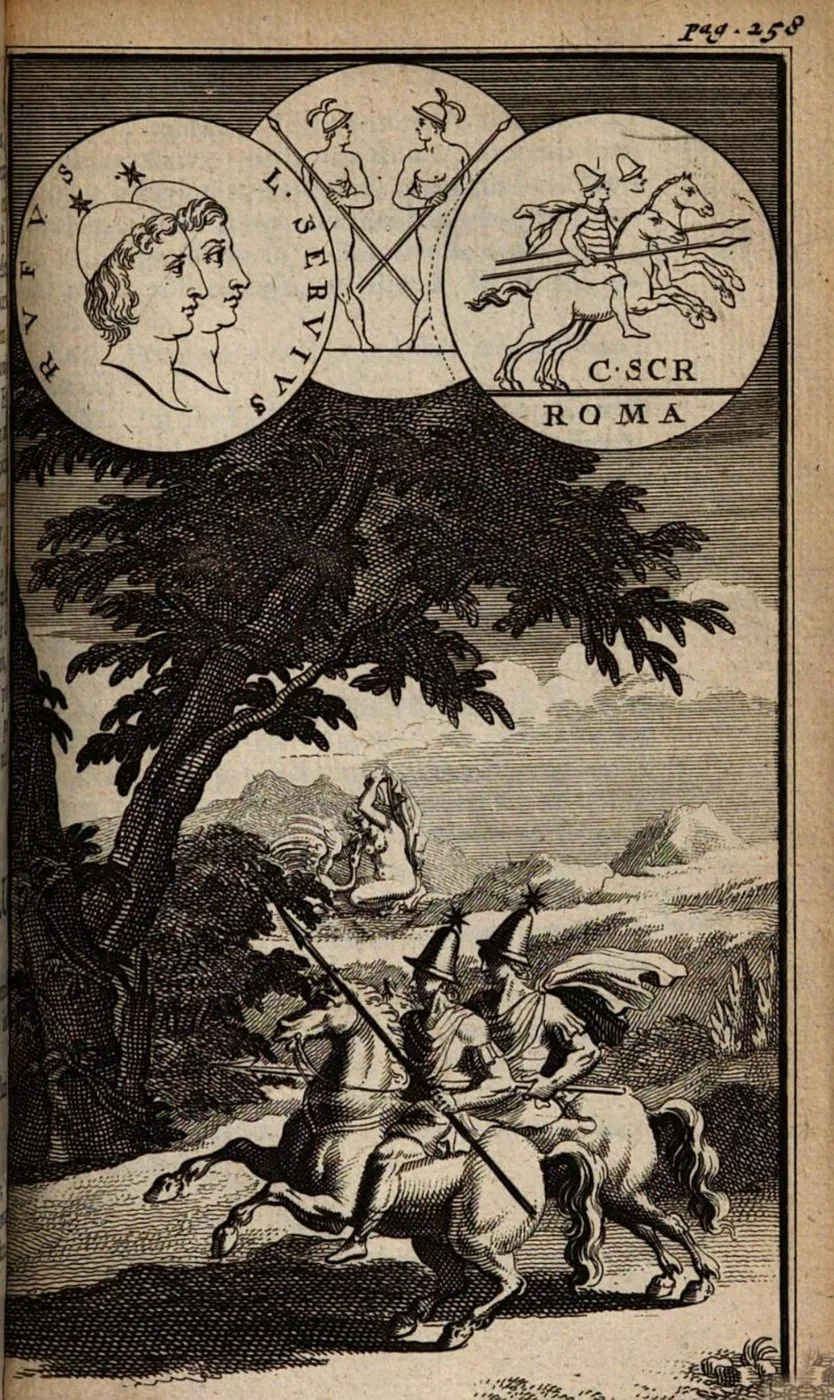
Neither account needs to become a command that everyone must sacrifice themselves for relatives. Mortal readers have none of Zeus's options, and mythical immortality cannot simply become an equation for real obligations. Pindar nevertheless makes a question visible: if the finest life can only be enjoyed alone, is it still the life one wants? Polydeuces does not ask that his brother remain a permanently dependent rescued person. He accepts shared time, including its underground half. The mounted twins and coin designs in the accompanying 1697 engraving are later representations, not an ancient record of this conversation. Keeping image and text distinct leaves room for the quieter miracle at the ending. The story offers more than distant stars: someone approaching silence regains eyes and a voice with which to answer his brother.