A stranger returns to his own city
Euripides’ tragedy Bacchae opens with Dionysus arriving in Thebes in the guise of a stranger. He intends to restore the honor of his mother Semele and demands that the city recognize his divinity. The young king Pentheus sees the new rites as a threat to order and commands the arrest of the worshippers and the stranger. The elderly Cadmus and the prophet Tiresias urge caution, but he persists in trying to control change through commands. The audience knows that the prisoner is a god; the king does not. This gap in knowledge sustains the approaching crisis.
At first Pentheus wants to find out whether the worshippers are breaking his rules; later he becomes obsessed with securing a secret vantage point. Watching shifts from a means of governing to a temptation, and a king becomes a disguised voyeur. The stage lets the audience watch his transformation step by step without being able to prevent its outcome. This distance makes the play’s mistaken recognition disturbing and asks spectators to examine their own judgment.
The sight he seeks transforms him
Dionysus guides Pentheus toward the mountains to spy on the women who worship him and has him dress in women’s clothes to avoid detection. The king becomes increasingly willing to obey the stranger he once despised, and even begins seeing double. He is placed in a tree, believing he has an ideal vantage point. Dionysus then draws the worshippers’ attention to him. In their frenzy, his mother Agave and her companions mistake him for a wild beast and tear him apart. She carries his head back to the city, still believing she has accomplished a magnificent hunt.
Awakening does not restore the past
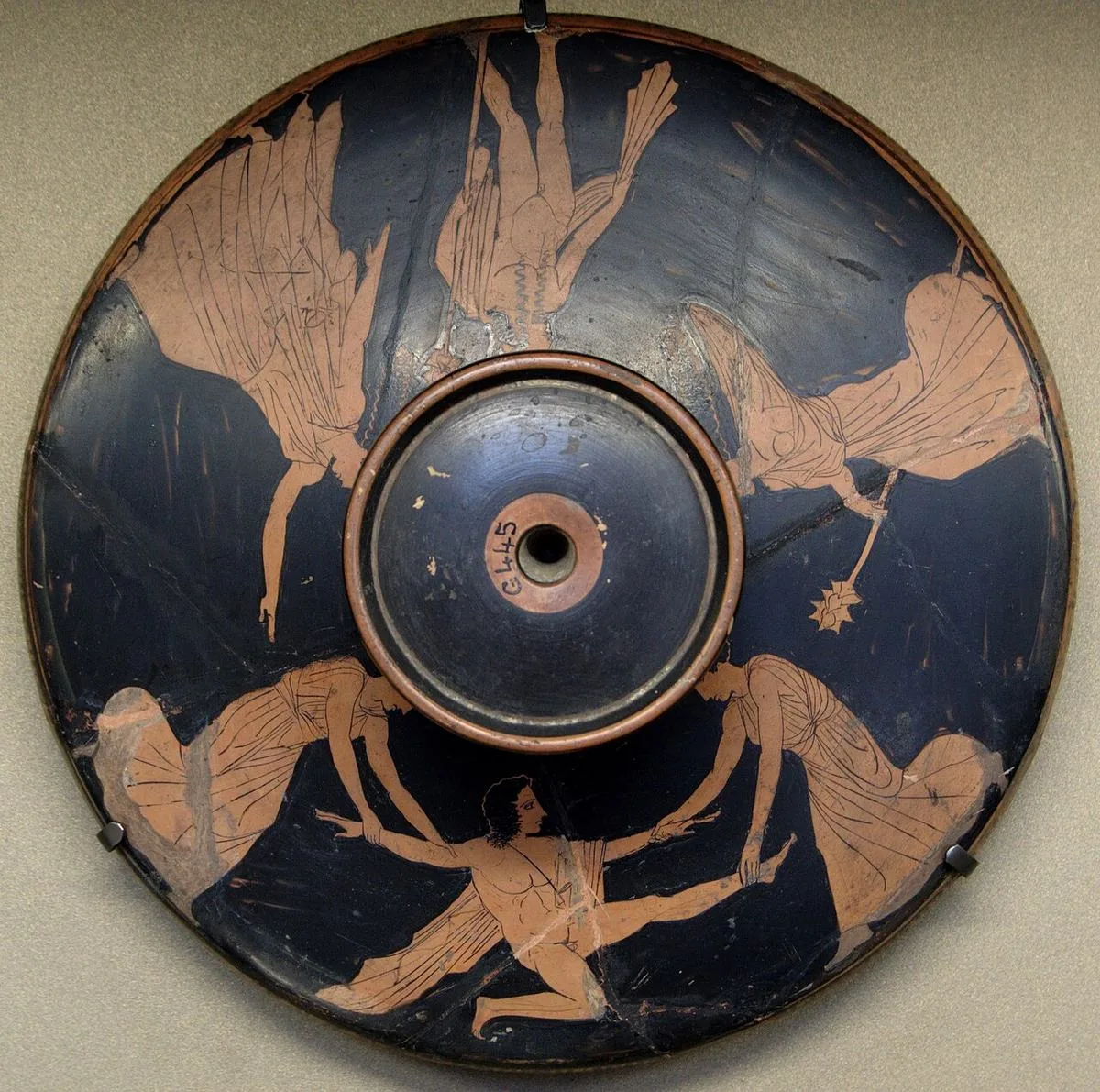
While gathering the remains, Cadmus asks his daughter to identify slowly what she is holding. Only as Agave returns to her senses does she realize that the trophy she celebrates is her own son. The play does not reduce this discovery to a simple verdict of good or evil: Pentheus’ refusal, divine manipulation, the worshippers’ loss of recognition, and the family’s exile are intertwined. This article follows only Euripides’ stage version. The women surrounding Pentheus on the cup’s lid offer another visual interpretation; the image alone cannot reconstruct his inducement to disguise himself or the gradual return to awareness.