First meet the living stag
Book 10 of Ovid’s Metamorphoses first lets us meet a stag that is still alive. Sacred to the nymphs of the Carthaean countryside, it has shining antlers and ornaments around its neck and ears. More importantly, it no longer fears people: even a stranger can stroke its neck. Cyparissus particularly loves it. He leads it to fresh grazing and clear springs, weaves garlands for its horns, and sometimes rides on its back, guiding it with purple reins. The animal does not begin as a mere instrument of tragedy. Repeated acts of companionship establish a daily rhythm before the poem takes that rhythm away.
An accident at summer noon
At the height of a hot summer day, the stag rests on the grass beneath woodland shade. A javelin thrown by Cyparissus pierces it. Ovid explicitly presents this as an accident. Seeing his beloved animal dying, the boy cannot bear what has happened and wants to die himself. We should not supply an episode in which a jealous Apollo guides the weapon, or claim that the boy intentionally kills the stag to prove his courage. Responsibility and malice are different here. He has caused an irreversible injury, but did not act with the purpose of killing his companion. The distinction leaves remorse intact without turning the incident into deliberate cruelty.
A god’s comfort cannot command grief away
Apollo tries to comfort him and urges a measure of grief proportionate to its cause. The boy does not immediately become calm because a deity has spoken. He continues to ask the gods for the ability to mourn forever. Their assessments of pain differ: the comforter proposes a limit, while the bereaved cannot make that limit appear by obeying an instruction. Apollo’s speech need not become a universal answer for every grieving reader. Nor should the boy’s wish become a prescription for anyone’s life. The story makes the limits of consolation visible, rather than establishing that someone deserves blame because their sadness has lasted too long.
What the tree preserves
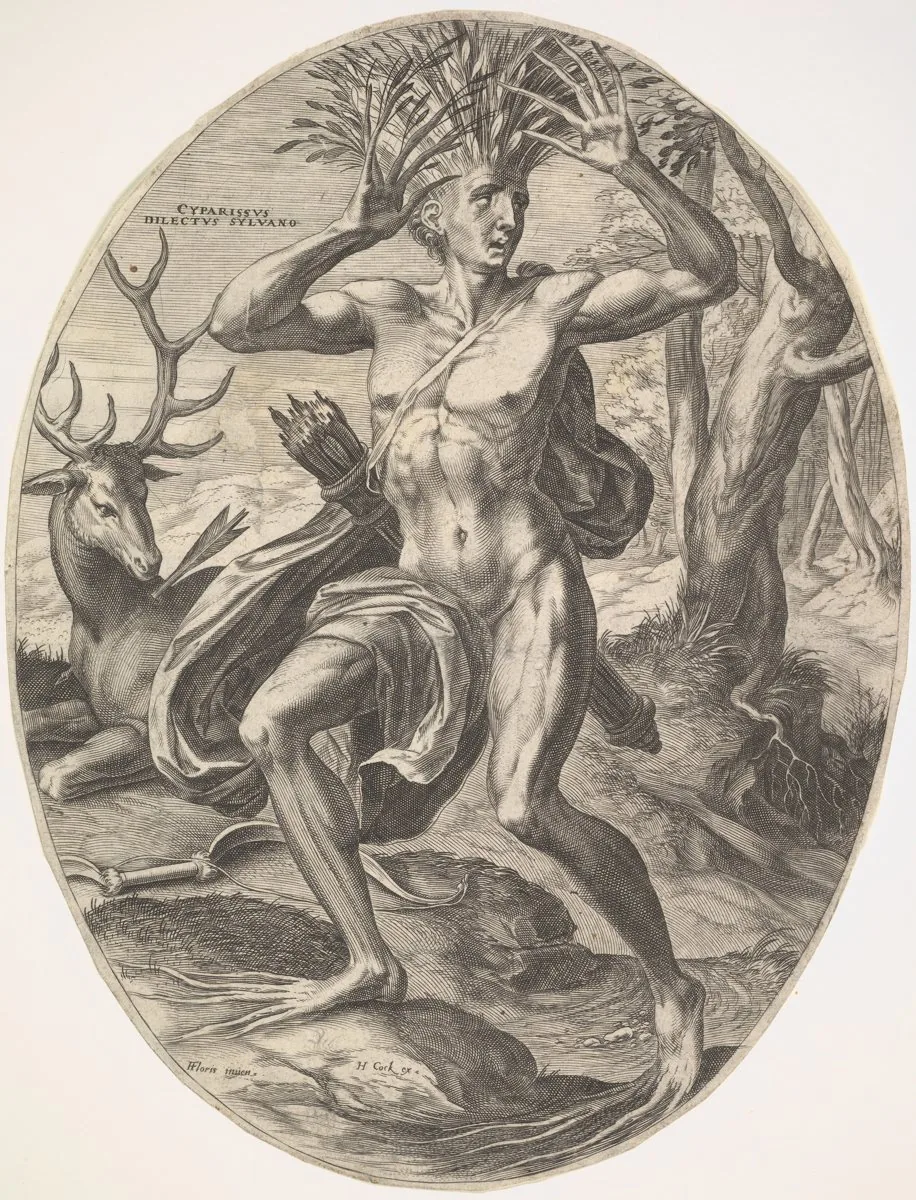
Weeping exhausts his strength. His limbs turn green, his hair becomes an upright crown, and the slender treetop points toward the sky. Apollo himself laments and assigns the tree a lasting association with mourning. This transformation neither revives the stag nor restores the boy’s former life. It gives continuing grief a shape that other people can see. Ovid places the episode among trees gathering in response to Orpheus’ music. A tree therefore enters the poem both as part of a wood and as the bearer of earlier relationships. Its shade comes from foliage, but the reader also encounters the loss that the narrative has taught us to remember.
Images need not preserve the same tradition
A sixteenth-century engraving by Cornelis Cort after Frans Floris also depicts Cyparissus in The Rural Gods series. The Musea Brugge catalogue notes that its inscription connects him with Silvanus; that name should not quietly be replaced with Apollo. Our illustration belongs to this same engraved design tradition, while the reading chiefly follows Ovid. Preserving the difference avoids claiming that ancient stories and later pictures all support a single account. A cypress may lead us toward mourning, but it is not historical proof that each real tree was once a boy. The myth offers a way to consider trees and memory together, rather than a simple explanation for every bereavement.