A mourner leaves his kingdom
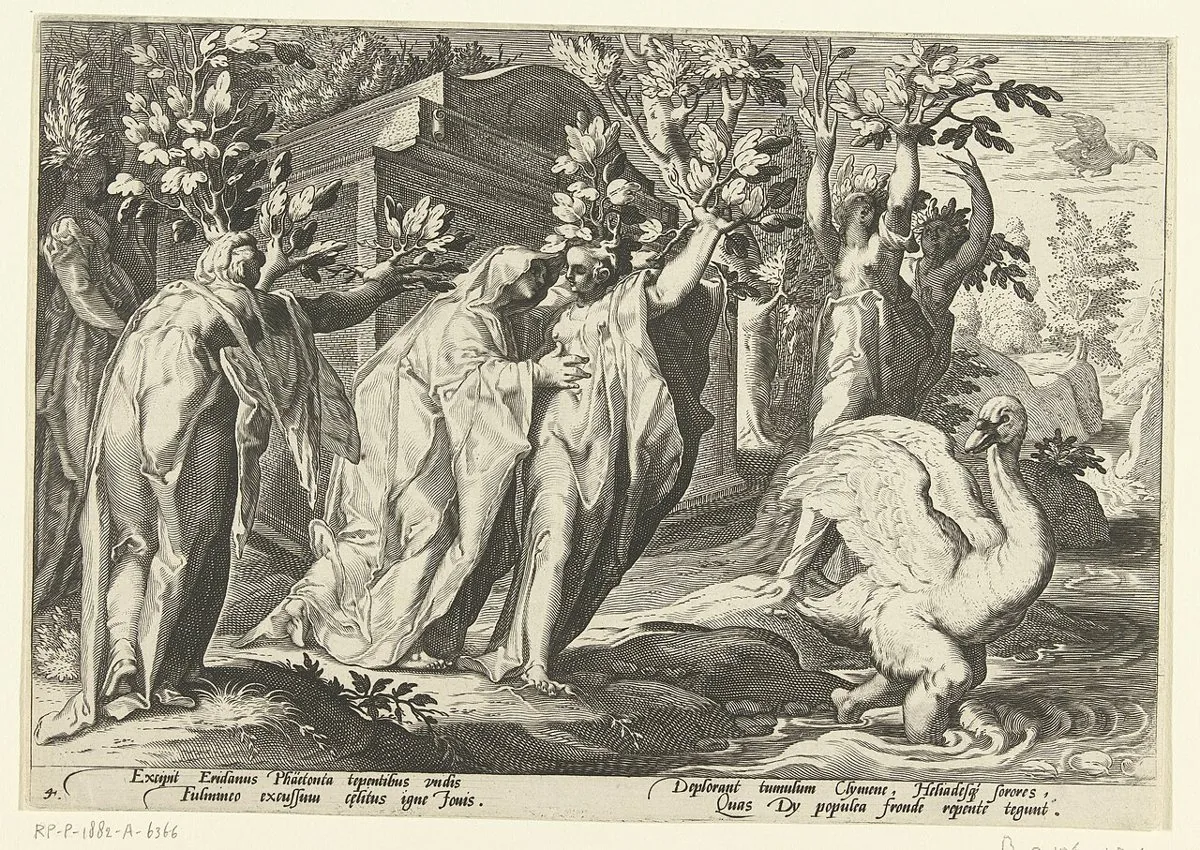
Book 2 of Ovid's Metamorphoses follows the death of Phaethon beyond the fallen chariot. Among those who grieve is Cygnus, son of Sthenelus, connected to Phaethon through his mother's family and through affection. He leaves the cities of his Ligurian kingdom and comes to the river Eridanus, where the dead youth's sisters have become trees. His place in the story is not that of another person who tried to drive the sun. He is someone whose life is redirected by a death he did not cause. The poem makes room for that altered life after the spectacular disaster itself has ended.
A voice changes before our eyes
As Cygnus laments, his voice becomes thin, feathers cover his hair, and his neck lengthens. His feet acquire membranes, his sides become wings, and his mouth becomes a beak. The description unfolds gradually rather than announcing a finished swan without transition. Each changing feature links the bird with a body the reader has just imagined as human. The new form does not erase the movement of mourning that began the passage. Instead, the visible transformation gives continuing grief a different shape. The resulting bird remains connected to an earlier relationship, rather than appearing as an unrelated ornament beside the river.
The sky no longer feels safe
Ovid gives the swan a reason for keeping near lakes, pools, and streams. Cygnus remembers the fire and Jupiter's thunderbolt; he distrusts the sky and seeks waters that oppose the heat he fears. The ability to fly therefore does not become a simple promise of liberation. His new wings coexist with a memory that makes their element frightening. The passage presents the lightning through the mourner's sense of its injustice, not as a settled judgement every character must share. Phaethon's death stopped a catastrophe, yet the act that protected the wider world remains unbearable when remembered from the side of someone who loved him.
Pausanias accepts only part
In Description of Greece 1.30.3, Pausanias discusses a swan near his account of Plato's monument and a dream attributed to Socrates. He connects the bird's musical reputation with a musician who became king of the Ligurians and was said to become a swan after death through Apollo's will. Pausanias accepts that a musician could become king, but explicitly refuses to believe a bird grew from a man. His account is not Ovid's exact scene of living grief beside Eridanus. It also shows an ancient reader separating a plausible human story from a transformation he considers incredible, without rejecting everything around it.
Keeping the two readings open
These accounts need not be combined into one sequence in which Apollo explains every detail Ovid leaves unstated. Ovid attends to memory inhabiting a changed body; Pausanias attends to the credibility of what he has heard. One lets a bird's habits carry an emotional history, while the other preserves a limit to belief. Reading both offers more than a familiar image of beautiful swans. It asks what a story does with the lives left behind by disaster and how readers decide which parts to accept. Cygnus' waters hold a particular grief, even when another writer declines to accept the literal feathers.