A letter carrying murderous intent
Bellerophon comes to Proetus’ court seeking purification, but is falsely accused after rejecting the queen’s advances. Unwilling to kill a guest directly, the king gives him a letter containing deadly instructions to deliver to Iobates in Lycia. Book VI of the Iliad preserves this story in Glaucus’ account of his ancestors, emphasizing noble households, obligations of hospitality, and concealed murder. Bellerophon does not know that he carries the message ordering his death, and is welcomed as a guest upon arrival. A reception observing every courtesy turns into a series of nearly impossible tasks once the letter is read.
Fighting the Chimera from above
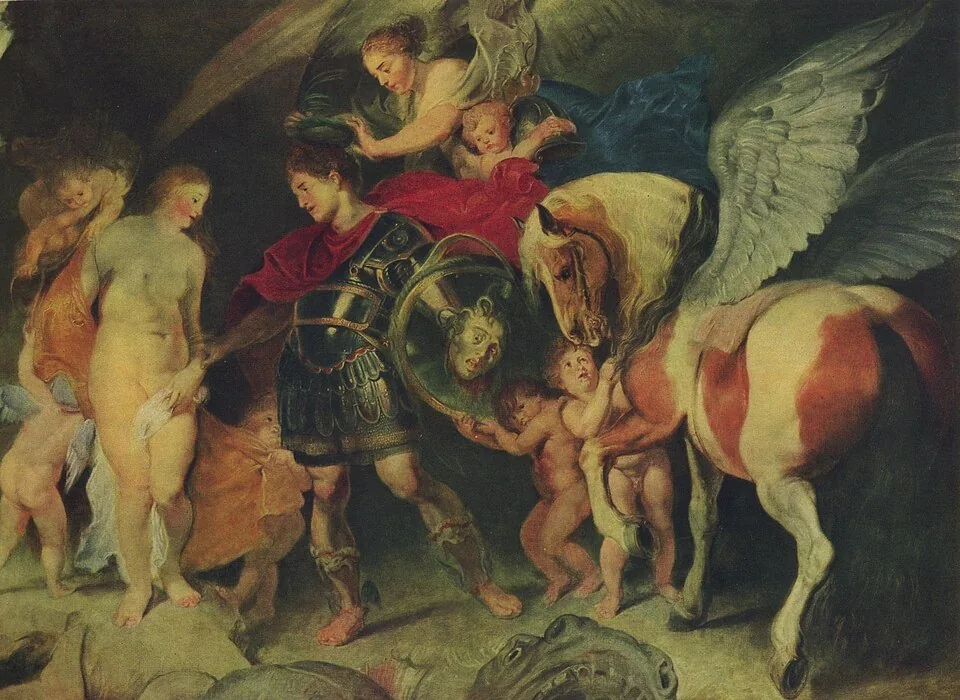
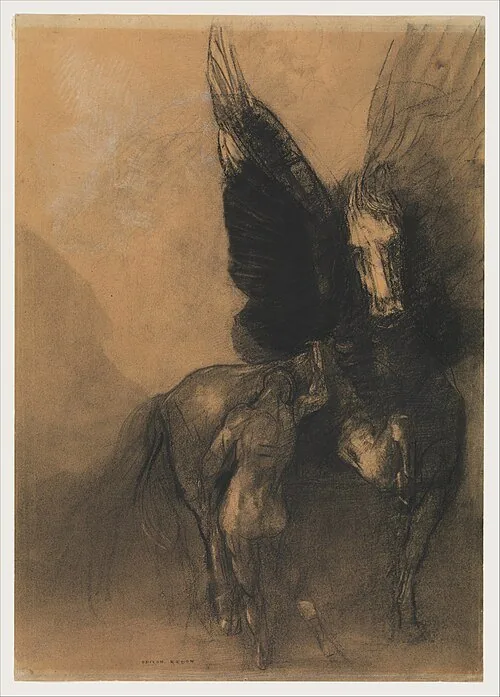
The Bibliotheca describes the Chimera as combining a lion, goat, and snake and breathing fire. Bellerophon rides Pegasus, the offspring of Medusa and Poseidon, to attack it from the air. Flight changes the distance of combat and gives him the advantage of avoiding the ground. The textual distinction matters: Homer recounts the killing of the Chimera but does not explicitly mention Pegasus in this episode, while later works develop the winged horse’s assistance more fully. A painting of a mounted hero fighting a fire-breathing monster can illustrate that fuller, later narrative, but should not be labeled as confirming every detail of Homer’s account.
A different loneliness after success
Victory does not bring immediate safety: the hero must also face the Solymi, the Amazons, and ambushes. Iobates eventually recognizes his ability and accepts him through marriage and a grant of territory. Homer’s account has the hero later hated by the gods and wandering alone; it does not tell a complete adventure of an attempted ascent to Olympus. Stories of a fall and transgression from other traditions can be read as a further stage, but cannot supply reasons that Homer leaves unstated. Bellerophon’s experience thus deserves attention along two lines: he resolves dangers through divinely granted abilities, while his social position still changes with the judgments of those in power. The image of flight is splendid, but the letter, obligations to guests, and final solitude give victory a more complicated tone.