The god's genealogy and the art of medicine
Asclepius is usually said to be the son of Apollo and Coronis, and was taught medicine by Chiron. The death of the mother and the rescue of the child were treated differently by ancient authors, and all the details cannot be pieced together into a single standard biography. Pindar's third Pythian Ode in particular connects superb healing powers with mortal limitations. The power of healing brings him closer to divine status, but it also raises questions about whether a person who can improve life thus gains the right to decide all life and death.
Resurrection touches the border
The myth says that he not only healed the sick, but also tried to raise the dead, so Zeus struck him down with a thunderbolt. Pindar's account also focuses on rewards and temptations, and other sources have different lists of the dead who were rescued. The point expressed in these versions cannot be reduced to the opposition of the gods to helping the sick, but rather to the conflict between healing, greed, and cosmic order. Human suffering requires rescue, and the inability to completely cancel death provides limits to the story. The two form a long-discussed tension in this god legend.
Waiting and Hope in the Sanctuary
In medical sanctuaries such as Epidaurus, seekers participated in rituals of purification, sacrifice, and sleeping in specific spaces, expecting instructions or healing in dreams. Records and votive offerings help us understand the ways in which ancient people sought help in the face of illness, but they do not serve as a basis for interpreting miracle stories as modern clinical evidence. The sanctuary is also a place where people gather, where memories of thanksgiving are preserved and where hopes are expressed. When introducing ancient religious practices, it is necessary to acknowledge the experience of the parties concerned and to distinguish the scope of what historical materials can prove.
Identify the snake-wrapped staff
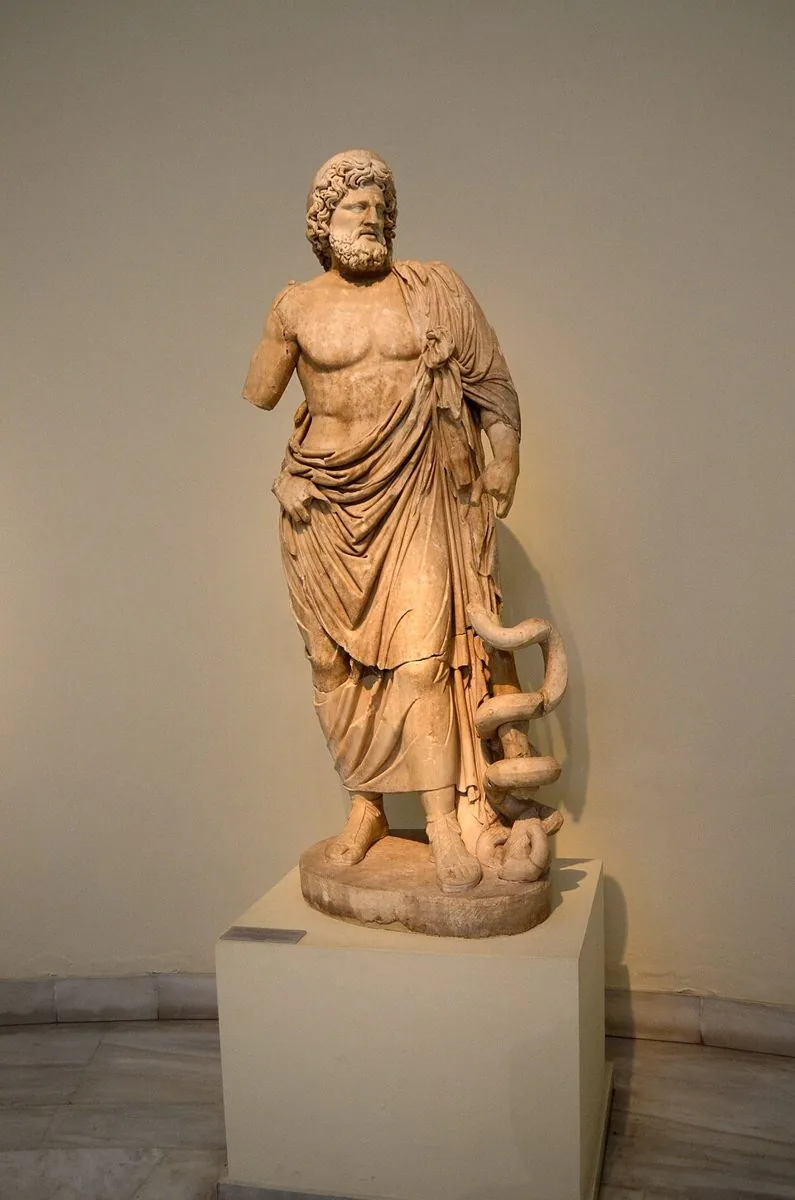
The common symbol of Asclepius is a snake-wrapped staff, which is different from the caduceus and wings common to Hermes. Ancient statues usually show mature, bearded men with this prop representing the god of medicine, and snakes are associated with sanctuary traditions. If photos of statues are used for illustrations, the age of ancient works and the permission of modern photographers should be distinguished. A hand-held object can help identify a god, but the appearance of a snake alone cannot determine that all artistic images are of the same person; the title, source, and overall posture need to be checked together.