The narrator raises her head from the spring
In Book 5 of Ovid’s Metamorphoses, Arethusa explains to Demeter why she became a spring. She raises her head from the water, arranges her wet hair and begins remembering. Notice the arrangement: she is not silent scenery introduced by her pursuer. She remembers hunting in Achaia, enjoying running and setting nets, and taking no pleasure in other people’s praise of her beauty. We therefore meet her earlier life before entering the chase. Beauty is neither an obligation to accept someone nor a reason to blame her for danger. What she wants and what another person wants upon seeing her should remain distinct questions in our reading.
Cool water suddenly asks a question
Returning from the woods one day, tired and hot, she finds a clear, gently flowing stream. First she tests it with her feet, then enters and swims. A voice sounds from below. The river god Alpheus asks where she is going. Frightened, she rushes ashore without retrieving the clothes left on the other bank. He follows and she keeps fleeing. The poem compares this pursuit to a hawk chasing a dove, rather than two people enjoying a race. Being able to run a long way does not mean being able to run without end. A shadow, footsteps and breath reaching her hair make speed a pressure experienced through the body.
A cloud hides her without ending the danger
Arethusa appeals to the goddess whose bow and arrows she has carried. Ovid uses the Roman name Diana, corresponding to Artemis. The goddess wraps her in a thick cloud. Alpheus circles it, searching and calling her name. Finding no departing footprints, he stays where he is. Concealment does not mean the pursuit has ended. Like a lamb hearing wolves outside its enclosure, she cannot move securely. Fear brings sweat from her body; drops gather into pools around her feet and drip from her hair. Then her whole body dissolves into flowing water. Her account makes us experience the transformation through fear, rather than seeing only an attractive moment suitable for decorating a fountain.
An underground route takes her somewhere else
Alpheus recognizes her altered water and returns to his river form, attempting to mingle his flow with hers. Artemis opens the ground, allowing Arethusa into underground caverns, from which she finally emerges on Ortygia. The first transformation is therefore no guarantee of permanent safety: the text immediately makes the pursuer recognize her. Rescue requires another route, not merely a different appearance. By the time she speaks to Demeter, her journey below the earth also enables her to convey information about Persephone. Someone who was pursued remains an active teller and messenger in the continuing narrative. The story does not simply stop treating her as a person once she becomes part of a landscape.
A fountain sculpture brings us back beside actual water
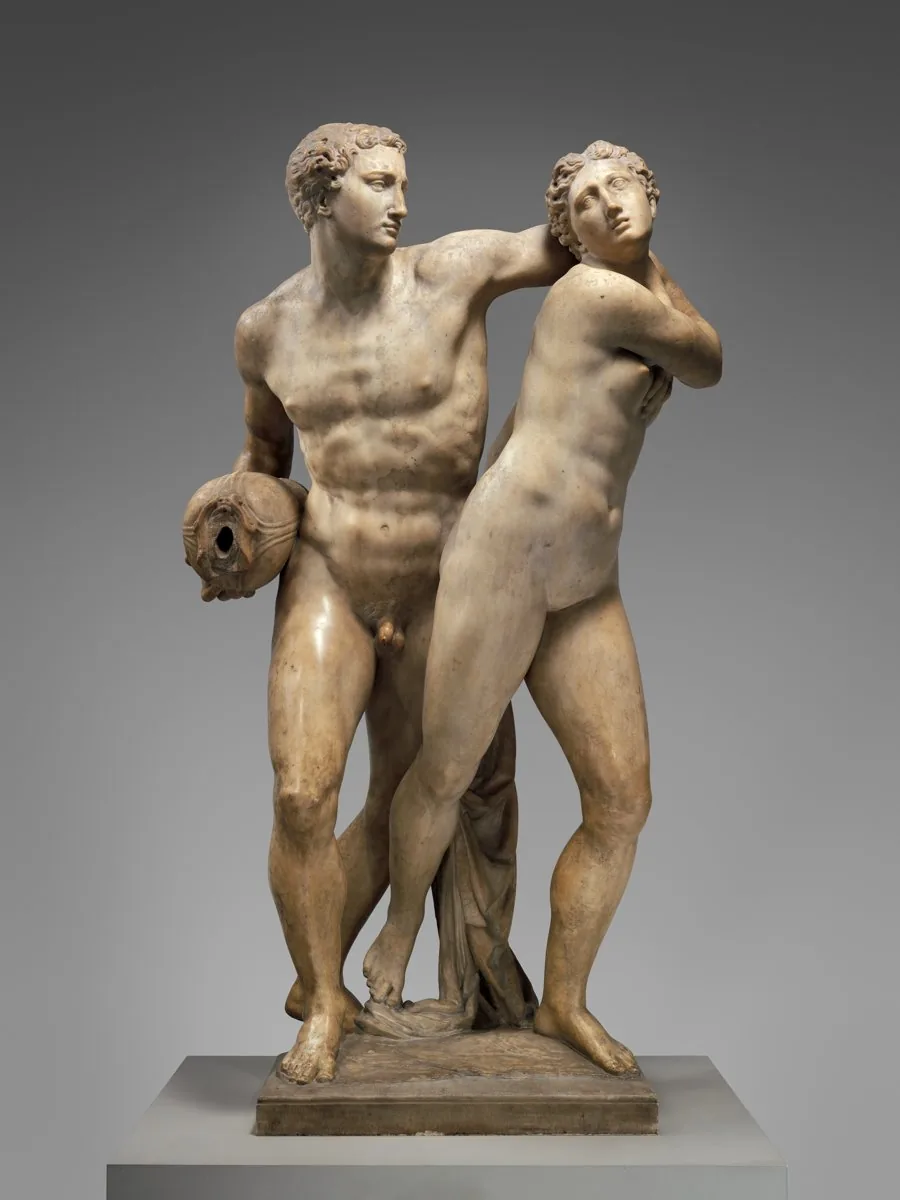
The Metropolitan Museum of Art preserves Battista di Domenico Lorenzi’s Alpheus and Arethusa, made in 1568–70. This marble group was created for a fountain at a villa near Florence, and the museum connects it with the pursuit and transformation into a spring. It records a later way of seeing the myth, not an eyewitness report of an ancient Greek event. Still stone, once-moving fountain water and flight in the text can be considered together without calling them all a victory of love. Arethusa’s surviving voice asks us to consider where the person wanted to go, what she feared and what she could still say after her shape had changed.