The traveller cannot decline
In Library 2.5.11, attributed to Apollodorus, Heracles crosses Libya while seeking the golden apples. The land is ruled by Antaeus, a son of Poseidon, who forces strangers to wrestle and kills them. Heracles does not arrive as a volunteer at an ordinary sporting festival. The challenge is part of a ruler's control over people passing through his territory. Beginning with that coercion changes the meaning of the famous physical struggle. The issue is not merely which exceptional body deserves a prize, but what happens when a traveller is required to enter a contest whose local organizer has made refusal impossible.
The ground is part of the strength
The Library explains that Antaeus grows stronger when he touches earth, which is why some called him a son of Earth. This phrasing preserves both a relationship and an explanation; it need not become a claim that every source gives an identical family tree. The ground is not a neutral surface beneath two isolated bodies. Contact with it contributes to one wrestler's power. Repeatedly forcing him downward would therefore fail to operate like an ordinary defeat. To understand the encounter, the reader must notice the connection between body and setting rather than count only the apparent size of the fighters.
What the lift accomplishes
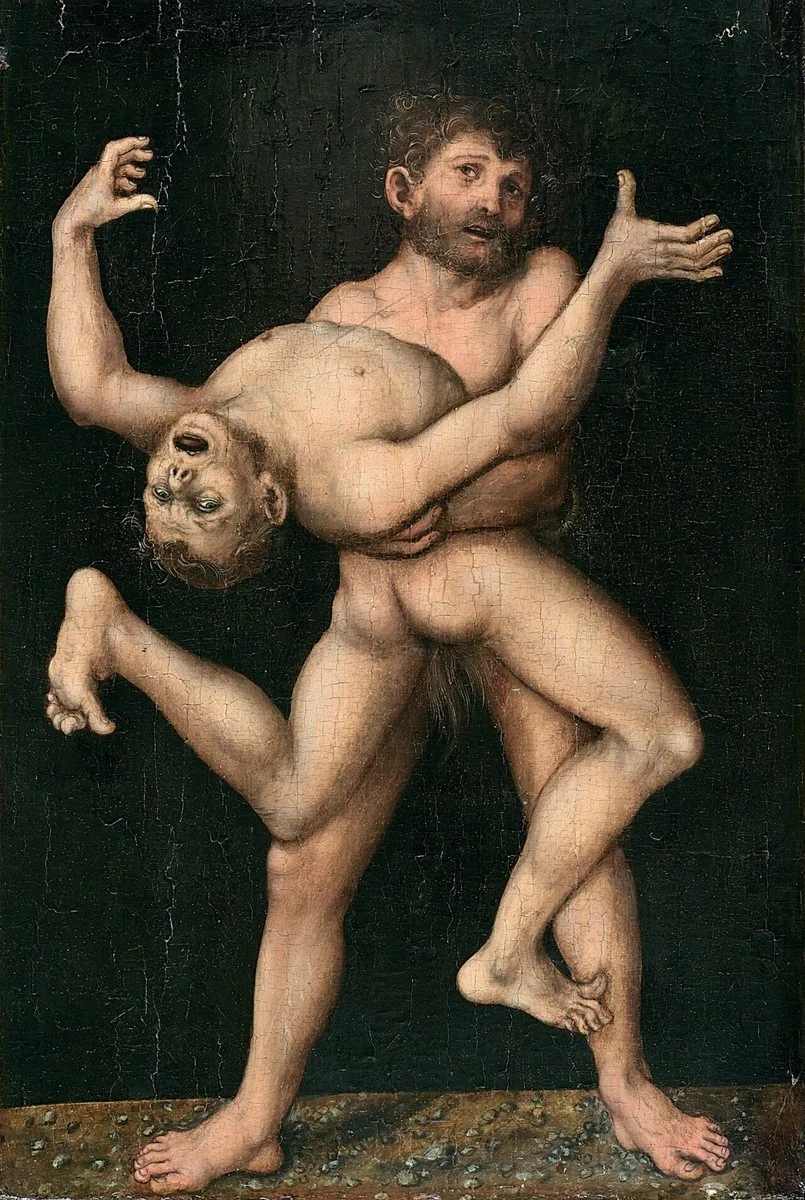
Heracles clasps Antaeus, raises him into the air, and kills him there. The decisive action separates his opponent from the source that renews his strength. This makes the embrace very different from a gesture of affection or welcome, even if an artwork isolates the intertwined bodies from their story. It is also more specific than saying that the stronger man simply wins. The hero changes the situation in which strength works. The Library gives a concise account without a long tactical speech or a sequence of failed attempts, so a retelling should not invent detailed training or private thoughts to make the solution seem more modern.
Diodorus emphasizes the imposed contest
In Library of History 4.27.3, Diodorus also connects Antaeus with compelling strangers to wrestle and presents Heracles' action as punishment. In that passage he does not explain the earth's renewing contact or describe the lift in the same detail as Apollodorus. His summary belongs to a wider journey involving Atlas' daughters and other encounters. It should not be expanded by silently importing every detail from another book. Together, the accounts support the coerced character of the contest, while differing in what they emphasize. The contrast shows how one writer can foreground the treatment of strangers and another the extraordinary bodily mechanism.
Seeing the space between feet and earth
Later artists often make the lifted body the recognizable centre of the scene. In the painting selected here, attributed in the source record to Lucas Cranach the Elder, the entangled figures invite attention to grip, weight, and the space beneath Antaeus. Such images are later interpretations, not evidence for an actual ancient wrestling match. Read with the texts, they direct us toward a precise question: what supports a person's apparent power? The story answers through earth and contact, but also through the authority that imposed the contest. Removing one support ends the fight; remembering the other keeps the people forced into earlier fights within view.