A Rival from the Depths of Earth
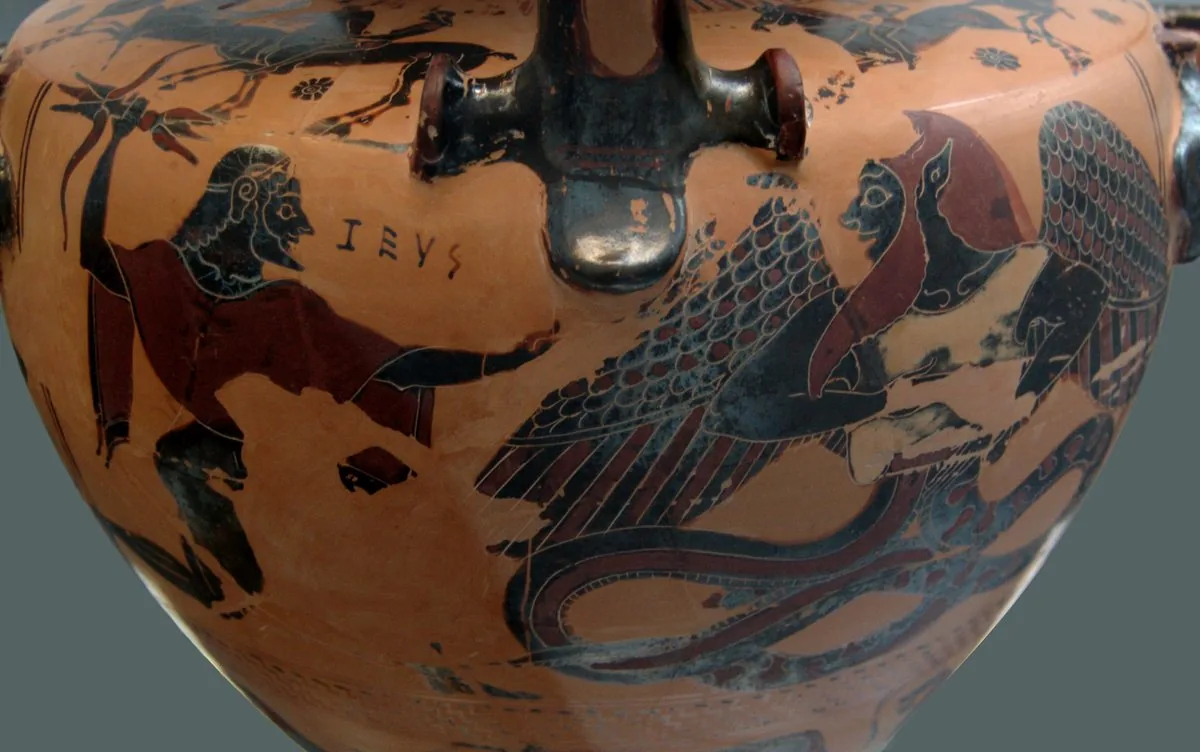
Hesiod's Theogony writes Typhon after the defeat of the Titans. Gaia combined with Tartarus to give birth to this powerful rival. The poet depicts him with a body that is difficult to classify: a hundred snake heads sprouted from his shoulders, fire flashed from his eyes, and the different heads gave out the sounds of gods, humans, oxen, lions and dogs. Typhon's danger comes not only from his size, but also from his irreconcilable appearance and voice. He makes the world seem to have retreated into an undemarcated chaos.
Many sounds converge on one body, making Typhon seem to be able to transcend species that were originally separate. The poet's description thus keeps moving between familiar animals and unimaginable wholes. We can observe how fear is created from this layer of language: every sound can be recognized, but there is no stable face that allows people to predict actions, and the classification of the world seems to have failed in him.
Thunderbolts Meet Flame
Typhon almost had a chance to become ruler of gods and men, but Zeus quickly sensed the threat. When the two fought, the earth, sea and sky shook, and the intense heat was like metal melting in a furnace. Zeus struck down Typhon with thunderbolts, burned his heads, and then threw him into the abyss. This version does not have the twists and turns of Zeus having his tendons cut off and being rescued by Hermes; that belongs to the narrative of the later "Library" and is suitable for comparison but cannot be connected to the same battle.
The Storm Remains
Poetry does not make the defeated monster disappear entirely. Typhon is still associated with harmful winds that can threaten ships, crops, and people's livelihoods; normal seasonal winds have another divine source. Victory means suppressing disaster, but it does not mean that nature will be docile from now on. Later authors linked Typhon to Mount Etna to explain underground shaking and erupting fire. Readers can regard these changes as the imagination of facing the environment in different eras: the same enemy has changed from a competitor for kingship to a natural danger that continues to lurk.