A Father’s Fear of Prophecy
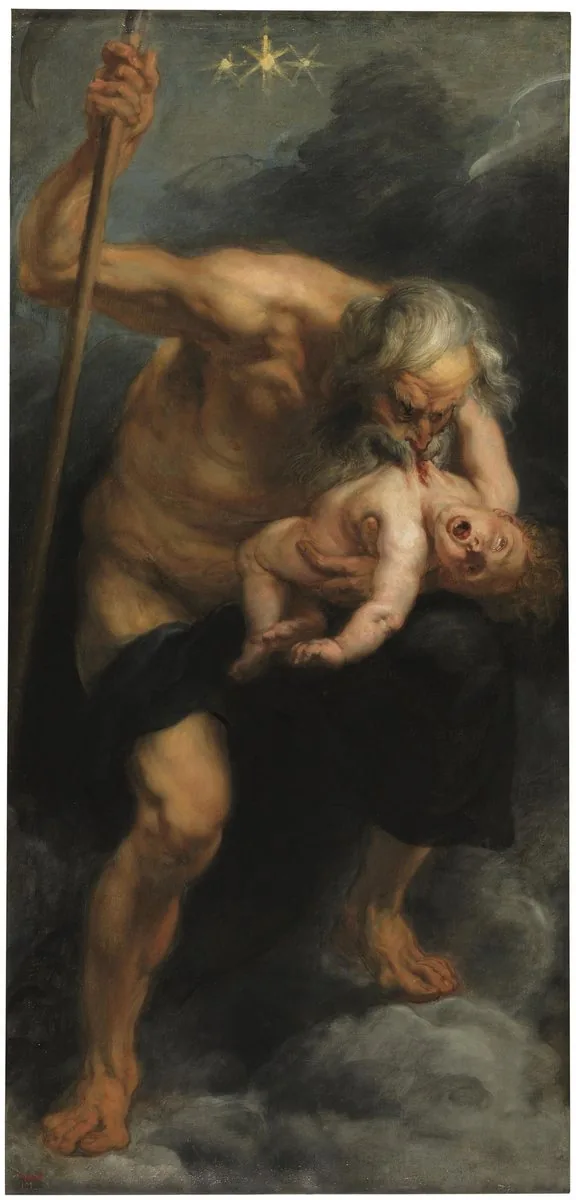
In "Theogony", Cronus learned from Gaia and Uranus that he would eventually be overthrown by his own son. He had violently taken his father's place, and now he was trying to make sure the same thing could never happen. Whenever Rhea gave birth to a child, he swallowed the baby into his body; Hestia, Demeter, Hera, Hades and Poseidon were all imprisoned. Devouring is therefore not simply a monster trait, but a way to hide heirs, futures and threats to power.
This strategy relies on a common and concrete object: the swaddling clothes can obscure the shape, allowing the father to see only what he has identified. Rhea took advantage of Cronus' obsession with prophecies. The child's body and the stone that replaced him, one was hidden and the other was swallowed, forming two opposite routes; the subsequent growth and spitting out brought them back to the same world.
Hiding the Youngest Son
When it was Zeus' turn to be born, Rhea asked her parents for help. She went to Crete and entrusted the baby to Earth. She also wrapped a stone in swaddling clothes and gave it to Cronus. The father swallowed the substitute without recognizing it. Theogony is concerned with the success of concealment and deception, and does not detail the nursing goat and guards beating shields; those familiar scenes appear in later works. When restating in the same version, the reader should be made aware of which details were later expanded upon.
The Stone Returns First
After Zeus grew up, Cronus vomited out his swallowed children under the plan of Gaia, and the last stone he swallowed came out first. The poet said that Zeus placed it in Delphi and it became a mark for future generations to watch. After that came the war between the younger gods and the Titans. Rhea in the story does not directly win the throne, but she makes political change possible by preserving a child. The stone also transforms from a tool of deception into an object of memory: a reminder that the strongest lose their judgment because of their own fear, and that family ties cannot be swallowed and frozen forever.