This is not a contest with equal starting conditions
King Oenomaus of Pisa makes his daughter Hippodamia’s marriage depend on a deadly test. In the Epitome of Pseudo-Apollodorus’ Library, a suitor must take the girl in his chariot and flee; the king follows fully armed and kills him if he catches him. Weapons and horses given by Ares support the pursuer, who has already killed many men. The compiler records a count of twelve; Pindar’s First Olympian gives thirteen. These numbers belong to different texts, not successive entries in one shared register. The supposed contest begins with unequal powers: a father controls the conditions of marriage and makes speed decide whether another person survives.
Pindar brings a request to the seashore
In Pindar’s ode, the grown Pelops comes alone to the sea at night and appeals to Poseidon. Recalling their earlier love, he asks the god to stop the king’s bronze spear and provide swift transport and victory. He chooses danger over an obscure life spent without achievement. Poseidon answers with a golden chariot and tireless, winged horses. The poem then briefly says that Pelops overcomes Oenomaus and marries Hippodamia. There is no scene of Myrtilus interfering with the wheels in this account. Prayer, divine response, and success form a close sequence suited to the ode. We can observe how sacred assistance makes risk bearable without declaring this the complete procedure accepted by every tradition.
The Library lets the daughter change the wheels
The Epitome gives Hippodamia a role in changing events. Falling in love with Pelops, she persuades her father’s charioteer Myrtilus, son of Hermes, to help. He too desires her and omits the linchpins securing the wheels. The king becomes entangled in the reins and is dragged to death; the compiler adds that some instead say Pelops kills him. This passage concerns missing pins, not an established substitution of wax ones. Hippodamia’s intervention moves her beyond the role of a silent prize, although acting through another admirer produces fresh danger. Divine transport has not disappeared entirely from this compilation: an earlier notice mentions Poseidon’s gift of a chariot. The detailed account of tampering should nevertheless remain attached to this particular telling.
Marriage does not immediately make fellow travelers safe
The Library continues after the race. On the journey Pelops goes to fetch water for his thirsty wife; meanwhile, Myrtilus attempts to assault her. Hearing her account, Pelops throws the charioteer into the sea, and the falling man curses his household. This is the sequence adopted by the compilation here. It must not be quietly attached to Pindar’s short marriage notice as though it were an unwritten second half of the poem. The ending makes the finish itself questionable: the marriage test has ended, but relations involving desire, commitments, and killing continue. A curse can connect injury to later generations without explaining away each participant’s choices. Blaming everything on inherited fate would obscure the particular actions through which harm occurs.
A relief preserves a vehicle shared by two people
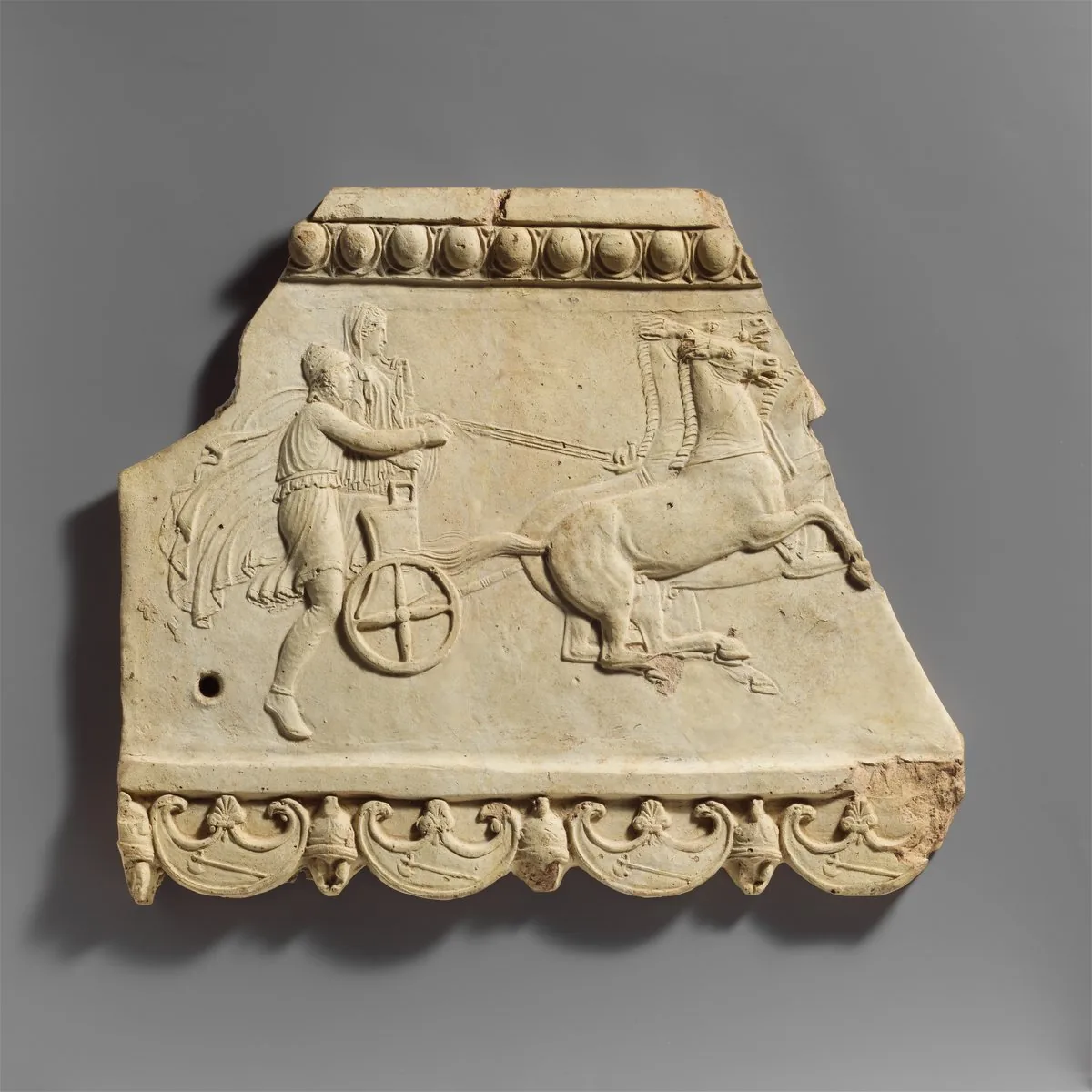
A Roman terracotta plaque in the Metropolitan Museum, dated 27 BCE–68 CE, bears the title Pelops and Hippodamia. Their shared chariot makes marriage and movement visible together. It is neither Pindar’s seaside appeal to Poseidon nor photographic evidence of a particular wheel mechanism. Pindar eventually connects Pelops’ tomb with honors at Olympia, while the whole ode celebrates Hieron and his victorious racehorse. Myth enters praise and public memory; the Library’s longer account keeps betrayal and consequences in view. These readings need not cancel each other. Together they invite questions about how a victory is remembered, whose assistance is acknowledged, and who must bear dangers that remain after the finish.